I love the Neal Stephenson quote from Dethe Elza's comment:
“In order to set her straight, I had to let her know that the reason she’d never heard of me was because I was famous. ”
“In order to set her straight, I had to let her know that the reason she’d never heard of me was because I was famous. ”
I don't really agree or even understand that there is a political consensus in the first place. (It's hard to undermine something which doesn't exist). Unfortunately, there is definitely a case to be made here for the last two sentences above.Climate politics is collapsing because of political realities, and not real or perceived changes in how people see the science. As I have often argued, in the ongoing battle between climate scientists and skeptics there will be disproportionate carnage, because the climate scientists have so much more to lose, and not just as individuals, but also for the broader field, which includes many people simply on the sidelines.
The collapse of the political consensus surrounding climate could well be an opportunity to recast decarbonization of the global economy and adaptation to climate impacts in a manner that is much more consistent with progress toward policy goals. If climate science can be saved from itself, that would be a bonus. However, for climate science I fully expect things to get worse before they get better, simply because the most vocal, politically active climate scientists have shown no skill at operating in the political arena. The skeptics could not wish for a more convenient set of opponents.
"Wow, that looks sort of right! Did you get a Hadley cell? A Walker circulation? A Gulf Stream? An El Nino? Cool!"
"Wonder what would happen if you twist this knob here? I'll bet it would do... ""Naw, it wouldn't, what would happen is...""Bet you a beer...""You're on..."
"Um, uh, that's a pretty big deal, it looks like", we say. "Maybe four watts per square meter, bigger than the forcing that kicks off ice ages, for sure.""Four watts per square meter?" you reply. "Are you sure? Are you sure you're sure? Ha! So you're not 100% sure you're sure, are you?"
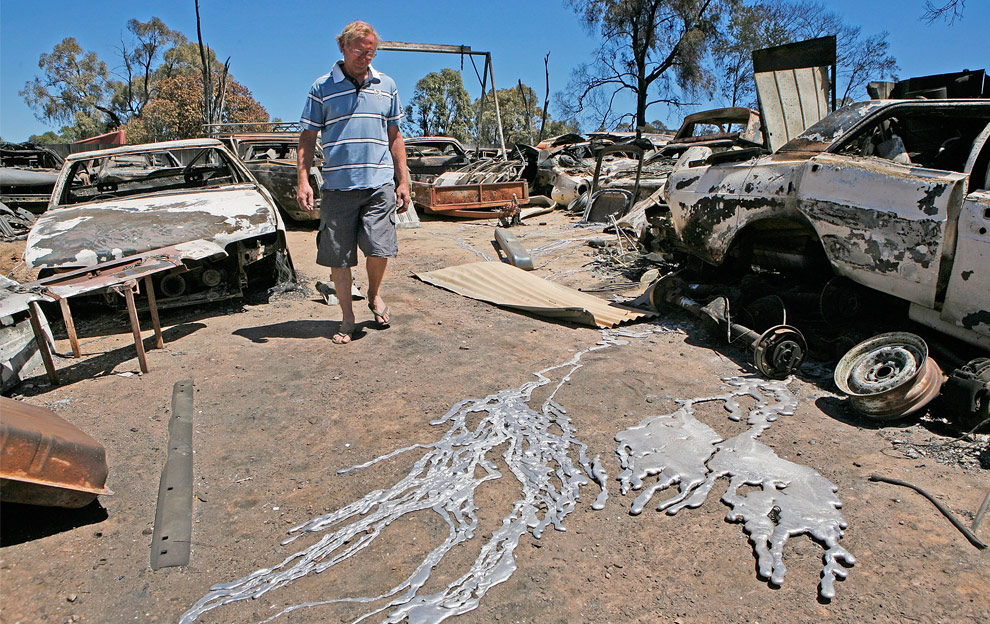

“Given that this was the hottest day on record on top of the driest start to a year on record on top of the longest driest drought on record on top of the hottest drought on record the implications are clear...Eventually things get too weird. Eventually you don't have to say "the sort of thing that is more likely to happen under climate change". Eventually you have to say, my God, this is unnatural.
It is clear to me that climate change is now becoming such a strong contributor to these hitherto unimaginable events that the language starts to change from one of “climate change increased the chances of an event” to “without climate change this event could not have occured”.
It's easy to refute all the contrarian arguments but that seems to have very little effect on how commonly they are believed. Refuted arguments seem to live on in the public imagination. To bring the public on board to a rational discussion of climate policy needs more than logical argument. So what should we actually do?So that's the core purpose here. It's not about convincing people as such, but more about understanding why we have failed to convince people, and what we ought to do about it. I already knew
"Law, politics and commerce are based on lies. That is, the premises giving rise to opposition are real, but the debate occurs not between these premises but between their proxy, substitute positions. The two parties to a legal dispute (as the opponents in an election) each select an essentially absurd position. "I did not kill my wife and Ron Goldman," "A rising tide raises all boats," "Tobacco does not cause cancer." Should one be able to support this position, such that it prevails over the nonsense of his opponent, he is awarded the decision. ...
"In these fibbing competitions, the party actually wronged, the party with an actual practicable program, or possessing an actually beneficial product, is at a severe disadvantage; he is stuck with a position he cannot abandon, and, thus, cannot engage his talents for elaboration, distraction, drama and subterfuge."
- David Mamet in "Bambi vs Godzilla: Why art loses in Hollywood", Harper's, June 2005.
For more than a year, my friend Jim and I have been documenting and recording stories on the great unravelling of our livable world, and trying to build entertainment into it.Isn't apocalypse fun? Yay!Climate chaos is a thread, just as is ocean acidification, and overfishing, and amphibian die-off, and pharma-laced water supplies, and giant dead zones, and the toxic plastic gumbo twice the size of Texas gyring in the Pacific. It's the heavy metals we've been spewing willy-nilly out of coal plants, the persistent toxic runoff from our cities and farms, and the debt of poison we're bequeathing to our children.
*These* are the problems that truly must be addressed. *These* are the problems that are "stuff that Really Matters." Our little project is a stab at trying to nudge some momentum of awareness of these really serious issues.
We've been trying to work out ways of making the news entertaining, even funny; we've added a weekly Pre-Apocalypse News and Info Quiz, a collection of paper-free crossword puzzles, and we try to find a punchline to each story we record.
We do this because without entertainment, nobody wants to know about the jellyfish swarms, the orcas and other mammals sickening from eating salmon poisoned with PCBs and flame retardant, the collapse of little brown bats in the Northeast, and the precipitous loss of biomass from the oceans.
jeff Id Says:
4 February 2009 at 11:21 PM
A link to my recent post requesting again that code be released.
[edit]
I believe your reconstruction is robust. Let me see the detail so I can agree in public.I don't know who Jeff is or whether he should be encouraged, but I find Eric's response unsatisfactory. Here is my reply, slightly expanded.
[Response: What is there about the sentence, “The code, all of it, exactly as we used it, is right here,” that you don’t understand? Or are you asking for a step-by-step guide to Matlab? If so, you’re certainly welcome to enroll in one of my classes at the University of Washington.–eric]
Eric, you snark: ” What is there about the sentence, “The code, all of it, exactly as we used it, is right here,” that you don’t understand? “
I don’t understand how you think that could be true. You link to a nicely documented and from all appearances elegant library of matlab functions. Where are the data files? Where is the script that invoked those functions and plotted those graphs?
There is absolutely no substantive reason this should not be distributed along with the relevant publication. You shouldn’t be sniffing at people who want to replicate your work in toto. You should be posting a complete makefile that converts input data into output data. This is common practice in exploration seismology, thanks to the example of John Claerbout at Stanford University, and that in a field where there are sensible commercial reasons for confidentiality. A related effort to create tools to facilitate this pervasive reproducibility approach, called Madagascar, is being developed at U Texas and is 100% open source. A recent issue of Computers in Science and Engineering discussed reproducibility as a topic.
The paradoxical backwardness of science in regard to adopting the social lessons of high tech is well analyzed in this blog entry by Michael Nielsen. An open source and test-driven approach is far more productive than petty jealousy. "Publish the recipe, and build the restaurant."If you refuse to be helpful, don't put up a pantomime please. I should be able to reproduce these results in five minutes, not after taking a course in Matlab. The course in Matlab should follow if I find the results interesting. RC again climbs on its high horse, doing none of us any good. You guys are the good guys. Please act like it.mt
Ok, I’m madder than hell by now, my good Irish temper is taking over so this is what I posted.It's sad really. Honestly I think it's more ignorance than rudeness, but it is amazing. And given the stakes attached to the core credibility of the ideas, amazingly unfortunate.
You know, if you claim you archived the code, you could actually archive the code rather than a link to the functions which may have been used in the aforementioned code.
Over the last couple of days, I’ve seen Eric accuse people of everything short of fraud including Steve McIntyre who does everything in the open. In the meantime my reasonable requests for data and code have been cut from the threads repeatedly. This man is intentionally deceptive about his openness and he’s doing it pretty effectively because nobody at RC made it through the thread who had questions and because I was actually had to disagree with by smart people at CA who believed Eric actually had archived the code by his link.
Dr. Steig, put up or shut up. Enough bull about the posting all the code and the data (including the satellite data). I will call you out to no end and people will know the truth. If your paper is good, they will know - I promise. If not, I also promise.
——————–
Update, I got through. I did I really did. I sent this comment to Real Climate.
4 February 2009 at 11:21 PM
A link to my recent post requesting again that code be released.
[edit]
I believe your reconstruction is robust. Let me see the detail so I can agree in public.
[Response: What is there about the sentence, “The code, all of it, exactly as we used it, is right here,” that you don’t understand? Or are youasking for a step-by-step guide to Matlab? If so, you’re certainly welcome to enroll in one of my classes at the University of Washington.–eric]
I replied again like this.
I’d love to take your class, but I’m busy running a company.
You point to the RegEm manual for use. I was hoping you could show the setup and implementation used. i.e. The actual code you used. I’m sure you would agree, it is pretty important as far as understanding the result. Also the satellite data set.
If you present this as used and it works as advertised, you’ll find yourselves with a big pile of supporters instead of the ridiculous situation we have now. As I have repeatedly stated, I believe your result simply because warming is true everywhere else.
Jeff
———————–
Banned again Real Climate.
[edit — thanks for your support dhogaza, but I’m not allowing ‘jeff id’s’ rants to show up here, even if passed on to me by someone else–eric]
———————-
This stuff is so silly, you know it saps you to listen to it. Doggozza calling me all kinds of things, real climate not allowing quesitons, they want me to be a denier. It’s like they’re saying please Jeff please deny our work just don’t make us disclose the methods.
Reply to #89:"[Response: My working directories are always a mess - full of dead ends, things that turned out to be irrelevent or that never made it into the paper, or are part of further ongoing projects. Some elements (such a one line unix processing) aren’t written down anywhere. Extracting exactly the part that corresponds to a single paper and documenting it so that it is clear what your conventions are (often unstated) is non-trivial. - gavin]"
Gavin, what you are describing here is what would be called, in any commercial or industrial setting, bad practice.
That is exactly the point I am trying to make. It's not a point about openness, it's about effectiveness. Good practice in any discipline evolves from long experience. The behavior you are describing is behavior every programmer occasionally does on quick projects. However, most of us know better than to defend such behavior on major work products.
It is considered bad practice with good reason. It takes a lot of effort to go back and replicate your own results from memory, but very little to maintain a script which can do all of it. If steps are expensive, you need to learn a tiny bit of rule-based logic, but that is hardly beyond the abilities of anybody doing scientific computations. The payoff is not just throwing the CA folks a bone to chew on. It's a very important component of reasoning about computations, which are, after all, error-prone.
Basically, you are making it easier to make mistakes.
Why should pure science be held to a lower standard than applied science or commerce? Does climate science matter or doesn't it?
Per #98,So to make appropriate use of the code and paper (enough to enable us to DEMAND it all be available), we need a team...
The issue is not whether the CA people are competent to examine the process or not. They might or might not be.
The issue is that when Gavin claims that this is unreasonably difficult, he is making a claim that many readers already know, as a consequence of their own daily practice, to be false and indeed absurd. Indeed, these readers overlap strongly with the group of nonscientists most competent and most willing to evaluate scientific claims. This does the credibility of RC, and by further extension the whole of climate science, no good.
In any case, whether this is sound practice on the part of the scientist or not, whether it is responsible behavior on the part of the hobbyists or not, one can expect demands for replication on any observational climatology analysis. Observational climatology is not at fault for having the perhaps worst relationship with its interested public of any science ever. There really are, after all, some truly malign forces involved. But it's nothing to celebrate, and it's worth making some effort not to make it worse.
In summary: First, it is not true that maintaining end-to-end scripts is onerous. If large calculations are involved a series of scripts or a rule-based makefile may be practical, but these are easy skills to develop compared to the background needed to do science. Doing so in commercial and engineering settings is standard practice because it dramatically reduces error and increases the potential for objective tests.
Second, that some branches of science don't do this is going to be perceived as an embarrassment. Defending the absence of a practice of end-to-end in-house repeatability is difficult, and coming from someone who has not spent much time thinking about it, likely to make silly claims.
Of course, as climatologists, we are barraged with silly claims, but in that we are not unique. We tend to lose patience with people making strident and erroneous claims about things they don't understand. In this, we are not unique.
Strong programmers also tend to dismiss the opinions of those making strong claims they know to be untrue. Every technical mailing list has plenty of examples, some quite funny. (Strong programmers can be quiet clever in their putdowns.) Generally, if one is trying to convince others of the validity of one's ideas, it pays to be modest and willing to learn about points where one may be less expert than the person one is trying to convince.

The long time family seafood restaurant on Main Street is gone - sign down, place empty. The old RV dealership on the edge of the village is gone too. Surprised at that - they were the only one downcounty. Used to buy Propane there. Looks like some waste collection place is there now. The old electronics company that moved out 5 years ago is now a self-storgage place and the old lumberyard (had been a coal company before that) finally had a new building put up after being sold a decade ago. Another storage place - not the condos that had been rumored. Not much of a neighborhood for housing IMO - light industrial - but such was the housing boom for a while. ANY site was worth building. Up the hill the car dealership of my youth that had been a Verizon garage was being leveled. Walgreen. How many drug stores can you have in a square mile? Seems absurd.Tales of woe like this aren't that uncommon. Presumably previous economic setbacks were similar. What is unusual is how people are thinking about it. Of course, the parties in power are desperately hoping it is a 'recession'; hence it will go away and everything will be back to 'normal' and maybe they can even get some credit for it.
LOTS of empty storefronts in local stores as I drove around. The Florsheim Shoe place further up in the upscale shopping center is now gone. When did that happen? Another restaurant gone. The small strip mall put up 2 years ago across from the Diner remains empty. The steakhouse it replaced was damn good. I miss it. One of the old bars I knew well in college is now gone..... that place was an institution. What happened? The camera store is now a hole in the wall - a shell of its former self when it had the whole building. The Food Emporium is decidedly grungier than it used to be. What happened there? Yuck.
Now these are not the 'worst' places in Westchester - they're pretty average - or on the higher end......
Back on Central Ave there were more vacancies than expected. Lots of long tenure stores gone. Downtown White Plains had taken decades to recover from the urban renewal bulldozing but had finally come back.
But the Galleria - the original mall - is now hurting pretty bad....
Conservatives appear to be proposing a repeat of Thatcherite austerity in the face of economic catastrophe. But this crisis is more than an ordinary recession. It represents a disintegration of the idea of the "market state" and makes obsolete the political consensus of the last 30 years. A fresh analysis of the ruling ideological orthodoxy is required. Certainly, this new thinking isn't going to come from the left. New Labour is intellectually dead, while Gordon Brown promises an indebted return to a now-defunct status quo. But, in truth, Brown's reconversion from post-socialist free marketeer to state interventionist is only plausible because the Conservatives have failed to develop an alternative political economy that explains the crisis, and charts a different future free of the now bankrupt orthodoxies. Until this is achieved, Brown's claim that the Conservatives are the "do nothing" party has real traction, and makes the result of the next election far from assured.It's frankly hard to imagine a similar article from an American Republican. (It's hard to imagine many Republicans having the attention span and open mind to plow through it, frankly.) Seriously, it's long struck me and others how the socially conservative rural backbone of the Republican party have been consistently voting against their own interests in favor of the mega-corporate view of society. The idea of social conservatism opposed to corporate gigantism is unfamiliar, but it's perfectly consistent. In fact, it's more consistent than the alliance that we currently call the "right" or "conservative" position. I've often remarked that growth-addicted mega-capital as the organizing principle of society is anything but "conservative" in any etymologically reasonable sense of the word.
On a deeper level, the present moment is a challenge to conservatism itself. The Conservatives are still viewed as the party of the free market, an idea that has collapsed into monopoly finance, big business and deregulated global capitalism.

