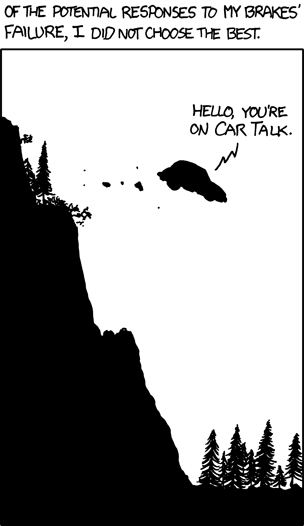
http://xkcd.com/582/

 I have tried to make the case that an economic slowdown properly handled can be a good thing on balance, even though it will be certainly stressful in the short run for people who are unprepared for it. I proposed repackaging the whole business, dropping the depressing words "depression" and "recession" in favor of "relaxation", on the presumption that the level of activity in the most advanced economies is already excessive.
In fact, I wish I had written pretty much the whole thing.Our current socio-ecological regime is founded on a worldview that emerged during a period—the early Industrial Revolution—when the world was still relatively empty of humans and their built infrastructure (33). Natural resources were abundant, social settlements were sparser, and inadequate access to infrastructure and consumer goods represented the main limit on improvements to human well-being. This set of circumstances has been called an ‘‘empty’’ world (34). In an empty world, it made sense to ignore relatively abundant ecosystem goods and services, and to favor the concentration of wealth in the hands of the few so that it could be invested and focus solely on increasing the consumption of market goods and services, which were relatively scarce. If wealth had to be concentrated in the hands of the few where it would be invested to fuel future growth, rather than distributed to the many where it would be consumed at the cost of growth, this was a sacrifice the present had to make for the future.
Our current worldview of what is desirable and what is possible was obviously forged in this empty world context. For example, ‘‘recession,’’ our word for economic decline, is defined as two or more consecutive quarters in which the GDP does not grow. Unending physical growth of the economy is only possible within a system unconstrained by any biophysical limits. Our current institutional and technical approach is also an extension of a long-term trend of adaptation to an empty world. Western society has increasingly favored the institutions that promote the private sector over the public sector, capital accumulation by the few over asset building by the many (35, 36), and finance over the production of real goods and services.
...
Our current [worldview is] failing to meet our needs in a changing world. Anthropogenic climate change, peak oil, biodiversity loss, rising food prices, pandemics, ozone depletion, pollution, and the loss of other life-sustaining ecosystem services all pose serious threats to civilization. These crises can be traced back to one, albeit complex problem: we have failed to adapt our current socioecological regime from an empty world to a full world. The aspects of our regime that no longer serve us in a full world can be grouped under two interrelated themes: a belief in unlimited growth, and a growing and unsustainable complexity.
the task is huge and will take a concerted and sustained effort if we hope to make the transition a relatively smooth one. It will require a whole systems approach at multiple scales in space and time. It will require integrated, systems-level redesign of our entire socio-ecological regime, focused explicitly and directly on the goal of sustainable quality of life rather than the proxy of unlimited material growth. It must acknowledge physical limits, the nature of complex systems, a realistic view of human behavior and well-being, the critical role of natural and social capital, and the irreducible uncertainty surrounding these issues. It is also important to recognize, however,that a transition will occur in any case, and that it will almost certainly be driven by crises. Whether these crises lead to decline or collapse followed by ultimate rebuilding, or to a relatively smooth transition depends on our ability to anticipate the required changes and to develop new institutions that are better adapted to those conditions.Hagen's followup is to call attention to an article by Jay Hanson that most people, myself included, would find excessive. Like the Unabomber tract, there are interesting ideas buried in the madness and it's not unworthy of your attention, though I would like to make clear that I don't think it's remotely ethically sound and so it's fortunate that it's impractical as well.
The American Clean Energy and Security Act will create millions of new clean energy jobs, save consumers hundreds of billions of dollars in energy costs, enhance America's energy independence, and cut global warming pollution. To meet these goals, the legislation has four titles:The process envisioned by the committee is as follows:
- * A clean energy title that promotes renewable sources of energy, carbon capture and sequestration technologies, low-carbon fuels, clean electric vehicles, and the smart grid and electricity transmission;
- * An energy efficiency title that increases energy efficiency across all sectors of the economy, including buildings, appliances, transportation, and industry;
- * A global warming title that places limits on emissions of heat-trapping pollutants; and
- * A transitioning title that protects U.S. consumers and industry and promotes green jobs during the transition to a clean energy economy.
So this thing is well on its way. My biggest concern is that it is a bundle of good intentions with nonobvious flaws that the drafters of the bill will not have the time to see but that the impacted industries will have ample time and motivation to discover and exploit. This is the reason to always err on the side of simplicity.The Energy and Commerce Committee will complete consideration of the legislation by Memorial Day. The preliminary schedule follows:
- Week of April 20: Energy and Environment Subcommittee Hearings
- Week of April 27: Energy and Environment Subcommittee Markup Period Begins
- Week of May 11: Full Energy and Commerce Committee Markup Period Begins
Barton and Walden are now pressing the EPA about why the case took so long to prosecute, the apparent leniency in sentencing, and the reported prosecution cost of $80 million. They're also probing the accuracy of EPA comments indicating there may be a raft of other fraud cases that haven't been investigated.Yes, of course Barton will oppose a tax just as vehemently, but will he have as cogent an argument?
Legislators also point to alleged fraud in the European Union emissions trading market. Under the program, companies are allowed to offset their emissions by investing in projects like high-efficiency power plants that cut greenhouse gas emissions. These projects are often located overseas where verification is difficult, if not impossible.
Environmental groups alleged, and EU officials acknowledged, that much of the offsets weren't legitimate. "Billions of dollars have been transferred from taxpayers to undeserving project developers and a growing army of carbon brokers and consultants," said environmental organization Friends of the Earth.
Such examples are also raising fears about the next U.S. market, which will be far more complicated and much larger than both Reclaim and the EU emissions program.
"All of the evil things that Wall Street will do to an unregulated financial commodity market, they will try to do in spades to this carbon market," said Mark Cooper, head of research at the Consumer Federation of America.

There was disagreement on many points, but on one issue most concurred. As Jeffrey D. Sachs, director of the Earth Institute at Columbia University, said, imposing some sort of price on fossil fuels “is a big improvement over the do-nothing status quo.”If this is the best they can do, I find the cap-and-trade arguments very unconvincing both in themselves and by comparison with those advanced by carbon tax proponents.
From an environmental point of view, the advantage of an emissions cap over a carbon tax is clear: A cap puts a legal limit on pollution. A tax does not. Guessing what level of tax might drive the pollution cuts we need to avert runaway climate change is a risk we simply can’t afford to take. Only a cap with strong emissions reduction targets — and clear rules for meeting them — can guarantee that we achieve the environmental goal.That is the sort of argument you get from people who are not telling you their real motivations. The time constant of the problem is thirty years; the time constant of a tax rate is what? The Fed adjusts the prime several times a year. It's an argument without foundation in reality, and yet all the proponents quoted here are flogging it very hard. As usual when people advance ideas that seem obviously wrong to me, I wonder how they are motivated to convince themselves of this.
Cap-and-trade emissions trading seems to politicians to be the ideal solution. It is “market-based,” does not require the T-word (taxes), and can be worked out with special-interest groups in back-room negotiations. For the rest of us, however, cap-and-trade seems a funny way to do business.As usual, Sachs makes sense to me. You?
A straightforward carbon tax has vast advantages. It can be levied upstream at a few dozen places — at the wellhead, the mine face, and the liquid natural gas depot — rather than at thousands or tens of thousands of businesses. A carbon tax covers the entire economy, including automobiles, household use, and other units impossible to reach in cap-and-trade. A carbon tax puts a clear price on carbon emissions for many years ahead, while a cap-and-trade system gives a highly fluctuating spot price. A carbon tax raises a clear amount of revenue, which can be used for targeted purposes (R&D for sustainable energy) or rebated to the public in one way or another, while the revenues from a cap-and-trade system are likely to be bargained away well before the first trade ever takes place.
Serious shortcomings in the Waxman-Markey (W-M) measure, some of which you have illuminated, coupled with the nature of the climate crisis, which you have done so much to publicize, easily could lead persons to support an alternative. While your ear may be finely tuned to Washington-insider realpolitik, it is not true that every proposal not already supported by this administration is off the table. Indeed, the W-M draft retains gaping holes with respect to auctioning, use of revenues, and so on. A full-throated debate about this legislation remains necessary and relevant.
First, I agree that we've simply ignored this for far too long. However, I'm also concerned that the recent doom-mongering is yet another iteration of the Shock Doctrine - an attempt by the Wall Street set to push through policies which have not been very successful in curbing carbon emissions, but merely create yet another phony market for speculators to siphon off the labor of the productive. Without a doubt, a carbon tax will be more successful in achieving these goals with a lower economic cost, yet we're told: "Don't worry about that! Don't think! We have to pass cap-and-trade immediately, or we're all doomed!"
Have we really not yet learned to disregard media-driven hysteria and think rationally?
Since we've been so far from any legislative action until now, I hadn't thought much about the exact form that action would take. So I'm a novice to this part of the debate, looking for cogent arguments. I am not yet trying to stake out a position; I am just reporting my initial reactions to the positions presented in the Yale article.
All I have heard from cappers so far, other than the argument that cap and trade creates a cap better than a tax does, is counterarguments to the arguments for the tax, and arguments from expediency ("the document already exists") indifference ("it should be quite possible to reach pretty much the same result from either direction") and failure of leadership ("the general population will not tolerate a tax but may be fooled briefly by a policy that is not called a tax, which raises energy prices and creates federal revenue").
So I have four problems:
1) Frankly, it is dishonest to create a Rube Goldberg contraption that is effectively a tax, call it somehting else, and deny that any taxation is involved. It continues the behaviors that make people distrust politics and politicians and the process that keeps the population confused about cause and effect.
2) It starts from complexity, leaving it impossible to advocate for simplicity and transparency.
3) It is presented as a fait accompli, but I have no idea where it came from. Where was the public consultation? Where was the effort to bring the public on board?
4) It smacks very much of business-as-usual, lobbyists, earmarks, etc. Businesses with Washington insider status get huge giveaways. Startups whose skills are actually in energy technology are placed at a distinct disadvantage.
In short, all the advantages you propose seem tactical rather than substantive. Even presuming those tactical advantages are true, the origins of the tactical advantage are deeply obscure from where I am sitting. It just feels like something elaborate and unclear is being sprung on me, and that most of the people supporting it are more interested in politics than in science.
Kevin Drum's rebuttal to Sachs is typical. It states pretty much that if you put the right ingredients into cap-and-trade it can act a lot like a tax. Your caliing Sachs "head-slappingly false" really doesn't seem to follow from that. If you put the right ingredients into a soup it can taste a whole lot like a chocolate cake, but that is still not what I want you to put my birthday candles in.
So again: it's easy to understand what a simple carbon tax would look like and how it could be tuned to achieve desired objectives. A compelling argument would address the follwoing:
1) What is cap and trade? Is it better in principle than a tax, and if so, why?
2) What exactly is the 700 page bill you are putting up as an alternative? (preferably with a link to the text and another link to a plain-english pointwise summary)
3) Where did it come from? Who drafted it? When? What interests are accounted for?
4) How are new ideas balanced against established interests? Specifically, given that existing interests are given permits, doesn't it systematically promote large institutional and corporate interests while suppressing startups and innovation? This is a clear weakness: what compensates for it?
Again, I am just starting to think about this. Honestly, I am nowhere near committed. Although the "head-slappingly" thing seems contrived to wedge me away, I am not entirely decided yet. Maybe all these questions are answered. All I say is that based on the Yale piece, I am becoming nervous that the answers are not going to be very compelling.
Presidential Memo on Scientific Integrity: Request for CommentHere's more on the memorandum:
On March 9, 2009, the President issued a memorandum for the heads of executive departments and agencies on the subject of scientific integrity, stating that “science and the scientific process must inform and guide decisions of my Administration on a wide range of issues.”
The memorandum requires the Director of the Office of Science and Technology Policy (OSTP) to craft recommendations for Presidential action to ensure scientific integrity in the executive branch. We hereby seek public input to inform the drafting of those recommendations.
Comments from the public will help the OSTP determine what should be included in these recommendations. Over the next six posts on this blog, we will seek your comments, as they may pertain to each of the six different principles outlined in the memorandum. To provide some seeds for thought, we have asked one or two framing questions after each principle. Feel free to respond in other ways to the principle, or even to other comments. You may want to consult the Fact Sheet for the Memorandum before commenting.
This comment period will end on May 13th. Thank you in advance for your input.
Today, more than ever before, science holds the key to our survival as a planet and our security and prosperity as a nation. It’s time we once again put science at the top of our agenda and worked to restore America’s place as the world leader in science and technology." - President Barack ObamaH/T @timoreilly
- * Today, President Obama is signing a Presidential Memorandum on scientific integrity. This memorandum helps to implement one of the President’s key campaign commitments on science policy, which was to "restore scientific integrity in government decision making."
- * Science and technology are essential to achieving a broad range of national goals: driving economic growth and job creation; allowing Americans to live longer, healthier lives; developing clean sources of energy that reduce our dependence on foreign oil; protecting our environment for future generations of Americans; strengthening national and homeland security; and more.
- * Realizing the potential of science and technology to help achieve all of these goals requires that the Administration’s decisions about public policy be guided by the most accurate and objective scientific advice available. The public must be able to trust that advice, as well, and to be confident that public officials will not conceal or distort the scientific findings that are relevant to policy choices.
- * Accordingly, the President is assigning to the Director of the Office of Science and Technology Policy (OSTP) the responsibility of ensuring the highest level of integrity in all aspects of the executive branch’s involvement with scientific and technological issues.
- * Within 120 days, the Director of OSTP must develop a strategy for ensuring that:
- - The selection of scientists and technology professionals for science and technology positions in the executive branch is based on those individuals’ scientific and technological knowledge, credentials, and experience;
- - Agencies make available to the public the scientific or technological findings or conclusions considered or relied upon in policy decisions;
- - Agencies use scientific and technological information that has been subject to well-established scientific processes such as peer review; and
- - Agencies have appropriate rules and procedures to ensure the integrity of the scientific process within the agency, including whistleblower protection.
 Hello, Central Texas! (Is this thang on?) Howdy y'all!

The evidence continues to mount. The way we run the economy around
the world is damaging the life-support systems of the planet. We are
treading water in a sea of profound environmental problems (like
climate disruption, species extinctions, and deforestation to name a
few). At the same time, our financial systems have entered a crisis
mode in the midst of increasing unemployment and a widening gap
between the haves and the have-nots. In the quest for economic growth,
the nations of the world are locked in a tragic competition for the
planet’s remaining natural capital. If economic growth is the best way
to manage our affairs, then why should I be worried about global
warming and losing my job at the same time?
The grow-at-all-costs mindset is at fault. It is time to examine the
irrational assumptions behind this mindset and get busy changing it to
fit the realities of the natural world. The modifier “grow-at-all-
costs” is perfectly applicable. Nations have an acute unwillingness to
explore the costs of growth. Economic growth is simply an increase in
the production and consumption of goods and services, and is indicated
by increasing Gross Domestic Product (GDP). GDP, therefore, has become
the standard measure of economic progress, even though it was only
intended as an accounting tool. Prompted by banks, governmental
organizations, and the media, citizens generally applaud increases in
GDP. The problem with GDP is that it doesn’t separate costs from
benefits. It simply adds them together under the heading of economic
activity. Even if the costs of growth outweigh the benefits, as the
evidence suggests, we still pursue it.
The Center for the Advancement of the Steady State Economy (CASSE)
takes a different position. The CASSE position, a document that can be
signed by individuals and endorsed by organizations, recognizes the
conflict between economic growth and environmental protection. It
proposes the steady state economy, characterized by stable population
and per capita consumption, as a desirable alternative to continued
growth.
Many leading sustainability thinkers have signed this position,
including David Suzuki, Vandana Shiva, David Orr, Bill McKibben,
Herman Daly, Caroline Lucas, Gus Speth, and Wendell Berry. Dozens of
organizations have endorsed the position, and it has been used as a
model for professional scientific societies to adopt their own
positions on economic growth. The point is to develop a critical mass
of support behind the idea of prosperous, yet non-growing economy – a
truly sustainable and green economy. Without this critical mass,
politicians will remain stuck in the old paradigm of growth that
continues to erode the foundation of life-support systems on the planet.
To find evidence that our leaders are mired in the old paradigm, we
need look no further than the bank bailouts. Stimulus spending to get
the economy growing is not the change we need. We can certainly strive
for growth in some industries, such as solar energy, but it must be
accompanied by declines in others, such as fossil fuel energy. As we
sift through the rubble of our collapsed financial institutions, we
shouldn’t be looking at how to rebuild them into the same old
apparatus of growth. It’s the incessant growth, mostly in the form of
speculative bubbles, that caused the collapse in the first place.
Many policy changes can help us establish financial systems and an
economy that are sustainable. But the chances of enacting them are
miniscule until we can demonstrate that a broad base of the electorate
recognizes that perpetual exponential economic growth is not the path
to prosperity. Simply put, society has to demand the change before it
can occur. We need to take a position on economic growth and promote
the concept of the steady state economy on the streets of our
communities, in the halls of our governments, and in the corridors of
our businesses. With enough voices, we can jumpstart the transition to
a better economy.
Please sign the CASSE position on economic growth to voice support for
a prosperous, yet non-growing economy.
Robert Dietz,
Executive Director
Center for the Advancement of the Steady State Economy
The Center for the Advancement of the Steady State Economy (CASSE) is
a U.S. nonprofit organization, and our mission is to advance the
steady state economy, with stabilized population and consumption, as a
policy goal with widespread public support.
www.steadystate.org

