OK, so it's come to this. There are people who doubt it is even warming at all, even on a thirty year time scale. Presumably all the migrating species zones and retreating glaciers and shortened snow cover seasons don't count for anything.
Dick Cheney doesn't doubt it is warming. Sarah Palin doesn't doubt it is warming. Lake Mendota, for its part, is clear about what's happening in Wisconsin. But Joe d'Aleo of icecap thinks otherwise, and in certain circles he is taken at face value on such things.
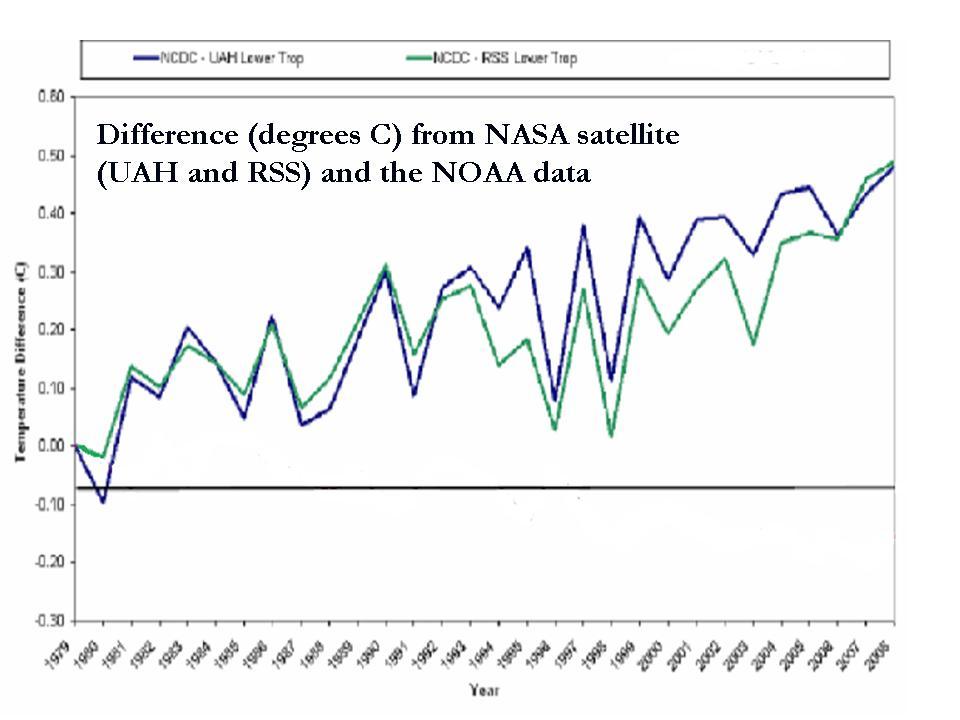
As we saw a few days ago he is attributing the following:

to Klotzbach et al. 1999.
Per my suggestion this has been very slightly amended as follows:
When you do a difference in the satellite trends of both UAH and RSS with NOAA NCDC land stations, you see an increasing warm bias in the NOAA data which explains why months with major cold in the news get ranked so high by NOAA and not by the satellite sources.Emphasis added; d'Aleo has not acknowledged my advice or the importance of the change that I noticed.
Now this is a very consequential difference indeed, though the difference is hardly stressed in the narrative. Land data covers perhaps 25% of the earth. The difference of about 0.44 C (whatever it signifies) must be divided by 4, leaving an uncertainty in the trend of 0.11 C per 30 years, or about 0.04 C per decade. This is large enough to be a matter of some concern, but by no means large enough to change the big picture of global warming which are substantially higher. So I'm willing to write the whole thing off.
But considering the dramatis personae on this paper, one wonders exactly what is going on. Is d'Aleo's effort the leading edge of a push to make this a major talking point among certain disgruntled groups at the fringes of climate science? How does this outlier of a paper align with the CCSP report on lower atmosphere temeprature trends which clearly bent over backwards to give the Huntsville folk the benefit of the doubt?
I think that before taking up the Klotzbach paper, it's clear that we should be reading between the lines of the CCSP report.
One thing that report proves, anyway, is that dissenting opinions are hardly ignored in American science. Indeed, they get 130 page glossy reports trying to respond. Note that Christy is a coauthor of the executive summary, which states right off the bat that
Previously reported discrepancies between the amount of warming near the surface and higher in the atmosphere have been used to challenge the reliability of climate models and the reality of human induced global warming. ... This significant discrepancy no longer exists because errors in the satellite and radiosonde data have been identified and corrected. New data sets have also been developed that do not show such discrepancies.In short, the problems we are currently experiencing reconsiling model to data are much smaller than those in the past. This is a success in collaboration between observational and modeling communities first of all, and a demonstration of the power of models in the advancement of science.
...
For recent decades, all current atmospheric data sets now shouw global-average warming that is similar to the surface warming. While these data are consistent with the results form climate models at the global scale, discrepancies in the tropics remain to be resolved.
Neither models nor observations are very clear about whether the surface is warming faster or slower than the troposphere. This is all about vertical amplification in the tropical troposphere.
The report acknowledges that the tropical middle-troposphere amplifies short time scales:
For month to month and year to year variations, models and observations both show amplification (the ... variations are larger aloft than at the surface.) This is a consequence of relatively simple physics, the effects of the release of latent heat as iar rises and condenses in clouds. The magnitude of this amplification is very similar in model and observations.However, disagreement is found at longer time scales, where observations show greater warming at the surface while models retain greater warming aloft.
There is no obvious reason to prefer model prediction over observation data or the reverse. The data could be wrong or the model could be wrong. The CCSP report gears up to argue that it is the satellite data that is wrong.
Section 2 discusses the limitations of the observational data frankly. However, they note that discrepancies between satellite trends are much larger than discrepancies between surface trends.
All in all it's pretty much inside baseball. Everyone agrees we need the satellites to stay functioning. Got that, delayers? Nobody wins if we have no data, OK?
So all in all, I don't see where all the sound and fury is supposed to be leading. Despite huge progress, we still have an outstanding problem in contemporary atmospheric trends. OK. And?
Update: This show is in reruns. See the following articles on Realclimate:
- Tropical tropospheric trends
- Tropical tropospheric trends again
- Tropical tropospheric trends again (again)
So Klotzbach is a variation on a previous molehill.
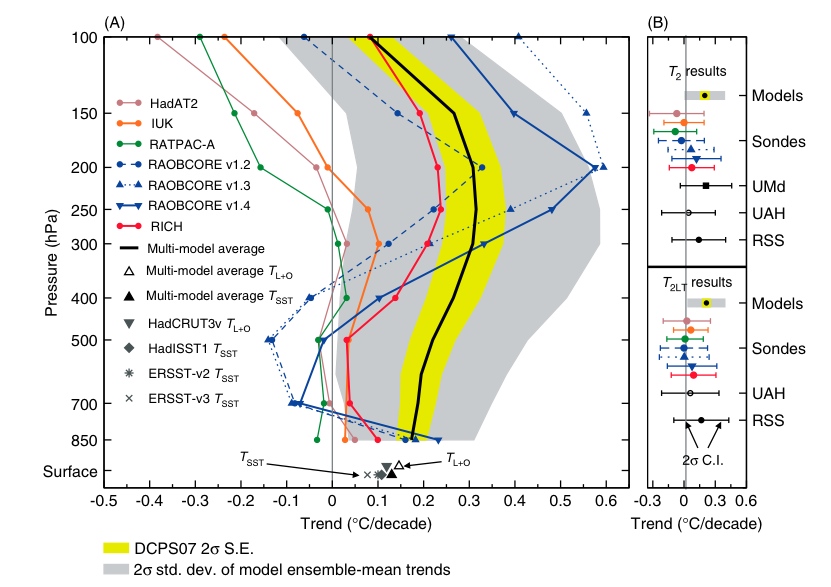
compares models and the datasets. Shaded is the range of model estimates of tropospheric temperature trend profile, while the lines represent various inversions of satellite data. The satellite inversion problem is not trivial. Extracting trends is more difficult yet, as some of the heuristics of the inversion may drift under climate change as well as under instrumental aging. The spread here makes clear that the method of doing so is not established. So when we look through Klotzbach, let's keep in mind that the spread in the estimates of the quantity of interest is huge.
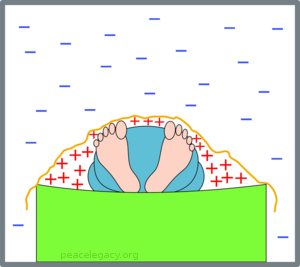
And then there is this deep analysis from Ron House on Watts' site, which the beginning skeptic is invited to analyze. It involves feet and blankets. Really.