The thing is that the Breakthrough people and their allies, among whom one must include Lomborg and Pielke Jr. at this point (and I'm betting on Kloor to line up real soon), are not asking for the technologically impossible. They are asking merely for the technologically possible at an economically impossible cheap price.
This really makes mindbogglingly little sense to me.
If carbon "costs" more in dollars such that clean energy is therefore competitive, vs. clean energy costing less via pixie dust, all that happens outside the energy sector is that energy costs more.
This leads to a balance between 1) a larger proportion of activity dedicated to acquiring energy 2) improved energy efficiency and 3) exactly the innovation which was wanted in the pixie dust strategy. It's too bad that this is morally equivalent to a Stalinist nightmare for reasons which continue to escape me, because otherwise it actually looks like a perfectly sound right-wing solution: account for externalities and coax the market to do the right thing.
I mean, you still get to look for the pixie dust! If it's really out there, a cost on carbon pretty much means somebody will find it. And if it's not out there, we do not all face a stupid, avoidable cataclysm.
Am I missing something? Aside from the Stalin thing, I mean?
We already have the technology. All the Breakthrough people are trying to do is negotiate with Nature over price. But Nature doesn't haggle. (Because, you know, of her monopoly position and all.)
Breakthrough thinking basically amounts to an idea that if we delay action on climate forcing, the price will go down. It's clear that at some point, if we delay too long, the price will start to go up. The argument is only whether we have passed that point.
I'd say it isn't even a close call anymore.
But it's an interesting question. If economics made any sense there would be an objective way to estimate this; it's a totally objective question if you have an objective definition of cost. If it's not too late to procrastinate yet, when will it be? How long should we wait for a price breakthrough that might not happen?
Monday, September 13, 2010
Sunday, September 12, 2010
Warmist Coup at Amazon?
Christopher Booker, after throwing in passing the usual baseless dig at William's fine efforts to keep Wikipedia's science articles representative of science rather than of lunatic conspiracy theories:
It's the beginning of a school year. People, rather than buying books recommended by self-aggrandizing paranoid columnists and superstitious, confrontational clergy, are buying books recommended by professors who know what they are talking about. I feel confident in reassuring Mr. Booker that the unfortunate normal, democratic, anti-elitist order of things he recollects with such poignant nostalgia will restore itself shortly.
The proselytisers for man-made global warming have long exercised a tight stranglehold over the contents of Wikipedia. The editors of that online source of all knowledge are ready with lightning speed to ensure that its entries related to climate change are purged of any hint of dissent from the party line – and that entries for “climate sceptics” are given a viciously dismissive twist,asserts that
Now it seems a similar coup has taken place on Amazon, the online outlet which is Britain’s largest bookseller.How silly.
Over the past year, Amazon’s list of global-warming bestsellers has been wholly dominated by sceptics, with my own book The Real Global Warming Disaster standing for months at number one. At the end of last month, however, all the more recent sceptical books were suddenly removed from the list.
It's the beginning of a school year. People, rather than buying books recommended by self-aggrandizing paranoid columnists and superstitious, confrontational clergy, are buying books recommended by professors who know what they are talking about. I feel confident in reassuring Mr. Booker that the unfortunate normal, democratic, anti-elitist order of things he recollects with such poignant nostalgia will restore itself shortly.
Saturday, September 11, 2010
Curry Blogs
Jeff Id writes,
Here. RSS here.
It looks like Dr. Judith Curry has decided to start down the road of climate blogging. This should be an interesting experience and I’m glad that someone else in climate science is willing to address concerns of the public in a direct fashion.I will take the rare opportunity to agree with Jeff Id. I have concerns about Curry's approach, which seems quite oblivious of the long history of the controversy surrounding the science. Sometimes this fresh perspective is helpful; other times it falls into one of the many traps that have been set over the past twenty years for the unwary. This will be interesting to watch, indeed.
Here. RSS here.
Friday, September 10, 2010
Ingrate
Tom Fuller is so attached to the position he is carving out for himself and, apparently, so far beyond the realm of intellectual rigor, that the fact that I went to a significant amount of trouble to introduce him to the outlines of ice sheet science just a few days back, an article to which he issued multiple responses, that not a single word of what I said appears to have been grasped by him.
Instead he has come up with a thoroughly toxic article on the subject which he is spreading from the ecumenical platform of Watts Up, the site that will run anything about climate as long as it isn't true.
My sympathies for Fuller being in over his head have evaporated. If this isn't willful ignorance I don't know what is.
Things Break deconstructs Fuller here.
The point is not only that Fuller is wrong, which he is, and woefully so. The point is that I made an honest effort to communicate. Fuller demonstrably had enough information to write an article based on evidence, as he had read up on the actual evidence here.
It's well known that people will see what they want to see and disregard the rest. It's a shame when someone decides to make doing that their life's work, though. A real, crying shame.
Instead he has come up with a thoroughly toxic article on the subject which he is spreading from the ecumenical platform of Watts Up, the site that will run anything about climate as long as it isn't true.
My sympathies for Fuller being in over his head have evaporated. If this isn't willful ignorance I don't know what is.
Things Break deconstructs Fuller here.
The point is not only that Fuller is wrong, which he is, and woefully so. The point is that I made an honest effort to communicate. Fuller demonstrably had enough information to write an article based on evidence, as he had read up on the actual evidence here.
It's well known that people will see what they want to see and disregard the rest. It's a shame when someone decides to make doing that their life's work, though. A real, crying shame.
Wednesday, September 8, 2010
Seeking, er, Duly Diligent Consideration Tactics

I am rerunning Toles' Emergency Procedures cartoon, because Byron Smith has added a ninth step. I'd like to offer a prize to someone who can provide a step 10 strong enough to stand with Byron's step 9, but I can't afford it and I can't afford the lawyers to figure out how to do it if I could.

So I am handing out traditional, old fashioned pulp-publishing no-prizes instead. Only In It for the Gold no-prizes are hereby titled No Gold Medals, and Byron surely gets one for his (slightly edited)
9. Consider that fire may actually reduce the building's heating bill. Commission study by think tank to investigate.Another No Gold Medal to he-who or she-who comes up with point 10.
Update: Tony Lee got an LOL out of me with 10. Maintain that those involved in fire detection cannot be involved in firefighting policy. If they insist on getting mixed up in firefighting policy, we get to ignore everything they say.
No Gold Medals are being prepared for both contributors as I write! Many thanks to all contributors.
Tuesday, September 7, 2010
Oh, Bother


Hermine has our number.
Update 8 Sep: The number is five.
Fortunately for us in East Austin, the line has moved a teensy bit to the west. Of course, that may not be fortunate on the whole, because the hill country to the west is more prone to flash flooding. There was still a massive wall of cumulus tower taking up half the sky a couple of hours ago but things are back to normal now. Here's the cume:

My neighborhood got about 5" (12 or 13 cm or so). The creek behind our house handled it without difficulty.
Looks like Round Rock is in the bullseye. It will be interesting to see how a prosperous Texas suburb handles a 15"/24 hour rainfall. I expect it will come through like a trooper.
Nice pix here and here. Most of the flood damage shown is from the next county north, much of it at a low-lying trailer park, the rest around Round Rock and Georgetown in the bullseye. The last few are wind damage in far south Texas (Raymondville) near the landfall site.

The San Gabriel river (above) often trickles so slowly through Georgetown that you can't really tell which way is downstream.

A few folks around here were pretty badly hit, especially in this low-lying trailer park.

and some modestly wealthier folk had a hell of a mess in their back yards.
There's some really amazing sights in this video (preceded by commercial message) for anyone familiar

with Barton Spring Pool. (Yes, that is the sissy stairway leading down to the shallow end of the pool.) Apparently this is not unprecedented at Barton Springs.

One of my mother-in-law's most endearing habits is to say something sort of peculiar, pause, and then say "In Polish, it rhymes!" There are things you wouldn't expect to rhyme in English that rhyme in Texas ("bend" and "wind" for instance). Here we have another example: in Texas, "around" rhymes with "drown" (and has the same number of syllables).

More informative signage.

A well known Austin small business was hit.

The pictures of the parks still being relandscaped from the prior massive flood are a good indication of how desperately this part of the world wants to be wild. Droughts and floods and nothing in between. That's Texas for you. Nothing unusual hereabouts, just your everyday 15 inch downpour on parched land.
Perhaps I'm taking this too lightly, but we did get off easy. Hermine wasn't even a Cat 1, remember, just a strong tropical storm.

I guess, there's no telling what the future holds for Texas, but what the future holds for everyone else is, basically, Texas. Hang onto yer hats.
Monday, September 6, 2010
Fullerminations
 Steve Bloom points out on a thread I had, oddly, hoped would be about Benin, that Tom Fuller is in Fuller bloom over at WUWT(*), accusing me again of being an alarmist, when I am merely alarmed about the state of the world (as described by Schellnhuber and Rockstrom and Foley). I truly wish I weren't. I truly wish those guys were wrong. I truly wish I were wrong. But Fuller is not pulling together a convincing story, even though he seems to think he is.
Like Fuller, I am eager to find evidence for the incorrectness of my views, but unlike Fuller, I have a more deeply elaborated understanding, and consequently am a bit more skeptical and harder to convince of alternative hypotheses.
The present kerfuffle comes down, apparently, to Fuller's claims about the Antarctic ice balance. Since I know or am at one degree of separation of some of the more prominent and talented researchers in the field of the mass balance of the great ice sheets, it reasonably falls to me to follow up and try to tell the whole story.
Before I look into it any further, let me state what my current understanding is. We can test out whether it is correct, but this is where I start.
The balance of evidence in mt's brain
as of early September 2010,
on the subject of
THE MASS BALANCE OF THE ICE SHEETS
1) First of all, the equilibrium response to a 3 C warming is enormous. If we hit the (approximately known and likely by now unavoidable) 3 C threshhold, and at that point civilization has no more capacity to think in the long term as we do today, we are looking at sea level rise in the tens of meters. This means Greenland will substantially be melted down to the rock, the WAIS (**) will totally disappear, and a substantial fringe of West East Antarctica will probably also be bare. The primary evidence is the geological evidence of seas that deep in the previous interglacial approximately 100kA ago.
2) It is considered nearly certain that the ice sheets will NOT respond quickly enough for the tens of meters of sea level rise which we would eventually expect with a 3 C rise to happen in this century (whew!) or even this millennium. But we would expect that level eventually if CO2 stays elevated high above quaternary (the past 2,000,000 years) values.
3) Rather than having a single time constant, though, the disintegration of ice sheets has recently been determined to be dynamically complex and operating on numerous time scales.
(Understanding the concept of time scales is key to understanding paleoclimate and clymate dynamics. As an example common everyday occurrence in some places I used to live is frozen puddles. Cold climate folk know that a puddle exposed to cold develops a film of ice first, and eventually freezes all the way through. The amount of time for it to gain or lose the thin film of ice at the top is much shorter than the time it takes to freeze through. Whether you are discussing whether the ice is superficial (say because you care about reflected light) or frozen solid (say, for traffic safety) determines a time scale of interest when you look at the weather.)
4) An ice sheet is in mechanical balance between large scale gravitational forces causing it to splay out and various small scale stresses and strains causing the ice to "like to" stay put.
5) On large physical scales, ice is a very viscous fluid, whose viscosity is sensitive to temperature. So different parts of the ice sheet flow at different rates. At the weakest points in the geometry, outlet glaciers form, which amount to areas where there is a steady flow of ice into the sea, which is where icebergs form.
(Icebergs are very different from sea ice.)
6) In a stable climate, the glaciers and the accretion of ice on top of the ice sheets are in rough balance. However, we know that the behavior of individual glaciers can be episodic, and important ones can grind to a complete halt, or conversely, speed up a great deal.
7) Imagine a huge mound of frozen grape jelly on a picnic table in the sun on a hot Texas afternoon. It will take a long time for the jelly to turn completely runny, though we know that will be its ultimate fate. Most of the jelly is a foot thick, but near the edges of the table it slopes off steeply. A tiny bit of the edge of the table is visible.
We know it will eventually run off the table, but consider how it might starts off. As the jelly warms up, it gets a little softer, and it can no longer sustain the steep slope. So it starts to spread. And the bits of spread that fall off the edge of the table no longer offer their viscosity to help hold up the rest of the pile.
The bits that fall off the table are like icebergs.
Near term sea level rise is about the fact that increasing temperature causes a gravitational instability at the steep edges. As long as the temperature increases, the edge of the ice sheets gets further into disequilibrium, and the ice sheet will retreat in much the same way as a beach retreats under rising sea level, where a small change in forcing yields a large response because the system needs to find a new physical slope.
8) It is also the case that the tops of the ice sheets, as they warm and hence receive more moisture, will be accreting. It will take a very long time before that mechanical signal becomes significant at the edges where the action is. Meanwhile, the tops of the ice sheets can somewhat mitigate sea level rise. The tops of the ice sheets constitute a true mitigating feedback to sea level rise, and in the short run this effect may dominate.
9) Both physical reasoning and paleoclimate evidence indicate that warming ice sheets do shrink, though. You were expecting, maybe, the Easter Bunny? So in the long run that effect is swamped by the shrinking edges, which makes sense in a simple model because the size of the accreting area shrinks.
10) A fellow named Christian Schoof appears to have worked out the mechanism for abrupt sea level rise such as the 14 kA event when sea level rose some 15 meters in 400 years. The mechanism has to do with ice sheets that have compressed the land the lie on enough that their bases are below sea level. Only certain geometric configurations of the outlets of such ice sheets are possible. If an ice sheet melts back or surges forward from one of these configurations, it is likely to reconfigure rapidly. There is only one such conditionally configuration on a large scale on earth at present, in the Amundsen Bay off the West Antarctic Ice sheet. If it were to retreat behind a certain ridge, it would become mechanically unstable, and a process would begin whereby it would eventually destabilize an ice basin large enough to cause an abrupt sea level rise of approximately 2 m.
11) The mass balance of Antarctica as a whole swamps the events in this area now, so the GRACE instrument may not pick them up. But nobody knows how quickly the destabilization will occur once the ice sheet lets go of its sill in the Amundsen embayment, which as I understand it, it already has. Once it starts, a one-time and abrupt sea level rise of about 2 or 3 meters in a few decades is plausible.
12) As for the Antarctic ice balance itself, I was coincidentally just looking at this picture in the Copenhagen Diagnosis yesterday

Here we see various estimates of the Antarctic mass balance over the past fifteen years. This is strongly suggestive of a significant change over that period.
Here, by the way, are comparable estimates for the Greenland mass balance:
 13) A press release just yesterday (!) amounted to a major correction to GRACE estimates of mass flux. This is apparently a correction for isostatic rebound. It is good news because it means our worst fears that might be gleaned form the above graphs may need reconsideration.
Based on this principle, previous estimates for the Greenland ice cap calculated that the ice was melting at a rate of 230 gigatonnes a year (i.e. 230,000 billion kg). That would result in an average rise in global sea levels of around 0.75 mm a year. For West Antarctica, the estimate was 132 gigatonnes a year. However, it now turns out that these results were not properly corrected for glacial isostatic adjustment, the phenomenon that the Earth's crust rebounds as a result of the melting of the massive ice caps from the last major Ice Age around 20,000 years ago. These movements of the Earth's crust have to be incorporated in the calculations, since these vertical movements change the Earth's mass distribution and therefore also have an influence on the gravitational field.
The corrected figures are reported in a multi-author paper in the Nature Geoscience by Wu et al. Quoth Wu:
According to our estimates, mass losses between 2002 and 2008 in Greenland, Alaska/Yukon and West Antarctica are 104±23, 101±23 and 64±32 Gt yr−1, respectively. Our estimates of glacial isostatic adjustment indicate a large geocentre velocity of −0.72±0.06 mm yr−1 in the polar direction. We conclude that a significant revision of the present estimates of glacial isostatic adjustments and land–ocean water exchange is required.This is a significant correction, but it nevertheless remains the case that the mass flux is clearly negative from all major ice sources. Of course, there's little reason to expect that this won't eventually be the case. The question at hand is when, and the answer is already, but the GRACE satellites may be weighing in on the low side for the next question, which is how much.
14) There is a geoengineering project called ice911 which I believe is worth considering that may fix the ice sheet problem.
(*) - WUWT is jargon on both sides of the climo-blogo-fence for "Watts Up With That", a blog of the sort that one refers to with a "nofollow". Watts has articles of varying degrees of sophistication, with the common thread that most of them are deeply confused. This does not mean everything said on WUWT is false. It means that all points of view are welcome, which is to say, scientifically informed opinion is vastly outnumbered and openly mocked. Watts provides a real service by providing a window into what people actually are thinking. How our society sunk to such a gnarled tangle that politically significant numbers of nonscientists see scientists this way is a subject I take up often, but not this time. Suffice it to say that articles on WUWT are often a horrifying mashup of information and disinformation, and that most readers have no serious basis to tell one from the other.
(**) - WAIS: West Antarctic Ice Sheet
ABOUT FULLER'S WUWT PIECE
"It is hard to understand many of those who are convinced that climate change will destroy civilization."
That is a near-empty class. I consider myself among those who hope that climate change will not destroy civilization, and choose to act on that basis.
And according to some scientists working with GRACE measurements, Antarctica is losing ice. Not just the Western Antarctic Ice Sheet, which has been predicted to melt and succumb to mechanical pressure since the 1930s, but also the vastly larger ice sheet covering East Antarctica.
And sure enough, the ‘apocaholics’ are all over this, using it to reinforce their unrelenting drumbeat of doom-laden predictions of disastrous sea level rises.
But this is actually quite strange. According to climate change theory, ice should be increasing in Antarctica–the (very slight) increase in temperatures and the natural increase in precipitation should result in more snow over Antarctica which gets compressed into higher levels of ice. The same phenomenon is both predicted and observed in Greenland, by the way.
"Instead of using this as proof of global warming"huh??? Sorry, what does that even mean?
" Because this is observed data working against the principles of their theory"uh, nope, remember, there is a tradeoff, one which Fuller actually described himself
"But they cannot pass up the chance for a quick and easy headline that reinforces the ‘all disaster, only disaster, 24 hours a day’ routine."huh???
"Certainly all measurements before GRACE showed increasing ice in Antarctica, as they do today."There's Fuller's hat, providing us with anti-information again.
"My guess (I’m not a scientist and do not claim to know) is that there are still a few bugs to work out in how they are doing this."This turns out to be quite true and an amazingly well-timed guess.
"So the paper referred to by scare artists like Michael Tobis of Only In It For The Gold "a - I am not a "scare artist"
b - It was Fuller who raised this paper
"says the Eastern Antarctic has lost 57 billion tons a year–plus or minus 52 billion tons."
I only said that - 57 +/- 52 was a decrease. I do not know to which paper Fuller refers, and can't seem to track down the original where he raises it. Fuller's name-calling is one thing, to claim that I raised some paper in the conversation after he himself brought the figures to the table is something else. (I looked all over the place and can't spot the conversation where this even came up, but I'm pretty sure the numbers came from Fuller and completely sure I didn't come up with them.)
Not all measurements of ice mass balance are via GRACE, as is obvious from the long record of Greenland estimates. John Cook has a nice piece on this on Skeptical Science.
It is one thing for Fuller to get the science wrong. On quantitative arguments requiring a little subtlety, one assumes he knows no better. But he is here making misleading statements on events of which he was a part. This can't be written off just as intellectual hubris.
And then a repeat of the claim that seems to me totally at odds with the facts:
Other measurements, consistent with climate theory, have consistently shown the Antarctic gaining, not losing ice.
No. That is wrong. Say it twice and it's still wrong.
Fuller seems to believe in making up facts to tell a convenient story. I don't think this constitutes helping.
Ganvie, Benin

I picked up a new follower from Benin, and in his or her honor, I spent some time looking at Benin on line. The main city of Benin, Cotonou, population approximately 1 million, is right at sea level between the Gulf of Guinea and a large bay or lake that seems geographically like Lake Pontchartrain by New Orleans. The entire short coastline of Benin is threatened by sea level rise. Perhaps the most interesting thing about the Bay is the town of Ganvie, whose transportation needs are served entirely by boat. Wikipedia says little about Ganvie, but what it says is quite interesting. I wonder what the submerged rectangular forms on the satellite view show.
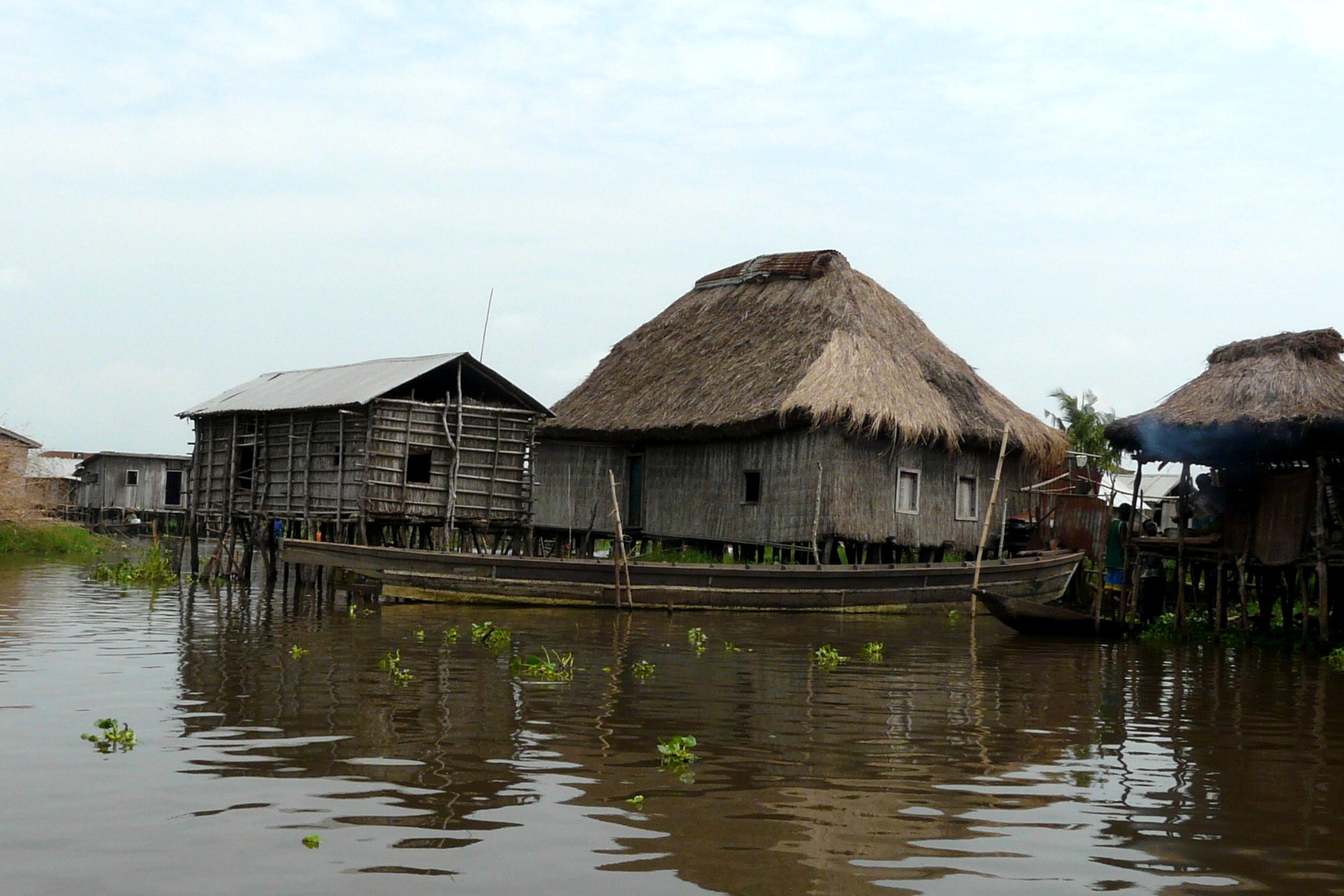
Images: Ganvie via Google Maps, Wikipedia.
Sunday, September 5, 2010
The Role of Scientists and of Scientific Authority
Paulina Essunger sends along this quote for the quotations file:
On climate change, IPCC (and especially WG I) has done a creditable job on reporting these things, notwithstanding the Himalaya glaciers blunder, and yet they are busily being discredited anyway. So one wonders what the point is; one could do worse that to take the IPCC position and defend it even though it rather understates the risks. Those of us who are willing and able to engage the public's confusion ought to do so, and if I may say so, ought to have some way of being rewarded for it.
But it should be noted (and in some circles it isn't noted) that this itself is a radical claim. The primary role of scientists has always been to impress other scientists in a scientific meritocracy. A very few of the most elite scientists are then consulted by the policy sector. This is seen as an end-of-career perk for the best of the best, and is conducted outside the purview of the scientific culture. From the point of view of science, being appointed to a national or international commission is a hobby, and being appointed to the cabinet is a form of retirement.
It is only recently that the substance of specific scientific issues have become matters of policy-relevant general public interest. This has created a role for propagandists, in some disciplines including climate well-funded ones. And this is responsible for the emergent gap in the set of necessary roles.
Simon Singh made a similar point in the recent Wired interview you shouldn't miss.
Indeed, this is the nugget of truth in Roger Pielke Jr.'s meandering and ultimately unsatisfying book "The Honest Broker"; that an advocate cannot be a scientist and that a scientist cannot be an advocate. On this key point, Roger is not saying anything new or controversial. On the contrary, it is people like Dean, or Singh, or myself who are searching for something new.
A scientist is a person who wakes up every morning asking "How could I be wrong?" Such a person cannot hold their own in a public debate against an advocate who wakes up asking "How could the scientist be wrong?" Yet, the scientist who surrenders to the conventional techniques of public relations and influencing public opinion, that is, to politics writ large, really does end up surrendering objectivity.
The public is more and more alienated from the scientific method and the scientific world view. (The ivory tower is increasingly populated by second and third generation academics.) The desperate need is for more people to understand not just what we know and what we suspect, but why we know and suspect these things. This is a non-trivial task, and doesn't get any easier.
Defending science is not about yelling back. It has to be about the nature of objective inquiry. Not everyone is going to be interested or capable of understanding this very well, but there are smart people everywhere. We cannot afford to lose them. Winning them back is more than a matter of making counterclaims.
On the other hand, we have to remain willing to say "no, that's wrong", in other words "science is open-minded but skilled; our skills do not allow room for your hypothesis". And we have to claim that authority. A model of biology that does not include evolution is simply wrong. We should not be taking polls to establish how many people "believe in" evolution. The press and the schools and the political elites should be treating this as fact.
Authority is not authoritarian. We are not telling people what to do about evolution. We are simply stating the facts.
We have reached the point where superstition has better marketing than science. Fantasy may have better appeal than reality at first blush. Reality is a refined, developed, adult taste. We can't live on candy bars forever, and a society that tries is not long for the world. Why can we sell olives but not charts and graphs?
Does advocating for science undermine scientific objectivity? I think this is a pointless paradox. The missing role must advocate for objectivity and yet connect objectivity to real-world situations where advocates for fantasy are prevailing.
Can we call the missing role "science journalism" or "science writing" or "science outreach"? Perhaps, but its funding model and its conduct are obviously in great need of redesign.
I don't find this role among Pielke's taxonomy. It's crucial. It isn't really policy advocacy. I think it needs to be distinct from the role of those conducting the scientific enterprise. I think that the failures of the recent past are to be blamed on people deliberately muddying the waters, but it's foolish to ignore the fact that no serious resistance to organized misinformation came from either the scientific community or the press.
“We need to adopt a broader view of what it means for researchers to fulfillHmm. I don't entirely agree with this as stated. It confuses the singular and the collective. It seems to me to claim that each researcher must engage in democracy as a researcher. It seems clear to me that the resulting cacophony would help very little; it's hard to imagine any broad issue on which scientists' opinions would not span an enormous range. What the democratic process needs to know is the narrow facts; what's deemed certain, what likely, what plausible, what unlikely, what impossible.
their obligations to society. It is not enough for them to make findings and report them in the scholarly literature. As citizens in a democracy, they must engage, and not just when their funding is at stake.”
-Cornelia Dean
On climate change, IPCC (and especially WG I) has done a creditable job on reporting these things, notwithstanding the Himalaya glaciers blunder, and yet they are busily being discredited anyway. So one wonders what the point is; one could do worse that to take the IPCC position and defend it even though it rather understates the risks. Those of us who are willing and able to engage the public's confusion ought to do so, and if I may say so, ought to have some way of being rewarded for it.
But it should be noted (and in some circles it isn't noted) that this itself is a radical claim. The primary role of scientists has always been to impress other scientists in a scientific meritocracy. A very few of the most elite scientists are then consulted by the policy sector. This is seen as an end-of-career perk for the best of the best, and is conducted outside the purview of the scientific culture. From the point of view of science, being appointed to a national or international commission is a hobby, and being appointed to the cabinet is a form of retirement.
It is only recently that the substance of specific scientific issues have become matters of policy-relevant general public interest. This has created a role for propagandists, in some disciplines including climate well-funded ones. And this is responsible for the emergent gap in the set of necessary roles.
Simon Singh made a similar point in the recent Wired interview you shouldn't miss.
A researcher could be doing really important work on global warming, and then somebody writes a column in a national newspaper that completely undermines what they’re saying. But the scientist doesn’t think the column is important—it’s just some nincompoop writing a column—so they don’t take that writer to task in the way they should. It’s a case of saying, “How do we make a difference?” We certainly don’t make a difference by just moaning over coffee the next day.These ideas, with which I agree, are totally in opposition to traditional scientific culture, and with good reason. Once you say something like "I can't believe Tom Fuller's latest, um, topsy-turvy piece. He really has hid head, um, in the sand, that guy." you are doing two things. One, you are calling additional attention to something that you don't feel deserves much attention. But more important, you are taking a public position outside the peer review process on a matter that itself is outside the peer review process. That is, you are stating an informal opinion, and therefore calling the neutrality of the scientific process into question. It's nowhere stated in some indoctrination session that you shouldn't do this. But it's important to realize that until recently this was the expectation.
Indeed, this is the nugget of truth in Roger Pielke Jr.'s meandering and ultimately unsatisfying book "The Honest Broker"; that an advocate cannot be a scientist and that a scientist cannot be an advocate. On this key point, Roger is not saying anything new or controversial. On the contrary, it is people like Dean, or Singh, or myself who are searching for something new.
A scientist is a person who wakes up every morning asking "How could I be wrong?" Such a person cannot hold their own in a public debate against an advocate who wakes up asking "How could the scientist be wrong?" Yet, the scientist who surrenders to the conventional techniques of public relations and influencing public opinion, that is, to politics writ large, really does end up surrendering objectivity.
The public is more and more alienated from the scientific method and the scientific world view. (The ivory tower is increasingly populated by second and third generation academics.) The desperate need is for more people to understand not just what we know and what we suspect, but why we know and suspect these things. This is a non-trivial task, and doesn't get any easier.
Defending science is not about yelling back. It has to be about the nature of objective inquiry. Not everyone is going to be interested or capable of understanding this very well, but there are smart people everywhere. We cannot afford to lose them. Winning them back is more than a matter of making counterclaims.
On the other hand, we have to remain willing to say "no, that's wrong", in other words "science is open-minded but skilled; our skills do not allow room for your hypothesis". And we have to claim that authority. A model of biology that does not include evolution is simply wrong. We should not be taking polls to establish how many people "believe in" evolution. The press and the schools and the political elites should be treating this as fact.
Authority is not authoritarian. We are not telling people what to do about evolution. We are simply stating the facts.
We have reached the point where superstition has better marketing than science. Fantasy may have better appeal than reality at first blush. Reality is a refined, developed, adult taste. We can't live on candy bars forever, and a society that tries is not long for the world. Why can we sell olives but not charts and graphs?
Does advocating for science undermine scientific objectivity? I think this is a pointless paradox. The missing role must advocate for objectivity and yet connect objectivity to real-world situations where advocates for fantasy are prevailing.
Can we call the missing role "science journalism" or "science writing" or "science outreach"? Perhaps, but its funding model and its conduct are obviously in great need of redesign.
I don't find this role among Pielke's taxonomy. It's crucial. It isn't really policy advocacy. I think it needs to be distinct from the role of those conducting the scientific enterprise. I think that the failures of the recent past are to be blamed on people deliberately muddying the waters, but it's foolish to ignore the fact that no serious resistance to organized misinformation came from either the scientific community or the press.
Subscribe to:
Posts (Atom)

