"Our greatest responsibility is to be good ancestors."

-Jonas Salk

Tuesday, September 13, 2011

Nielsen-Gammon vs the New Normal

John Nielsen-Gammon, our Texas State climatologist came up with this scary image that most of you have seen, and that everyone in Texas ought to take a good long look at. I was one of the first to reproduce it, but I've seen in lots of places since, and with good reason.
Unfortunately, John has followed up on this contribution with what I consider a mistaken article, wherein he claims that

"Texas would probably have broken the all-time record for summer temperatures this year even without global warming."

Before we get into his argument and its drawbacks, let's note the obvious. We see that this years drought/heatwave is far outside the observed pattern distribution of events.

It's hard not to take note of the tremendous similarity of the situation here to Australia's a couple of years back, though Australia's droughts are on the other end of the El Nino seesaw. (Australia has, in fact, been extraordinarily wet of late.)

So is it a "New Normal"? Is Texas in perpetual drought now? Will we swing back and forth out of unheard-of droughts and unheard-of floods? Will Australia do the same, along with other parts of the formerly semi-arid subtropics? Certainly this is the intuitive impression that many of us come away with. Barry Brooks is no amateur, and he was at least willing to quote a colleague saying
“Given that this was the hottest day on record on top of the driest start to a year on record on top of the longest driest drought on record on top of the hottest drought on record the implications are clear...

It is clear to me that climate change is now becoming such a strong contributor to these hitherto unimaginable events that the language starts to change from one of “climate change increased the chances of an event” to “without climate change this event could not have occured”.
Clearly, we can say similar things in Texas this year. But should we? Nielsen-Gammon says we shouldn't.

Let me summarize his argument:
  • The temperature anomaly this summer is about 5.4 F
  • Global warming to date has led to a local warming of Texas summertime temperatures of 0.5 F, so the temperature anomaly can be divided into 0.5 F background warming + 4.9 F other warming.
  • There is a strong correlation between annual rainfall variation and annual temperature in the graph. N-G finds a second order curve that fits the data [about as well as the linear fit] (see comments), and figures that the low rainfall could account for most of the remaining 4.9 F
  • He sinks into the tea-leaf territory of the "AMO" and claims to pick up the balance
  • Leaving aside the odd idea of superposition of temperature anomalies and the very weak evidence for the AMO, clearly there is a plausible claim that the huge temperature anomaly is "mostly" "because of" the drought
  • There is no obvious trend in Texas toward drought, so climate change does not cause unheard-of droughts
  • Therefore this is a fluke and has nothing to do with climate, or that other fluke in Australia in '09, or all the other flukes we have been seeing lately
I don't buy this for a minute. I am, in fact, shocked by the seriousness with which this argument is being taken.

It is interesting that when I have run this by non-experts, they all think it is crazy. Are they right?

I've been struggling for an analogy, and have come up with nothing resembling a realistic real-world example that allows this fallacy, so allow me a parable instead.

There is a small, isolated urban country where the wild fauna have been eliminated, and the public is only familiar with pets: dogs, cats, hamsters, and a few horses used in ceremonial events. The entire population knows very little about other animals, and even the experts have acrimonious debates based on fossil records and old paintings, just as we are familiar with contemporary climate but have to extrapolate to ancient or future climates.

One day, there is an earthquake. Not only does a border fence fail, but that fence abuts on the neighboring country's great zoo. Many animals escape into our urban country, and it happens that one of them is an elephant, which they will perceive only as a large, bizarre animal.

However, our experts have been observing the zoo from a distance. They believe they have a good idea of the number of animals at the zoo from the number of feeding stations (visible from an observation tower), and a good idea of the total mass of the animals (calculated from the size of the food deliveries). They conclude that the average zoo animal is the size of a large dog. Therefore, the elephant is not an escapee from the zoo! It must be an extremely unusual dog or cat.

That's the best I can do. It makes no sense, does it? We have an invasion of phenomena which we have only weak characterization for. We have some idea of averages and trends because of physical constraints, but we know very little of the nature of outliers in the changing climate.

(This is to say nothing of anomalies due to transient climates for the present.)

Here is the thing. We are increasingly disturbing the climate. A truly bizarre season occurs in a particular place. Either these extraordinary events are connected, which is perhaps unlikely, or they are unconnected, which is extremely unlikely. That is, you are asking for a bizarre coincidence.

But now we add up the number of bizarre coincidences, for each of which John can make comparable arguments. The tornado outbreak this spring. The huge blocking event in Asia last summer which did so much damage in central Russia, Pakistan, and parts of China. The fires in Australia in 2009 and the floods this year. The floods in the midwest. Heat waves in Europe.

None of these are clearly part of local trends. None of these are particularly predicted in the literature, and as far as I know the GCMs don't indicate these things happening.

But, here's the thing. They are happening.

So when I look at John's plot, I see that there are only two possibilities. First, a bizarre coincidence as John suggests: a gigantic grey housecat with big teeth, floppy ears, enormous legs, and a strange nose. Second, an unexpected consequence of climate forcing. An elephant.

That is, what we have is not because of a change in the mean but because of a spreading, an expansion of the cloud of possibilities. From a dynamics perspective, that's not surprising in the least. We're passing, year by year, from one climate configuration to another at a very rapid pace, and we are used to thousands of years of unusual stability.

Does anyone actually expect "global weirding"? Well, I am not sure how we should specify an a priori metric for it, and without one we can't really formally detect it. And the models, well, we already know that the non-assimilating GCMs are very stingy with extreme events. Why? My theories on that are too vague for publication, but it's widely known to be true.

But when I see a graph like that one, I don't find myself saying, hmm, obviously not part of the trend, therefore natural.

Now my other analogy is emotionally fraught, and let me apologize if it offends anyone, but I have to say it. When I saw a couple of 100 story buildings falling down, I didn't say, there's no anthropogenic trend to date for buildings to fall down so they must have fallen down naturally.

I'm sorry, but I find that argument, ahem, less than compelling.

Let me offer a couple of simple propositions instead.
  • There's a first time for everything.
  • If you push something hard enough it will fall over.
I for one think the fan is no longer pristine.

I am working on a longer version of this article. It also ties into the less obvious but very similarly wrong arguments about rainfall anomalies and also to a case that the egregious Pat Michaels has been flogging.

I think it's time to take this bull by the horns. You can't apply small-signal arguments to large signals in nonlinear systems. So please stop it.

Update: Via Google Plus, Jonathan Abbey summarizes my argument nicely:
Climate characterizes the statistics of weather and the statistical bounds of weather. If we start seeing weather patterns change, that can indicate a change in climate.

The question is all about how likely it is that this weather would occur if the statistical parameters of the climate were held fixed as it has been since instrumental records began, say.

If weather like this is sufficiently unlikely under our previous understanding of regional climate, it may be (a piece of) evidence that the climate is itself experiencing a dislocation.

Which is sort of interesting.

Friday, September 9, 2011

Texas Pics


The consistently remarkable "The Big Picture" photo site at boston.com has a series of pictures of the drought and fires in Texas.

Thursday, September 8, 2011

Daily Rainfall Record Exceeded By 60%


While we're caught in futile waiting for our first raindrop in over a month and perhaps our fourth rain event of the year here in Austin, the northeast continues to be drastically, roll-a-13-ishly wet.

Jeff Masters, as usual, has the scoop:
An extreme rainfall event unprecedented in recorded history has hit the Binghamton, New York area, where 7.49" fell yesterday. This is the second year in a row Binghamton has recorded a 1-in-100 year rain event; their previous all-time record was set last September, when 4.68" fell on Sep 30 - Oct. 1, 2010. Records go back to 1890 in the city. The skies have now cleared in Binghamton, with this morning's rain bringing the city's total rainfall for the 40-hour event to 9.02". However, another large region of rain lies just to the south in Pennsylvania, and all of the rivers in the surrounding region are in major or record flood. The Susquehanna River at Binghamton is at 25.18', its highest level since records began in 1847, and is expected to overtop the flood walls protecting the city this afternoon. In Hershey, Pennsylvania, Swatara Creek is 18' over flood stage, and more than 8' above its record flood crest. Widespread flash flooding is occurring across the entire area, and over 125,000 people have been evacuated from their homes.
...
You don't often see a major city break its all-time 24-hour precipitation record by a 60% margin, according to wunderground's weather historian, Christopher C. Burt, and he can't recall ever seeing it happen before. It's worth noting that the Susquehanna River Binghamton stream gage, which has been in operation since 1847, is due to be shut off in 3 weeks due to budget cuts.
Have we been underestimating the extent to which climate change will drive extreme events?

How should we be thinking about such bizarre occurrences?

And how the hell is it possible that we cannot afford something we were able to achieve in 1847, after 164 years of sustained 3% growth compounded annually? Can someone explain that to me?

h/t Lou Grinzo

Bastrop Fires Subside

I think Ron was joking, but in fact some of the success in controlling the Bastrop fire was actually due to informal, volunteer contributions.

Firefighters are mopping up the remnants of a blaze that tore through Bastrop State Park this week. All but 100 acres of the park were blackened by wildfire, but crews managed to save many historic Depression-era buildings.

...

Firefighters worked 30 hours without rest to limit damage by the fire. They saved cabins and other structures by spraying them with water and carving fire lanes around them with bulldozers loaned to the agency by volunteers.
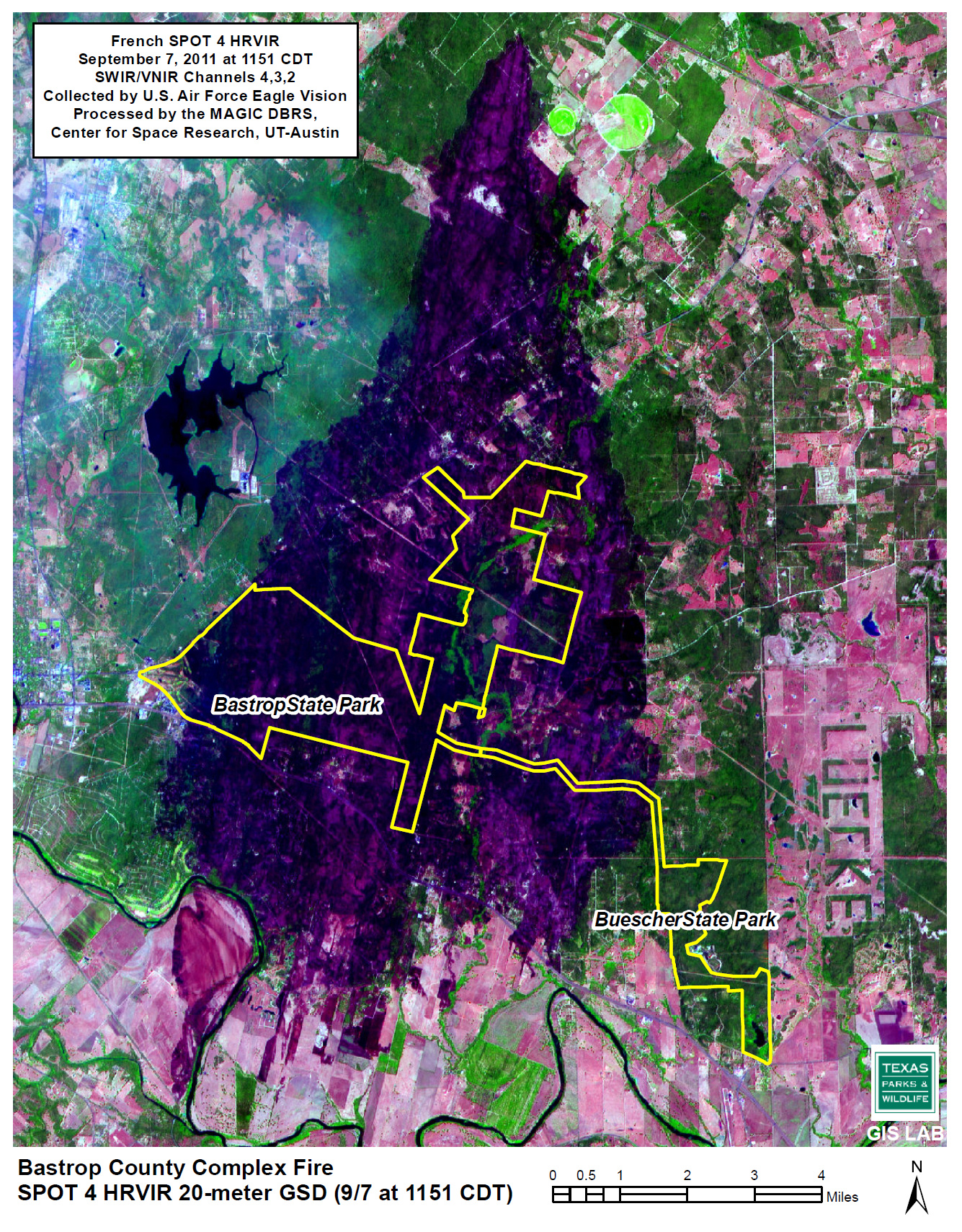
Here's (hopefully) the final footprint of the Bastrop fire.


(NASA explains the 'LEUCKE', which is coincidentally used to calibrate their image resolution.)
We also made an empirical estimate of spatial resolution for lower contrast vegetation boundaries. By clearing forest so that a pattern would be visible to landing aircraft, a landowner outside Austin, Texas (see also aerial photo in Lisheron 2000), created a target that is also useful for evaluating spatial resolution of astronaut photographs. The forest was selectively cleared in order to spell the landowner's name 'LUECKE' with the remaining trees (figure 10). According to local surveyors who planned the clearing, the plan was to create letters that were 3100 ´ 1700 ft (944.9 ´ 518.2 m).

Another Anthropogenic Forcing

Rick Perry, among his other interesting attributes, has managed to unbalance the state budget of Texas, you know, the state with the miracle economy, to the tune of $2.5e10/annum; yes that is twenty-five billion dollars. Consequently, the forest service and the volunteer fire departments were among the services substantially defunded as of September 1, and some professional firefighters just recently lost their jobs.

The following is a republication (with permission) of an article from the Texas Tribune:


Fire Crews Straining Amid Devastation in Central Texas
by Matt Largey 9/7/2011

Federal authorities arrived in Bastrop on Tuesday to assist with the wildfires that have killed two, charred more than 30,000 acres and destroyed at least 600 homes. Matt Largey of KUT News reports that the crisis has stretched fire crews to their breaking point.

This article originally appeared in The Texas Tribune at http://www.texastribune.org/texas-environmental-news/environmental-problems-and-policies/fire-crews-strained-devastation-in-central-texas/.


Who's left holding the bag? Not the wealthy taxpayers of Texas who got a big tax break from Perry, presumably. In fact, nobody seems to know.

As a Texan, I have no hesitation drawing on my vast supplies of culturally encouraged hubris to propose that the Bastrop disaster (now approaching the scale of the Joplin tornado disaster with over 1000 houses lost, with the fire only "35% contained" as of this morning) be considered primarily a federal matter. But I wouldn't be surprised to find the rest of the country disinclined to agree.


Update: Some comments at the LA Times fit my expectations nicely.
Stone_icon at 12:24 PM September 08, 2011

What kind of moron cuts the fire proctection budget in the midst of a long drought? You brag about your balanced budget and making hard choices, and then beg for aid when your foolishness bites you in the rear. Well good luck with that. Remember, there is no such thing as climate change.

JohnZ52 at 10:45 AM September 08, 2011

Perry slashed the budget for firefighters in his state. The majority are volunteers who pay for their own uniforms and equipment. Now Perry who foams at the mouth when government intrudes on business and regular folk is whining about not getting Federal Aid. Why should my tax dollars as a resident of CA go to assist a state and governor who are anti-gay, anti- choice and anti-immigrant? Perry once advocated that Texas seceed from the Union. Deal with it Gov, and quite crying that the rest of the United States isn't bailing you out.

JasonFerguson at 10:39 AM September 08, 2011

A tax free state with affordable housing is the accepted trade off for living in states that are vulnerable to natural disasters. Bet hedging 101 would encourage them to buy the best insurance they can afford. Why do they deserve additional financial help? I've chose to pay additional taxes to live in California and enjoy the beaches. Will the government help me out if I can't pay my property tax? No. They shouldn't. I knew what I was signing up for and so did they. The government can't continue to bailout nitwits. This is non-sense
!
No. You guys are wrong. You should send us money because Texas! Texas, Texas, Texas! And oh yeah, because climategate.

Wednesday, September 7, 2011

More on Fires


An excellent piece on the Texas fire situation at Texas Climate News.
“In rapidly growing population areas like Austin, as more and more of the desirable land fills up, you get kind of a pushing in and a pressure to build in the zone that everybody knows you shouldn’t be building in,” says George Rogers, a senior research fellow at Texas A&M University’s Hazard Reduction and Recovery Center. “As your population expands, it’s a natural consequence: You have built-in pressure to build in less safe places.”
Picture is from a gallery at the Washington Post site.

Tuesday, September 6, 2011

Lost Pines, Yesterday

Not the Obligatory Spencer Post


Satellite-derived fire sites today. (click image for higher resolution.)

Sorry if I'm not in the thick of the soap opera this week.

We are kind of sliding into a full blown catastrophe around these parts. It seems not quite timely to be playing paranoids and nerds right now.

Monday, September 5, 2011

Approaching Bastrop Today


More pictures via the Statesman. Top image from the Texas Trib.

"Lost Pines" Today vs 30 Months Ago


Also known as Bastrop State Park.

Click image for details.