What are the logical premises shared by both sides of the AGW debate?
The questioner, Martin Stoehr, proposes for starters that:
* The average land surface temperature has increased over the last 200 years
* A CO2 molecule does not absorb EM energy at visible wavelengths and does absorb EM energy at infrared and near-IR wavelengths (1437nm, 1955nm, 2013nm, 2060nm, 4257nm asym-stretch, 7205nm sym-stretch, 14993nm bending: Page on wesleyan.edu)
Well, you'd think.
I respond as follows:
The question holds a premise that there are two coherent scientific positions. But there aren't.
Within science, there is no polarization, although there is a spectrum of opinion on a lot of open questions.
The illusion that there are two competing camps is promoted by political interests. If you look at the actual scientific perspective of the few people who are constantly invoked by the naysayer camp, you will find no coherence or commonality among their opinions. Many of them are frank crackpots, and all of them are, by definition, scientific eccentrics.
Therefore there is almost nothing or maybe nothing at all that they would agree to among themselves. They really don't have an alternative theory they are advancing.
It should be considered settled that
* humans affect the climate in many ways
* greenhouse gases are among those ways
* CO2 accumulates so the greenhouse perturbation grows every year
* CO2 accumulation causes energy to accumulate in the climate system on short and long time scales, which causes warming, some of which is delayed
* warming is observed, most of which is a direct result of human impacts
* a great deal more warming is to be expected.
That some warming has occurred is obvious - sea level is rising and this provides a crude global thermometer just by itself. You don't need a whole lot of observations and subtle data manipulations to observe this.
Also it is demonstrated that the rate of CO2 accumulation overwhelms the ocean's buffering, creating ocean acidification.
We can debate ethically, economically, and politically what to do about all these things. We can debate scientifically about the numbers and scales. But those facts should be considered established.
People questioning these points are very rarely real scientists in the physical climatology domain . Such exceptions as there are don't agree with each other, so they collectively concede nothing.
You'd think people who think we have the earth's energy balance wrong would be eager to go ahead and fund a science mission that could prove it. But you'd be wrong. You don't seem to understand how know-nothingism works. The denier position is not that we don't know enough - it is that we can't know anything and therefore we can do whatever we want. (If you don't follow the syllogism, you still don't understand know-nothingism.)
So observing the energy balance of the sunlit side of the planet turns out to be possible because of a peculiar consequence of orbital dynamics. And it turns out that, although a clever idea for "an expensive screen-saver", and arguably worth it for that purpose alone, such a satellite, properly instrumented, could offer important constraints on the earth's energy budget.
In short, if the consensus understanding of climate change really were badly wrong, this instrument would almost surely provide enough information to prove it.
The instrumentation and platform was proposed in 1998 in conversations initiated by then Vice-President Gore and quickly constructed; it was ready for launch in 1999. But Republican pressure in the 1999 budget negotiations mothballed the project, disparagingly called "Gore-Sat" by its opponents. (In some circles, and mention of Mr. Gore is considered disparaging. He's sort of like Mike Mann in that way, a serious, moderate, thoughtful and highly competent person who has somehow been painted as a demon. Witness modern discourse at its best.)
And in mothballs it sat. Because Al Gore. Because conspiracy. Surely not because the data would utterly fail to upend the existing consensus and would help refine it.
Until this year, when it was launched. Until today, when its first image of the whole earth was released, to much calloo-ing and callay-ing.
Would it have been more sensible to redesign the platform rather than launch an almost 2 decade old gizmo? Is this the best instrumentation for the mission to launch today? I don't propose to have answers for those questions; I would not be surprised if the contemporary purpose of the launch is almost as political as the purposes of the absurd delay.
These are also things worth talking about.
That all admitted, I would defend the screen-saver aspect of it. Actual photos of the whole earth available on a daily basis are worth the few cents per capita that we actually spent on this thing. Providing collectively funded information of collective utility is a legitimate function of government. Science has never been the sole purpose of NASA, or we wouldn't have sent astronauts to the moon.
Apparently taking pictures of Pluto is less controversial than taking pictures of the Earth, though.
Welp, Pluto is cool too. Perhaps a bit too cool, but that's another tale, nicht wahr?
There's lots of bother about what the climate community agrees or disagrees to and to what extent.
This all follows on from Naomi Oreskes' investigation into the existence of a consensus in the literature basically on the question as to whether the future holds an unusual amount of climate disruption. (It does and the literature is consistent with near unanimity on that question.)
But whether there is, as is commonly claimed a "97%" consensus depends crucially on who you include as a scientist, what question you are asking, and how you go about asking it.
I think the most consistent and interesting pattern is that the more a person specializes in climate as a physical system, the more alarmed they are by our future prospects. At least two surveys have shown this.
1. When compared with pre-1800s levels, do you think that mean global temperatures have generally risen, fallen, or remained relatively constant?
2. Do you think human activity is a significant contributing factor in changing mean global temperatures?
...
In general, as the level of active research and specialization in climate science increases, so does agreement with the two primary questions (Figure 1). In our survey, the most specialized and knowledgeable respondents (with regard to climate change) are those who listed climate science as their area of expertise and who also have published more than 50% of their recent peer-reviewed papers on the subject of climate change (79 individuals in total). Of these specialists, 96.2% (76 of 79) answered “risen” to question 1 and 97.4% (75 of 77) answered yes to question 2.
This result is further confirmed by a more recent and more extensive study conducted by Verheggen et al. There's much of interest there, but I'd like to focus on the following, which examines the distribution of opinion among the group that the prior study would consider the most expert.
Here we see that the gradient of concern vs expertise arguably goes even to the most expert. The more you have published, the more likely you are to consider the anthropogenic component of warming to date to be "strong".
And that's worth considering.
When science discovers something alarming, how does the alarm propagate? It makes sense that the best informed people would be the most alarmed if the cause for alarm is real, while if it is dubious or baseless, the distribution would be very different.
This should all come as something of a shock to people interested in public health, where a formal consensus process has long been the mechanism of interaction between science and policy. For instance, "In the United States, for example, the National Institutes of Health promotes about five to six consensus panels per year, and organizes this knowledge by means of a special Consensus Development Program, managed by the NIH's Office of Disease Prevention (ODP)."
So why doesn't climate science have such a consensus process? That should settle all this argument and allow us to move on on the basis of formally selected information. It seems like a good idea. Indeed, right-wing commentator Peggy Noonan suggested exactly this in 2006:
During the past week's heat wave--it hit 100 degrees in New York City Monday--I got thinking, again, of how sad and frustrating it is that the world's greatest scientists cannot gather, discuss the question of global warming, pore over all the data from every angle, study meteorological patterns and temperature histories, and come to a believable conclusion on these questions: Is global warming real or not? If it is real, is it necessarily dangerous? What exactly are the dangers? Is global warming as dangerous as, say, global cooling would be? Are we better off with an Earth that is getting hotter or, what with the modern realities of heating homes and offices, and the world energy crisis, and the need to conserve, does global heating have, in fact, some potential side benefits, and can those benefits be broadened and deepened?
Also, if global warning is real, what must--must--the inhabitants of the Earth do to meet its challenges? And then what should they do to meet them?
You would think the world's greatest scientists could do this, in good faith and with complete honesty and a rigorous desire to discover the truth.
You know what would be a great pity, though? What if there had been a consensus process of just this sort in place for decades, and nobody noticed. Fortunately the world is not that silly, is it?
...with Lomborg grinning enthusiastically from the panel
Peter Huber’s video is interesting and worth watching.
He expresses the Prisoner’s Dilemma aspect of the situation very well. His conclusion “chasing the impossible is never worth the money” is of course a tautology.
But there are other players than individual economic interests and national economic interests. There is the interest of the whole world. And the collective interest at the global level is profoundly opposed to the sovereign national interests in a classic tragedy of the commons setup.
Economically, leaving the carbon in the ground is a hugely losing proposition as long as there is no accounting for the diffuse but accumulating and persistent damages of fossil fuels. Specific interests will always look for ways to continue this lack of accountability. The market will continue to slowly but hugely damage our collective future as long as this accounting is neglected.
Huber, like most people with an axe to grind, considers only one side of the ledger. So while most of what he says explicitly is right, his implicit selection of evidence is profoundly biased, and his conclusion is distorted by the blinders he is wearing.
Others looking only in the other direction see the transition to carbon free fuels as an economic boon, which is, if anything, even sillier.
The energy/climate future will be expensive, difficult, and disruptive. It’s too late to avoid that. The longer we pretend that changes will be either unnecessary on one hand or easy on the other, the more expensive, difficult, and disruptive the future will be.
I have thought quite a bit about Revkin since. I saw him as two-faced, and others have struggled with this as well. People who have met Revkin find it hard to entirely dislike him (I have since entered into that category), and people who have been interviewed by him especially so. There's an obvious sincerity and wit (not matched by musical talent, alas) that makes the two-facedness even harder to account for.
I have since decided that it's best to think of Revkin as the Larry King of the sustainability world. A good interviewer of the friendly sort - the type that brings out the best, most convincing, most coherent, in anyone he interviews. When he interviews somebody basically sound, the result is extremely helpful. When he interviews someone basically confused and/or ego-driven, or tries to address both "sides" of what ought to be a noncontroversy, the result is toxic. On the whole we end up with a few gems in a total contribution that is not helpful.
A key controversy is on the "stridency" question. Journalists face competing ethical pressures - to tell the truth as it exists and to be open to challenge. This is a tightrope act. As such, journalists are suspicious of advocates - those who only tell one side of the story. I sympathize.
In the end my position on all this is closed to Gavin Schmidt's. What we want from all this communication is for real conversation based on realistic assessments of evidence to replace all these idiotic proxy arguments we are having instead. But when the proxy arguments are hopelessly skewed away from reality, representing a success on the part of the advocates of policy paralysis, the best thing to do is not always the thing that looks to the confused public as the most balanced.
So a case in point arises in a recent kerfuffle between Greg Laden and Andy Revkin.
It begins with an article Greg writes that is heavily critical of Andy, suggesting that he is becoming an active agent of the forces of confusion and denial.
For what it's worth, I wouldn't have written it that way. I don't think Andy has changed much. As Greg points out, it's the evidence that has changed, and there's little sign that Andy has moved along with the evidence.
But of course, that misunderstands what his role in all this. He has always been a de facto agent of confusion and denial, because his kindness and essential neutrality combines with excellent interview skills to produce this mass of wonderful and terrible articles, the net effect of which is terrible. Andy Revkin, though I like him, is the embodiment of the problem I set out to solve when I started blogging.
True to form, Andy is open to criticisms of himself, but decides to put some focus on this paragraph of Greg's:
There is plenty of room for variation in policy approaches to climate
change. But there is absolutely zero room for considering the reality
of climate change or its severity. We can honestly argue about
thresholds, and which decade will see what severe effects, but we can no
longer argue about the existence or overall seriousness of the problem.
Revkin picks up on Olson's critique and in his response replies sarcastically
It is on the severity question that his “zero room” for debate meme fails.
Randy "Don't be Such a Scientist" Olson (grrr...) runs with it:
By pinpointing the “zero room” comment, Andy got right to the heart
of the problem, and even cued a more specific elaboration from Greg of
“zero room for debate.”
There’s your problem. In just two words you’ve captured much of the
core of the failed climate movement of the past decade. And it is
failed, given that there was once climate legislation in the works and
bipartisan support for action, but today there’s nothing.
In 2006 Gore’s movie gave rise to the misguided “there is no debate”
communication strategy. It took Climategate and Jon Stewart ridiculing
the climate science community to show that actually there very much is a
debate if you use the broader public’s definition of the word “debate”
(that half the public does not support climate action) rather than the
academic community definition (all the data point one way).
“Zero room” captures the self-defeating arrogance and tone deafness
that has characterized the American environmental community for decades.
Thank you, Greg, for distilling it down to just two words.
I won't waste my breath on how much every word of that irritates me, but that's Olson for you. Maybe I will write a book for Olson called "Don't be Such a Media Whore". What's important is that this does seem to capture Revkin's point.
But look, it's obviously wrong. The question is what Greg meant by "zero debate" on the "severity question". Does it mean zero debate on HOW SEVERE, or zero debate on WHETHER IT US SEVERE. Because if it's the former, there's certainly room for criticism. But see, Greg already answered that for us. Since bits are free, I'll repeat it with emphasis:
There is plenty of room for variation in policy approaches to climate
change. But there is absolutely zero room for considering the reality
of climate change or its severity. We can honestly argue about
thresholds, and which decade will see what severe effects, but we can no
longer argue about the existence or overall seriousness of the problem.
Although the second sentence is open to criticism on one interpretation, it is immediately paraphrased in the third sentence. And that paraphrase makes clear that the zero debate question refers not to quantitative dickering but to the basic facts of the matter, facts which Revkin insists that he accepts.
In short, this particular line of attack is baseless and at best very sloppy.
Beyond that, I'll let Andy and Greg slug it out. I don't entirely agree with either of them on their characterizations of what Andy does (and what most of the rest of the American press does too).
In the large, Greg is wrong when he (implicitly) calls Andy a sell-out. (* UPDATE/NOTE - Greg says on Twitter that he wouldn't use that description.)
(It's perhaps unsurprising that Andy turns around and defensively calls Greg a zealot, and that's wrong too. I don't always agree with Greg, but I think we've learned that tiptoeing around the climate issue trying to sound like a proper scientist is not having the desired effect. Greg can be reasoned with - he's reasonable in that sense.)
The problem at root is a totally confused sci-comms ideology that has gripped the press, exemplified and championed by Dan Kahan. And the best illustration of it has been provided, ironically and apparently unwittingly, by Andy Revkin. Watch.
Sorry. A bit excruciating, I know.
But if you ever wanted to see what ideological blinkers really do to a person, listen to how Revkin ducks and weaves to avoid answering Gell-Mann's simple question. (Ironic, no?)
A real pity the camera is facing the wrong way because Gell-Mann is the interviewer. (A hat tip to Steve Bloom for the reminder.)
And this bizarre abdication of responsibility by the press leaves nobody willing to take responsibility for the public understanding the issue. And that's the problem. I'm hard pressed to see how we reach a point where the public "believes in" something it doesn't have any understanding of.
So Facebook recommended a group to me whose description starts out
Mainstream media is marketing collapse panic or denial and must be countered with a responsive and honest citizen media initiative...
Hmm, well that sounds promising, so I clicked on the full description
Mainstream media is marketing collapse panic or denial and must be countered with a responsive and
honest citizen media initiative to prepare local communities for the
onslaught of starvation, dehydration, disease, predation, and
hopelessness. Images and narratives may empower the public with examples
of those who are preparing to enter planetary hospice; images which
reinforce ritual behaviors that do not require electricity, and can
sustain us until life leaves our bodies. Ritual activities like:
mindfulness practice; yoga; exercise; dance; prayer; hiking; gardening;
painting; singing; journaling; massage; woodworking; reading; listening
to live music; playing cards or games; cleaning and cuddling; or
sleeping. Additionally, indie media could portray rituals in which we
joyfully say good bye to our neighbors; our planet and our suffering.
To quench the fire of retribution, and the agony of waste,
independent media producers could choose to portray collapse as a
spiritual event, a passing through the veil of our species, a
culmination of our short excursion on Earth, with great reverence, and
humility, humor, and compassion for one another. Indie media can act as a
bridge uniting disciplines by collaboratively envisioning a post
apocalyptic culture in which we use our stories and our art to celebrate
our multicultural heritage, and pay homage to our planet, with
compassion for every single being, releasing them to the infinite, each
as a beat of a butterfly's wing, and a victim of unintended
consequences.
Aargh "rituals in which we
joyfully say good bye to our neighbors; our planet and our suffering"! How empowering... None for me thanks.
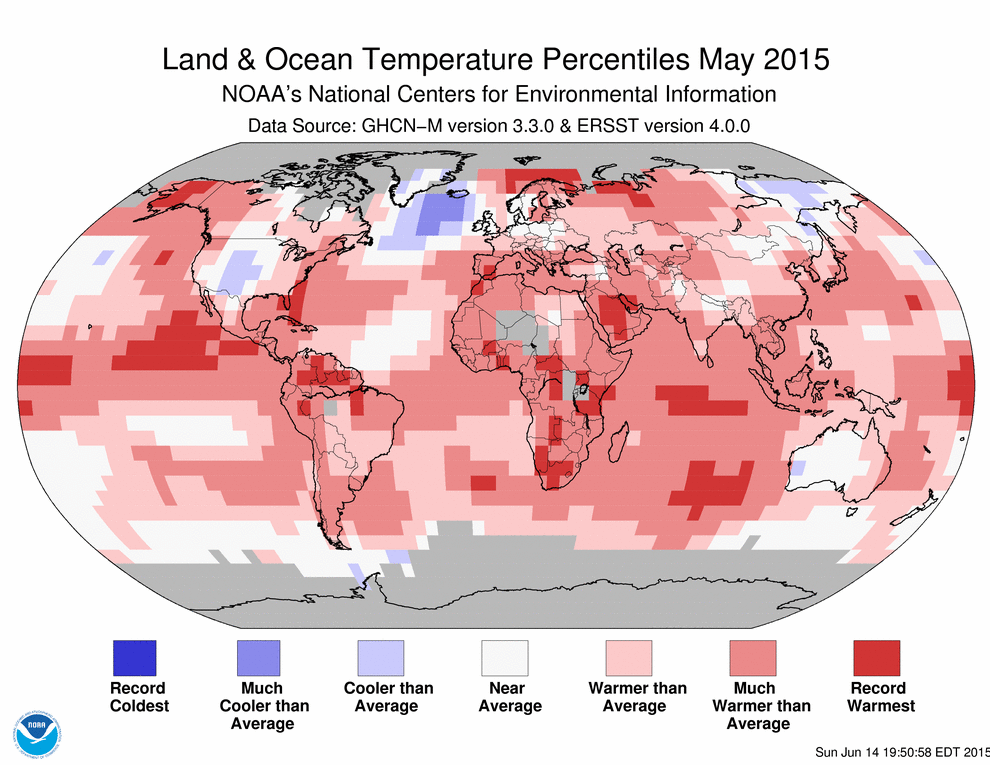
Record large-scale warm monthly temperatures in May: Northern South America, Florida and offshore, southern Africa, central Africa, Arabia, equatorial Indian ocean, south Indian ocean, equatorial Pacific, Alaska. And a couple of other isolated spots.
Record large-scale cold monthly temperatures in May: none.
Also NOAA has this as the warmest monthly global anomaly on record, though GISS doesn't; by their count it's merely very very warm.
It looks likely that the overblown "hiatus" story will go away in the next few months. Good riddance.
And what with the "tropical hot spot" issue also likely going away, one wonders what the naysayers will dig up to complain about next. I don't doubt it will be something. After all, it's a "hoax", right? They just have to move the goalposts a little more....
It's worthwhile to try to visualize the anthropocene, and photography is a good way to do it.
Here for instance is my own image of the anthropocene stratum being formed in a gorge in New Mexico:
A parking lot at the top of the cliff apparently had collapsed some years ago, and the cars are sinking into the earth forming an iron deposit of an idiosyncratic sort. What we dig out of the earth eventually goes back into the earth. It has nowhere else to go. So if humanity fades from the scene, the modern era will be explicitly represented geologically by the earth swallowing our detritus again. (Click on the image for more detail.)
Much of our quandary needs to be expressed in abstract ways. People are so easily impressed by big numbers that aren't that big.
("Every year, Alaska loses some 75,000,000 tons of ice" I read recently. Why, that's enough to raise sea level by 5 microns!)
UPDATE: For what it's worth the real number should be 75,000,000,000 per 20 years. 25 mm/century in other words if my math holds. It's not an important number in any case, but bigger than I made out. The Himalayan ice may be a bit more important, but the real sea level story remains thermal expansion and the big ice sheets. I think the Facebook claim I saw was twice garbled.
Similarly, pictures of environmental awfulness need to be accompanied by some though into how widespread they are.
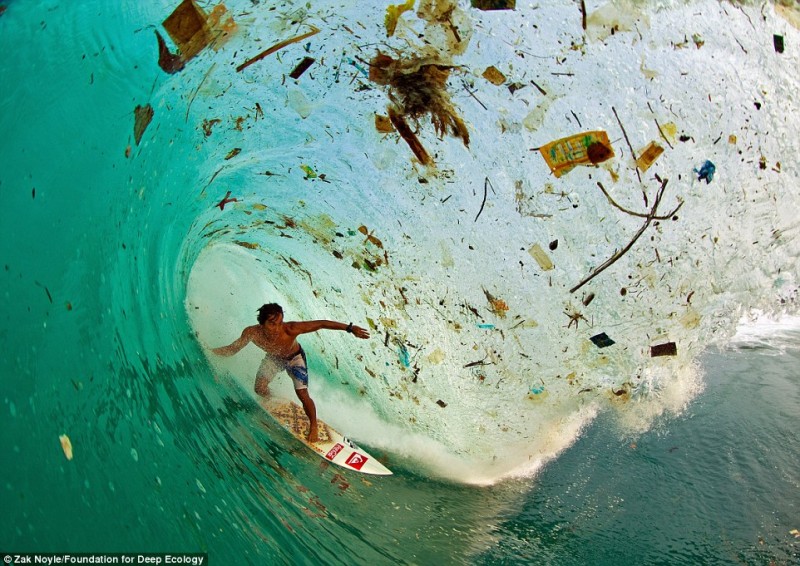
There's a series of pictures that's gotten some play in Facebook circles here. Some just represent large problems, while others demonstrate them. This for instance is an unequivocal horror:
while this could represent a huge problem or not; we have to provide context ourselves:
(My aesthetic sensibilities prevent me from reposting the horrifying #15.)
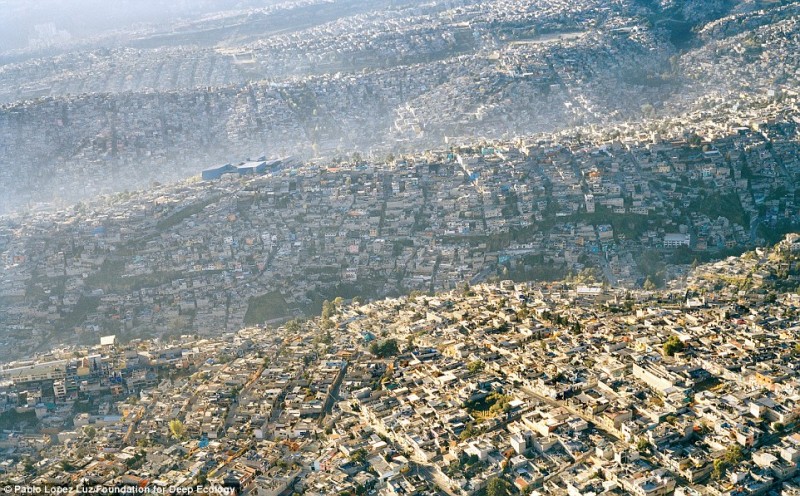
But what are we to make of these two images, of Mexico City and Los Angeles?
Well, there sure are a lot of us, yep. But given that, is this sort concentration of humanity a problem? Maybe it's a solution! If we live closer together, we can share resources more effectively.
It's widely known that whatever else there is to being a Manhattanite, it comes with a much lower environmental footprint than anywhere else in America, with places like Boston and Chicago forming the second tier. Granted this sort of bird's eye view is sort of scary, but given that there are billions of us, isn't this the right way for us to live?
But then there was one image in the set, intended after all to be as
mortifying as possible, to shake the viewer into some sort of
radicalism, one image to which my response was unequivocally favorable.
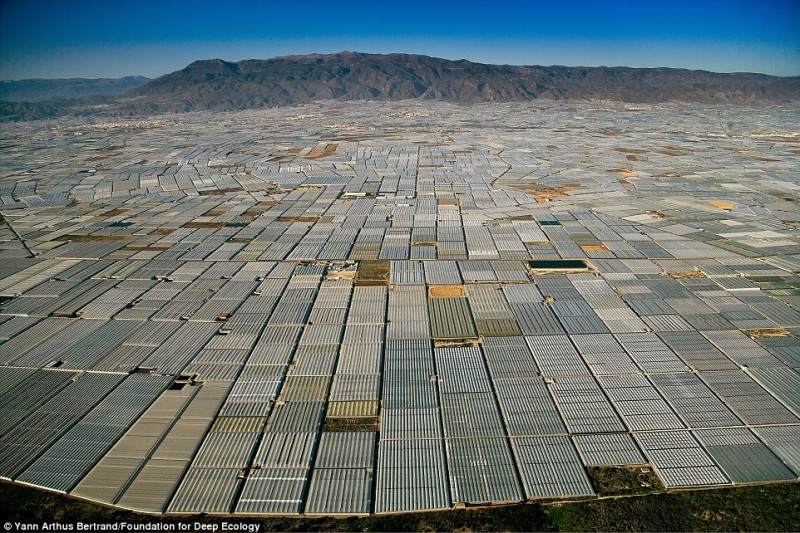
Maybe I'm odd about this. It's this one, captioned "The
area around Almeria in Spain is littered with greenhouses as far as the
eye can see – simply for a richly filled dinner table."
Assuming that really is what we are seeing here, so how is that a problem? Imagine how much more land and resources this agriculture would take done out in the open.
I'm not convinced by this idea that plowed-field agriculture is in any way "natural", that an agrarian landscape is particularly sustainable or delightful. (The endless cornfields of bizarrely flat Illinois are a particular horror, actually, as I look at it. I have nightmares about them.)
So regarding "greenhouses as far as the
eye can see – simply for a richly filled dinner table"?
Yeah! More please!
I think it's not an easy question whether, in the end, agriculture has not done more environmental damage than heavy industry. Certainly it's not heavy industry that depleted the soil or displaced most of the world's biodiversity with monocultures. If we can pack ourselves into small spaces, so much the better. I think the same holds for our crops.
What's more, the more we rely on traditional agricultural methods, the more we are at risk from climate change. Indoor solar-powered agriculture recycles water, saves land and thereby preserves habitat, stops soil erosion, and increases resilience to the climate shocks that are coming.
I just don't buy into the back-to-the-land plan. It's way too late for that. Are greenhouses really so terrible?