Following up
from yesterday, we have a bunch of people being a little bit coy in response to a straightforward statement,
Richard Branson's comment that "If we could come up with a geoengineering answer to this problem, then Copenhagen wouldn’t be necessary. We could carry on flying our planes and driving our cars."
Note that he didn't say
all our problems would be solved. The finiteness of fossil fuels is obviously on deck. And while we might manage enough biofuels to keep our airplanes flying, that won't be enough to solve our problems. Still, there's little wrong with the substance of the assertion: if CO2 emissions could be made harmless, they would be harmless.
In response we have a chain of half-stated reactions:
David Roberts: "entrepreneur Sir Richard Branson said something heroically, world-historically stupid" and "The authors of the upcoming book SuperFreakonomics also think that geoengineering is a cheap, easy way to avoid the work of fashioning a more sustainable society." Branson is lumped in with Levitt and Dubner, a place one really doesn't want to be lumped these days.
(What David clearly means is that there are plenty more limits beyond this one, and finding a workaround to one limit without changing our behavior in the long run is not a happy ending, just a prolongation of the inescapable crisis. With this I am in total agreement.)
Keith Kloor: "The irony is that Roberts posts a set of global land use & ecological impact graphs to make his point that geoengineering won’t save humanity from all the upward trends in the graphs. So if every ecological and climate indicator demonstrates that the earth is becoming less livable because of increasing carbon dioxide concentrations and other global land uses, then is it realistic to take geoengineering off the table just because someone like Richard Branson makes a glib and simplistic statement?"
(I kind of agree yet again. Depending on what you mean, I don't think geoengineering should be off the table. Branson is advocating for biochar. Biochar should definitely not be off the table, and I don't think David Roberts wants it off the table anyway.
Where Kloor rubs me the wrong way is in his closing paragraph:
But the truth is that no matter happens at Copenhagen and in the U.S. Congress, some type of adaptation measures will be necessary. Roberts is a very smart guy, and I know he’s capable of chewing gum and talking about climate adaptation at the same time. The fact that he doesn’t want to likely results from his belief–which is shared widely by climate activists–that any discussion of climate adapation is an unwelcome distraction from the debate at hand on mitigation. Why there isn’t room for both discussions to occur beats me.
The idea that there is some sort of zero-sum game between "adaptation" and "mitigation" is really a very half-baked way of thinking about the problem. Forcing things under that rubric is simply a distortion.)
me: My coy statement was: "But what about geoengineering? Is David right? Is Richard Branson right? They are both right, as I'll explain later."
(In that article I tried to explain the very loose coupling between what is normally considered the mitigation community and the multitude of disparate adaptation communities, and the difference in scale of their problems. I explained that thinking of geoengineering as a part of "adaptation" was not splitting nature or the relevant intellectual communities at their joints. It's a very poor apprehension of the situation to find these communities as if they were in competition, and weaker still to assign geoengineering to the wrong side.
But what of geoengineering solutions? I am not in the least averse to using whatever tools we can bring to bear to manage the situation on the way to some sort of sustainability, a sustainability that I can't imagine really coming to fruition for a century or two, while the population slowly drops to a billion or a tenth of a billion.)
We need to use whatever works in the intervening generations. (It seems to me the 350.org folk are in agreement with Branson in supporting biochar as the nicest way to quickly bring the CO2 concentration down. So I can't see how David Roberts chooses to lump Branson in with the egregious Dubn and Dubner).
What works? Well, in addition to a rather ill-informed attempt to create a zero-sum game between "adaptation" and "mitigation" the press seems to be forming a rather confused idea of "geoengineering" (a trap into which Branson has inadvertently walked, though he will likely walk right back out none the worse for it personally), and unfortunately the scientific community writ large is contributing to the confusion on this matter.
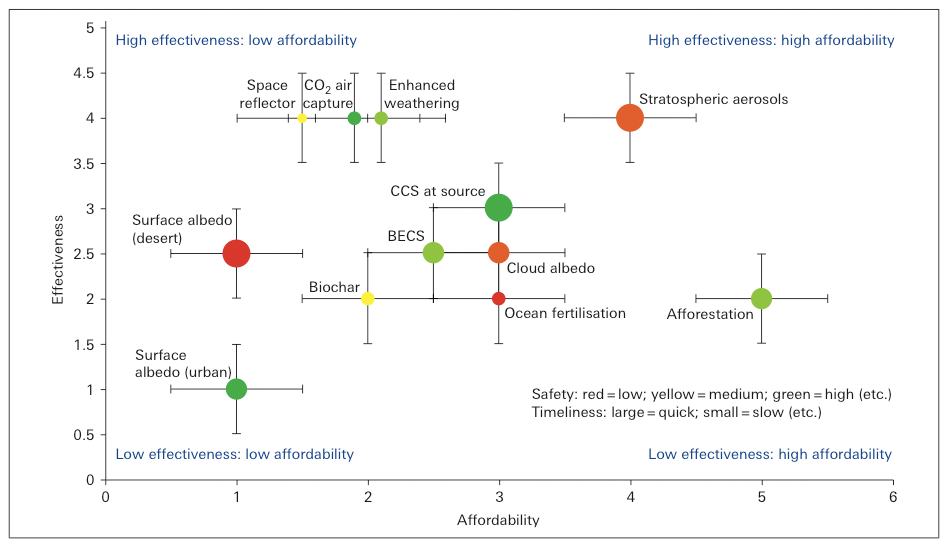
Have a look at this figure, from the Royal Society report "Geoengineering the Climate", Sept 1 2009,
via 2020Science
The above is from Royal Society’s much-anticipated report on geoengineering. As
2020science puts it:
Aimed at presenting “an independent scientific review of the range of methods proposed [for geoengineering the climate] with the aim of providing an objective view on whether geoengineering could, and should, play a role in addressing climate change, and under what conditions,” it provides what is perhaps the most authoritative and comprehensive assessment of the options to date… It dares to consider the option of actively engineering the climate on a planetary scale to curb the impacts of global warming, and advocates further research into geoengineering. In doing so, it will no doubt simultaneously enrage deniers of anthropogenic climate change, and those who fervently maintain that technological fixes are not the solution to the consequences of humanity’s excesses. ...Yet for anyone mature enough to consider the merits of evidence-based and socially-responsive decision-making, the report offers a clear and insightful perspective.
The figure speaks eloquently for itself. (I'd have made the size of the dots represent the potential scale of the effort, but that is somewhat subsumed under "effectiveness". Roof painting is fine, but of course there really aren't enough roofs to make a difference.) Rather, and somewhat counterintuitively, the size of a bubble indicates how quickly the approach could be brought online. Of course, this sort of chart subsumes a tremendous amount of debate and uncertainty, and is likely far from the final word on any of these approaches, but it's certainly interesting on its own.
Well, maybe not completely eloquently. "BECS" is "bio-energy with carbon sequestration".
What I'd like to point out is that there are
two very different classes of strategy being discussed here:
carbon sequestration strategies and
radiative transfer balance strategies. It is easy to tell them apart. All the
green dots (except for the low-effectiveness urban rooftop one) are carbon sequestration strategies. Those are considered safe. All the
red ones are radiative transfer strategies. Those are considered high risk.
This is not a coincidence! These are really two very separate categories of idea! I am increasingly frustrated at the extent to which they are being confused. It amounts to retrograde progress in public understanding.
Can we please distinguish between them?Removing the carbon from the atmosphere solves the carbon problem. The climate disruption goes away. The direct ecosystem disruption goes away. The ocean acidification goes away. The cost is pulling out the carbon. The effect is that there is no extra carbon! It's pretty difficult in practice, but in principle it's a no-brainer!Changing the radiative properties of the atmosphere is global climate engineering. It has numerous and extremely spooky consequences. It's like drinking more and more liquor every night and drinking more and more coffee every morning to compensate. You may crudely cancel out a few of the symptoms, but you're getting more and more unhealthy with every passing day, and anyway, plenty of the symptoms are still with you.Part of this traces back to the earlier mistake of calling the problem "global warming" in the first place. Our problem is accelerating climate change, not global temperature. Global temperature is merely an easy-to-measure symptom (and is relatively easy to obtain from paleodata as well). No doubt it is an interesting quantity. But the change in global temperature is not the problem, and never has been. The problem is that the atmosphere is a forced fluid flow, and relatively small changes in the forcing can have very large changes in the flow as a consequence.
It is easy to counteract the changes in global temperature by cancelling out an inadvertent heating with a deliberate cooling. But it's really a desperation move. It might keep our ice sheets from falling apart, and that is a big goal, but it will add to climate change, not cancel it out!
Now, neither approach will solve all of our problems.
But the sequestration approach will solve one of our problems, and it is a big one. If you don't believe in
any of the sequestration approaches, you;d better take off that "350" cap, mate, because we need at least one of them to work if we're going to get to 350 before Greenland melts.
My bottom line, then, is all about nomenclature.
The "adaptation" community deals with local change on decadal time scales. The "mitigation" community deals with global change on longer time scales, and with forcing.
There is no real competition between the adaptation and mitigation communities and certainly no zero-sum game. It's irresponsible to try to drum one up.Technologies that can affect the forcing on a global scale are not really part of the adaptation conversation but rather part of the mitigation one. There are two main types of global strategy that don't address emissions directly:
radiative and
geochemical. The word "Geoengineering" is often applied to both but should probably only be applied to the radiative class of strategy.
Studying radiative geoengineering in this sense is probably justified, but anyone thinking that sort of geoengineering provides a free pass is indulging in childish wishful thinking. (One surely shouldn't publish a reputation-bearing book making such a case.) Also, of course these symptomatic approaches do not save the oceans from death by acidification, another environmental problem of the highest order.Sequestration strategies are commonly lumped under geoengineering, but they are very different in strategy. They deal with the carbon problem itself, not just with one of its symptoms.Solving the carbon problem will not suffice to bring us into balance with the world, but it will help a lot. It will help us survive to the day when we can achieve sustainability. If you dismiss every one of these ideas you need to hang up your "350" cap because we need at least one of them to work to get to 350.PS - It's still a good idea to have a reflective roof if you are in a hot climate. It just won't fix global warming to any significant extent, okay?
PPS - Wow. A long article for a short attention-span world. David, can I borrow
some puppies? (OK, I did some
coloring, hope that helps.)
Needless to say, no one would credibly argue that geo-engineering is a replacement for mitigation of carbon emissions. A business-as-usual scenario of coal burning, taking atmospheric CO2 to 750 to >1000 ppm (directly or via carbon-cycle feedbacks), will force the climate system so far out of whack that no ‘patch up job’ will be sufficient. No, the context under which geo-engineering might need to be considered is if a measured analysis shows that even with major emissions reductions, the impacts of committed warming will be so bad as to warrant using additional ‘terraforming’ of planet Earth. Are we at that point already? Dunno. But let’s have that risk assessment and necessary R&D done, just in case.
Needless to say?
Nothing is needless to say anymore, apparently.
Update: Related article
on RC. (With a link back to here, thanks!) The crucially relevant point which seems invariably forgotten by people who wish there were an easy solution so they could trumpet how blind we all are, is explained thus:
The point is that a planet with increased CO2 and ever-increasing levels of sulphates in the stratosphere is not going to be the same as one without either. The problem is that we don’t know more than roughly what such a planet would be like. The issues I listed above are the ‘known unknowns’ – things we know that we don’t know (to quote a recent US defense secretary). These are issues that have been raised in existing (very preliminary) simulations. There would almost certainly be ‘unknown unknowns’ – things we don’t yet know that we don’t know. A great example of that was the creation of the Antarctic polar ozone hole as a function of the increased amount of CFCs which was not predicted by any model beforehand because the chemistry involved (heterogeneous reactions on the surface of polar stratospheric cloud particles) hadn’t been thought about. There will very likely be ‘unknown unknowns’ to come under a standard business as usual scenario as well – another reason to avoid that too.
There is one further contradiction in the idea that geo-engineering is a fix. In order to proceed with such an intervention one would clearly need to rely absolutely on climate model simulations and have enormous confidence that they were correct (otherwise the danger of over-compensation is very real even if you decided to start off small). As with early attempts to steer hurricanes, the moment the planet did something unexpected, it is very likely the whole thing would be called off. It is precisely because climate modellers understand that climate models do not provide precise predictions that they have argued for a reduction in the forces driving climate change. The existence of a near-perfect climate model is therefore a sine qua non for responsible geo-engineering, but should such a model exist, it would likely alleviate the need for geo-engineering in the first place since we would know exactly what to prepare for and how to prevent it.
This is why all intervention
has to be about reducing net carbon. Anything else is a desperation backstop and probably won't work for all sorts of reasons.
Update: RP Jr shows up to say that
"Here is what I have said recently (for example) on adaptation vs. mitigation:
"I think that mitigation policies should be completely decoupled from adaptation policies and they should proceed on separate tracks. They are not trade-offs but complements."
http://www.robertbryce.com/node/267
If this is his opinion I have indeed misrepresented it and apologize. I would like to register complete agreement with the above and regret any inconvenience. I have removed the reference to Dr Pielke's opinion within the text and apologize for my error.