"Our greatest responsibility is to be good ancestors."

-Jonas Salk

Tuesday, January 19, 2010

The Pink Line

Part I: Incoherent Arguments

So during the Luciagate episode, I wandered over to Lucia's to see what she was up to. Read through the comments (especially the second half) to see the result.

Lucia is at least a semiregular reader here, but I can't say I reciprocate. Though she seems a pleasant enough person, she is very much in the grip of the conspiracy theory view of climate science and in particular the idea that McIntyrean hairsplitting is of the essence. I've always been a kind of a top-down guy myself. I find the whole baseball statistics approach to climate tiresome and, sorry, shallow.

So if you go look at the people who took me on, you will see some classic examples of some of the various naysayer species, all getting along, and all saying very different things. There is Kentucky Andrew whose strategy is simply that of a three year old: why? why? why? and prove it! prove it! prove it! Therefore Not the IPCC. This kind obviously has zero capacity to listen to any answers. Even Lucia expresses exasperation with this specimen.

There is the Russian mathematician type. If this isn't just one guy with three aliases, this is the third example of this type I've encountered. There is a rich literature of the mathematics of nonlinear dynamical systems which I have never been able to penetrate. It is amazing that people who accuse us of arrogance make common cause with this type of person whose main point is that I don't know their theorems and haven't read their papers, so who the hell am I to claim I know anything about climate.

My answer is that the relationship between their field and the one we care about is much more remote than they believe, so their theorems avail them naught. They say, well, of course our theorems do not apply, your system is too messy and therefore you know nothing. Therefore we should act as if the sensitivity is zero, therefore Very Not the IPCC. (Since they tend to be emigres from Soviet Russia, they may throw in, Lubos-like, a dig about our supposed Stalinist motivations.)

The third kind is the "throw spaghetti at the wall" type, the one who will wheel out fifteen half-baked arguments for every one you try to refute. This kind seems the most thoroughly trained in political shenanigans. The approach is as common as it is frustrating. They refuse to play by anything resembling the rules of logic, instead resorting to pure polemics. If you score a point of any sort, they will pretend not to notice. Therefore Very Very not the IPCC.

The fourth kind is the tantalizing sort like Lucia herself or others you see on CA or Blackboard. They are polite, considerate, and show every sign of seeing your point. Then they proceed to ignore it or forget it had been made. They are a great pleasure to talk to, at least relatively speaking compared to the other sorts, and they will not actively subvert your appeal to neutral readers. But somehow like in an Escherlike endlessly rising staircase, their pleasant small concessions never amount to a movement of position. Anyway, you will find them stubbornly sticking with Very not the IPCC and now Very Very not the CRU.

Actual debate seems quite unheard of on these sites. You will only find actual debate among people with an inclination to think. The press calls this sort of constructive debate "disarray" or such, by the way. This is one of the most irritating things about the journalistic approach, where rabid certainty is treated as somehow better than, um, reason. In their view, a club of lunatics humoring each other is somehow more impressive than people who constantly challenge themselves and each other.

Now at one point, Eli thanked me for the word "coherence", as a description of what we've got that the other guys ain't got. But I have been mocked by them for using such a big word, a word whose meaning is so non-obvious. Fortunately, I have some examples.

One came up in the conversation at Lucia's. It appears that the climate catastrophe at the Paleocene Eocene boundary yielded an increase rather than a decrease in terrestrial animal biodiversity. It says so on Wikipedia and my attempts to find credible supporting evidence were in fact successful. It appears that the evidence supports this increase in species diversity at the PETM.

One DeWitt Payne uses this to argue that climate crises are good for you if you are a mammal. This set me back for a bit, since it seemed incoherent. Intrinsically, a climate crisis must be worse than a stable climate; it must be a stressor for well-adapted species. But then I noted that it is stressed species with small breeding populations that tend to speciate. So the fact that the number of land animal species emerging from the PETM was larger than the number going in would have to mean the viable populations had been fragmented and diverged. (Whereas the decline in ocean species simply meant that ocean life had nearly been wiped out.) The number of species in non-crisis circumstances is nearly constant. Both increases and decreases in species count demonstrate stress, and both demonstrate decreases in the population of the various species at the time. So rapid climate change is not actually a good thing. It wouldn't make sense, and so it's not surprising that there's an explanation as to why it isn't what happened.

Nature is coherent.


Part II: The Pink Line

So today I found myself thinking about this figure from AR4:

I had seen this figure several times and had long had a coherence problem with it. I had been taught in the 1990s that temperature increases had a twenty to thirty year lag; in other words, to find warming that is inevitable today (even if all emissions ceased instantly) you would extrapolate the roughly exponential black curve a quarter century forward, and read the temperature from there. Yet the pink line in the IPCC figure shows an increase of somewhat less than half that, attributed to Hansen et al 2005. And I had not heard any changes in the estimated warming "in the pipeline". Had I missed a major change in the consensus?

Today, I decided to have a closer look and try to resolve my confusion. It turns out that the Hansen result assumes "no changes in atmospheric composition", not "an abrupt end to combustion". In other words, the somewhat implausible scenario that dust emissions stay constant (since dust settles out quickly) while CO2 emissions go abruptly to zero (since CO2 lasts a very long time) is portrayed. This understates the committed warming, since everyone expects aerosol concentrations to decline as pollution controls get put in place in developing countries and as shifts to non-carbon-based power proceed.

It turns out on discussion with my fellow bloggers that Zeke Hausfather has already thought this through and has reached similar conclusions.

I am surprised and astonished that the IPCC critics have not been all over this, since it amounts to a systematic underemphasis of climate related risk. The pink line should really climb much more steeply. As you will see from Zeke's article, we are already committed to warming very close to the Copenhagen threshhold.

Given how excited IPCC critics get about every case where an aspect of climate risk is arguably overemphasized, you'd expect them to be equally up in arms about this case where the risk is very seriously underemphasized. Perhaps they missed this one. I await the IPCC critics' vigorous and constructive critique of the IPCC's understating climate risks on this graphic.

Anyway, and here is the point, when you have actual scientific knowledge, information from one source or topic can and should influence your thinking on others. Thus a coherent worldview arises. The naysayers on climate change lack a coherent worldview. Their claim is that climate has some magical properties making it unapproachable by science, and that thus very little can be known. But all they know for a fact is that they themselves know very little. Those of us who know enough are uncomfortable with bits of information that don't fit in right. Our experience is that if we look closely enough, there is usually a difference in assumption or nomenclature, not inconsistent evidence. We don't know everything, but what we do know tends to hang together, because we are practicing actual science, not as some philosopher of science would describe it, but as it actually works. Human minds collaborate to produce a robust and coherent view of the world. When we say "I don't believe that" about something or other (even something well argued like for example a Lindzen and Choi result) it isn't bullying or arrogance, though it may sometimes look that way.

What we are doing is relying on the fundamental coherence of nature. It generally all works out in the end.

---
Image from Wikipedia: Pink Line (Chicago Transit Authority) by Nate Beal, (c) (cc Attribution Generic) 2006
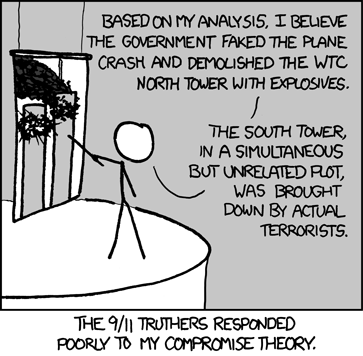
Neither Duck nor Non-Duck

Yet again, the truth, as it so often does, lies midway between the extremes.


Via xkcd; h/t Rust Never Sleeps

Monday, January 18, 2010

Growth

See, the economists believe we will have perpetual growth of something or other called wealth. If environmental impact is proportional to wealth or "gross product" or such in economic growth scenarios, the extinctions don't stop. Basically it goes on until it's down to us, our farm animals, our pets, and our pests.

But oh joy, we will be even wealthier than now in our further diminished world!

Whatever that means.

I think maybe it means everybody has a 600,000 square foot mansion with robot servants. We will be living on synthetic paste because the farmland will all be covered with big houses and big roads for our 98 ton cars. But what houses! What cars! We will all be the envy of our neighbors! We will all be members of exclusive clubs!

Maybe someday in the very distant future we will be rich enough to try to reconstruct our natural environment from whatever has been salvaged in arboretums and zoos! We will finally be able to afford the trees and flowers and birds and beasts that are now such an absurd and unconscionable extravagance, because they interfere with our accumulation of wealth.

Sunday, January 17, 2010

My negative fifteenth birthday

September 1, 1939 - W H Auden

I and the public know
What all schoolchildren learn,
Those to whom evil is done
Do evil in return.

...

All I have is a voice
To undo the folded lie,
The romantic lie in the brain
Of the sensual man-in-the-street
And the lie of Authority
Whose buildings grope the sky:
There is no such thing as the State
And no one exists alone;
Hunger allows no choice
To the citizen or the police;
We must love one another or die.

Defenseless under the night
Our world in stupor lies;
Yet, dotted everywhere,
Ironic points of light
Flash out wherever the Just
Exchange their messages:
May I, composed like them
Of Eros and of dust,
Beleaguered by the same
Negation and despair,
Show an affirming flame.

Friday, January 15, 2010

Luciagate

Lucia Liljegren gets to be my next "gate".

She's been missing my point about the two devils, summarizes my position as "The Other Side is THE DEVIL!" and has come up with the following clever bit of repartee.

Why is the other side of the debates I’m on always so hypocritical? They always jump on what my side says, and yet they willfully ignore all the faults on their own side. Let’s be honest about the double standard: The other side gets away with stuff that my side would never get away with. It’s just like the other side to be so deceitful: They’re always looking to score any advantage they can. People like that drive me crazy, and it seems like most of the people on the other side are just like that.

(Source: The Internet)

Real Source: Orin Kerr

Get it? This side? That side? It applies to all sides!

Well, if you follow the link you see the serious answer to this snark, which is "it depends"

Ken Arromdee says:

I’m going to defy Internet convention and respond to this in complete seriousness.

Remember back in the Cold War era, when the left liked to use moral equivalence between the US and the Soviets? For that matter, there are certain areas of politics now where they still do the same thing. And there are right-wing groups that do it too.

Sometimes both sides say the other side is acting unfairly, and one of them is right and the other isn’t. The solution is not some sort of moral equivalence which says “well, both sides rag on the other. I bet they’re both just biased.” The solution is to figure out which one. It may be hard, but nobody ever said politics is easy.

Creationists say scientists are lying or deluded. Scientists say the same about creationists. But the truth isn’t symmetrical–both sides say similar-sounding things about the other side, but they’re not equally right. The creationists, and only the creationists, are being deceitful and spouting nonsense–and you’d do scientists a great disservice by saying “oh, it’s just both sides using the same rhetoric about each other” when similar words don’t imply similar levels of truth.

And of course creation is just a particularly obvious example. It happens plenty of times in politics. It may be harder to tell which side is right than it is with the creationists, but that doesn’t mean that there can’t be a right side and a wrong side, no matter how similar the two sides seem to sound.

Indeed, the non-sensible side usually makes some effort at sounding sensible (though apparently in the Palin era this is less necessary), precisely to make the choice more difficult.

Let me say again, I think the number of ill-intentioned people among the opposition is probably quite small, and presuming ill intent on the part of any specific opponent is a bad idea.

On the other hand, to look at the situation, and see how many accusations are flying about, suffices to prove that there are bad guys at work, though it doesn't suffice to prove which side they prefer and to what degree of unanimity. When accusations of gross malfeasance exist, either the accuser or the accused or perhaps both pretty much have to be in the wrong, i.e., unethical. Judgment must be applied to find out which is which, but the presence of a malign influence is already pretty much guaranteed.

I think, though, that Lucia has missed the point quite thoroughly.

The point isn't that there are some actual bad guys among the various fools and egotists who plague us, though I have no doubt that there are some. The point is that scientific opposition and legal/political opposition are based on very different views of ethical behavior. When a scientific mind encounters a scientific mind on the opposite side of a question, if all is going well the exchange of ideas can be beneficial for both parties, because whatever opposing goals the parties may have are (at least ideally) subordinate to their shared goal of discovering the truth. This ideal may usually be honored in the breach, of course, but both scientists operate in a larger context where discovery of the truth (at least ideally) is the institutional goal of all participants.

That these ideals are under stress is not something I would contest, but let's agree at least that this is the ideal. Wiener refers to nature as the opponent of the honest scientist as a "devil" in the Augustinean sense; an evil of incompleteness, not of competitive agency.

In legal and political circumstances, the opposition really is not just seeking the triumph of their ideas, they are seeking the triumph of their ideas irrespective of truth. That is, winning the battle is what counts; the actual validity of their position is secondary and the prospect of shifting sides under the weight of evidence is nil.

This sort of opposition is a Manichean "devil" in Wiener's taxonomy. It does not even have to be malign, really. It just has to be implacably in opposition regardless of evidence.

The trouble arises when the Manichean worldview addresses matters that are ordinarily discussed on Augustinean turf. Many of the Manichean techniques are of absolutely no use to the Augustinean scientist, who is thus ill-versed in them. In short, implacable opposition breaks science.

Debating techniques are brought into territory where they are inappropriate, and confusion reigns. This confusion is quite perfectly captured in an analogy by the contest between the Augustinean scientist #1 and the Manichean pseudoscientist #2, in the presence of a journalist and something that we shall, for purposes of argument, take to be a duck.

Responding to the superficial aspects of the argument ("heh-heh-heh - he said 'devil' heh-heh") is Manichean itself, and I seem to get shallowly misinterpreted every time I try to refer to ethics around these parts. So listen carefully, low-sensitivity types (and by that I may or may not refer to the insensitivity of your belief structures) I do not say you specifically are evil. I say the configuration of the debate is the consequence of the injection of an inappropriate ethical context. If we approach matters collaboratively we may yet get somewhere, but if we approach matters with merely a veneer of politesse and actually act like opposing litigants in a courtroom, we're abandoning the principles that make science work.

Update: Please remember, as Deech56 points out in the comments, that in the courtroom of science-related fact, Nature is the judge, and I don't mean the journal.

PS, more tree lobsters h/t Hank Roberts

Wednesday, January 13, 2010

OK Getting Serious Again

Let's think about the nature of evil in the context of science some more.

Specifically, an Augustinean perfectability impulse confronted by a malicious, anti-progressive Manichean enemy, an active agent which wants to replace the best available understanding with something less: Lysenkoists, creationists, climate change denialists. What does it look like when they succeed?

It depends. In a totalitarian state, of course, the official doctrine dominates the scientific one wherever they diverge. We saw this in the Nazi discounting of Einstein's work and in the Stalinist's corruption of evolutionary theory with Lysenkoism.

In a democracy, the goals of malicious pseudo-science are different. The sowing of doubt about important results that people are otherwise already predisposed to disbelieve is the goal. In that case, the objective is not to replace science, but simply to present an appearance of a scientific alternative.

Let's revisit the graphic I came up with, illustrating some aspects of the state of debate in climate science, and see if we can spot the stigmata of malice. Here we are factoring out policy ("business as usual", meaning the only constraints on carbon use are supply and demand, and that therefore fossil fuels will remain in use for a long time) and simplifying impact to a qualitative measure of good, indifferent, and various stripes of bad.

The curve is a probability density; the population is "informed opinion", by which we mean something like "people with Ph.D.'s who have spent more than 6 months full time equivalent on the subject", so the vertical axis is reasonably well defined. I admit that the horizontal axis is mathematically problematic; you can't call it a linear scale but it's obviously not logarithmic either. So the graphic can only be qualitiative in nature.

My original scanned sketch is here; a more presentable version has kindly been put together by Stephen Ban, a graduate student at James Cook University in Australia and a new sustainabilty science blogger. (Welcome to the fray, Stephen!) Here is Stephen's much improved rendition:


(As always on Blogger, you can click the image for a cleaner view of it.)

Now the image is purely a schematic. It isn't social science, and though I imagine it could be put to the test in a formal study it might be difficult to refine the design enough to really identify the two populations. In short this isn't a formal claim, it is a schematic. Still I think it captures something of how the situation is structured and at least part of why the public's position is so extremely out of tune with that of the expert community.

So what does this two hump structure mean? If there were no malice involved, a two-humped opinion spectrum would mean there is an alternative theory, either ascendant or in decline, to the mainstream. There would be, in such a case, no consensus. But in the present case, we discover to our astonishment that the much broader mainstream hump has a much more coherent set of beliefs about how the system works. It is the narrower, smaller hump thaty contains a vast plethora of competing hypotheses. That is to say, the smaller hump doesn;t represent a position, but simply the union of a very large array of positions agreed on only one thing.

"Not the IPCC. Very not the IPCC."

By creating this debate they keep the increasingly shallow and lazy press occupied whenever they wander onto this turf, which is rarely enough. Consequently, the real risk spectrum remains invisible to the public.

This article isn't the place to discuss all the debating tricks and so on used to prop up the left hump and its prominence in the public debate. What I propose to say here is that when you actually look at this, it become too much to attribute the peculiar hump to pure chance acting on people acting in good faith. This sort of evil requires some sort of agency, if only an implicit and half-conscious conspiracy.

Steve Easterbrook is a very nice man, and he has tried to convince me that there need be no malice whatsoever involved. And I;m sure we can find other scientific questions where the relevant population is clustered rather than continuous. The trouble is that it works out all too conveniently. If it were merely denial, it wouldn;t have well-funded conferences.

This is not to say that everyone or even most of the people in the left hump have malign intent (and pleasant social skills, as often they do). Very few conscious agents are required given that the truths of the right hump are indeed somewhat inconvenient. I just question whether the left hump could exist in the absence of evil.

The trouble is the masquerade. By approaching as reasonable colleagues, the bad guys appeal to our fundamental strength/weakness. Our interest in challenging ourselves in pursuit of truth is wasted on people whose challenge is not dedicated to us but to the peanut gallery; whose acceptance of our challenges is likewise. We find ourselves wasting enormous amounts of time on pretend science.

This leaves us with two very big questions.

How can we protect science from this sort of attack? That is a very big question indeed, but it is trivial compared to the second one.

How can we protect society from this sort of scientific charade? That's the gigantic, crucial one. Without reliable communication channels between science and society, any modern society has a very poor prognosis.


Update/Clarification:

One key message in this oft-misinterpreted article is that the vast majority of professional opinion concurs with the highly coherent conceptual framework presented by IPCC WGI, even though that represents a wide spectrum of impact assessment.

The bulk of the opposition is concentrated in a narrow spectrum of impact assessment (specifically, so near zero for CO2 emissions as to require no policy change), but they lack a coherent conceptual framework and tend to just snipe from various angles.

Therefore it is legitimate to conclude that a consensus exists, not on impacts, but on the underlying physical phenomenology. It is to this physics-based understanding with which the thirteen leading national academies, the AAAS, the AGU, the American Meteorological Society, the APS, the ACS, the EGU, etc. etc. have expressed concurrence.

If that’s not a consensus then I am pretty baffled as to what is.

Fuller Wit

I don't really want to follow Tom Fuller's writing, especially since the Examiner don't allow URLs in the comments, but when someone takes you on directly I guess you need to respond.

Fuller:
Bart, I don't like your friends. Not Michael Tobis, not Eli Rabett. I am happy to engage with people who disagree with me and I stuck around while they were insulting me. But Bart, I don't know if you realise it, they were attacking Roger Pielke Sr. only because they knew I have expressed my appreciation for him in the past. They don't have the stones to confront Pielke directly, so they threw it in to hide the fact that they have relatively little to say to me. After all, Tobis said our opinions of climate change are very similar. The disagreement is about policy--which he says he doesn't want to discuss. It's not that he doesn't have a policy--he just feels no need to discuss it.
Sheesh.

" I am happy to engage with people who disagree with me and I stuck around while they were insulting me."

but didn't actually engage on any substantive points whatsoever before running away. Ducking out, so to speak.

"But Bart, I don't know if you realise it, they were attacking Roger Pielke Sr. only because they knew I have expressed my appreciation for him in the past."

Oh please. You really don't figure that prominently in my thinking, Tom.

" They don't have the stones to confront Pielke directly,"

Uh, wrong.

"After all, Tobis said our opinions of climate change are very similar. The disagreement is about policy--which he says he doesn't want to discuss"

It's your reading comprehension problem, Tom, that is exactly what disturbs me about you.

As regards policy, he and I are more or less in agreement: solving poverty cannot be separated from global energy policy, and poverty must be solved.

The problem comes when Tom takes on science.
Now isn't that exactly the opposite of what Tom says I said?

The point of this blog is to increase the science and engineering content of the public conversation. I really don't care about cap and trade vs carbon taxes; I started to get into it but then backed off.

It's obviously important, but for me it is premature to discuss details of policy all that much. Most people still don't understand what is going on; thus any policy that has any real effect is likely to be reversed. It is an absolutely crucial part of the problem to stem the tide of bullshit and get real information to the public.

Tom Fuller is among the people lacking much clue about science, but who is happy to write about it and to try to attract an audience. This is irresponsible, especially because he does not appear to be learning anything, and has not offered to explain how he chooses whom to trust.

Tom Fuller is part of the problem.

I have advised him to write about stuff he is better equipped to write about. He thinks this is insulting but it's intended as honest and thoughtful and even kind advice. Perhaps with reading skills like he displays he ought not to be writing at all.

Nevertheless Fuller is working on a "climategate" book with CA denizen Steve Mosher. Won't that be ever-so-helpful? Maybe they will finally tell us what we ought to be so upset about.

Pro-Nuclear Petition

Via Rod Adams at the Energy Collective, news of a multi-signatory open letter to John Holdren in support of renewed American development and deployment of nuclear power. The signatory list is peculiar, including a couple of high school students for some reason, and most of these people aren't on our turf so I hope I can be forgiven for not recognizing them.

That said, Barry Brook and Jim Hansen are in fact on there.

I'm more concerned with public understanding than with public policy, but on this point I've had little doubt for a long time. People sometimes assume that people who take climate change seriously are "green activists". Well maybe some are, but some are just weighing options.
Our nation needs to proceed quickly — not twenty or fifty years from now — while the people who pioneered this science and engineering can still provide guidance to a new generation of scientists and engineers. There is no political, economic or technical justification for delaying the benefits that nuclear power will bring to the United States, while the rest of the world forges ahead.
Nobody asked me to sign. On considering it, while sympathetic I think I'd have stopped short of signing it.

I think we need to work the numbers. Is nuclear necessary?

Well, something that actually involves engineers and managers and huge infrastructure is necessary. Wishful thinking is something we have plenty of. Serious technical plans are not. Is there any way forward through the next 200 years that is nonnuclear and not actually disastrous?

Given the choice between nuclear and catastrophic I will pick nuclear without hesitation.

Tuesday, January 12, 2010

The "Travesty" Travesty

Trenberth has a nice little article about his "travesty" comment and how it is being abused.
from one of my e-mails that was illegally stolen: "The fact is that we can't account for the lack of warming at the moment and it is a travesty that we can't."... The quote refers to our observation system which is inadequate to observe Earth's energy flows at the accuracy needed to understand small fluctuations in climate; it does not mean there is no global warming, as is often interpreted by the likes of Danaher. What is does mean is that our observing system is not adequate to fully track the energy in ways that allow us to understand and make best statements about the effects of natural climate variability
The reader comments are woefully awful though. I think this is an occasion where it might be worth pitching in. Please don't let this garbage go unanswered! Do us all a favor. Just answer one comment, calmly and completely, with reference to evidence.

Every reasonably polite, reasonably well-informed comment in a situation like this is worth a hundred low-energy lightbulbs!

Monday, January 11, 2010

Fullergate


Tom Fuller writes:

"Now, did you want to talk about the foundations of my criticism of some of the science and scientists recently involved in climate research? Because I'll guarantee you the foundations are stronger than your critcisms of me."

I reply:

Sure! Why not? I like that game. Let's play.

My criticism of Tom's position is that he tries to portray himself as the reasonable one and paint his opponents as arrogant, when in fact us opponents are only trying to call a duck a duck. There is nothing arrogant about that. It's just the nature of the beast. But we are, to be sure, getting a little exasperated about the whole business. How would you feel? Tom almost compulsively takes the journalist's middle ground.

His statement of position, actually, has much to recommend it.

But I see it as a threat that must be dealt with in the same context as many other threats to our continued development. I believe our first responsibility is to the poor of this world, and that brings an immediate conflict between our responsiblity to them and to remediation of global warming. The most important thing the poor need is access to cheap energy, which will serve to worsen CO2 emissions. But I have to say their need is so pressing that we should address it first.
Remarkably, this is pretty much the eco-equity point of view. As regards policy, he and I are more or less in agreement: solving poverty cannot be separated from global energy policy, and poverty must be solved.


The problem comes when Tom takes on science:

I believe the first theory of global warming--that a doubling of concentrations of CO2 in the atmosphere will lead to a slight warming of the planet's mean temperatures--but not the second--that this will trigger positive feedback through the untrammeled growth of water vapor leading to much more drastic temperature rises.
Now where the heck does he get that from? OK, kids, be polite.

He pulled it out of his, um, hat. Right. Hat.

On what basis is he claiming to know anything about water vapor feedback? None whatsoever. It is a "belief".

Proposing that matters of fact are decided by intuition or faith is a very very very bad idea. This way of "thinking" separates the reading public from science. It becomes some magical thing that Matt Damon is born with and probably you aren't. It is described as having nothing to do with evidence. It's a very poor start to a discussion based on facts, to get the facts wrong and not provide a hint of a trail as to where the opinion came from.