"Our greatest responsibility is to be good ancestors."

-Jonas Salk
Showing posts with label climate change. Show all posts

Saturday, April 3, 2010

Climate Disruption


Simon Donner takes on the great "climate change" vs. "global warming" debate. He argues, albeit somewhat tentatively, for capitulation; we should call a thing what everybody else calls the thing:
Rights and wrongs of the different labels aside, the fact is that there is a disconnect here. We use a term that means less to people. And it puts scientists and others communicating the real scientific consensus at a disadvantage. Do a Google search for "global warming" and "climate change". With "global warming", the term the public is more likely to use, a "skeptical" site comes up second [note: search is done from Canada, others may find different results].
Let me take the opportunity to remind everybody that I'm on record taking the opposite position in my RealClimate article "Imprecision of the Phrase 'Global Warming'"

The problem in capitulating to the common usage is that the common usage is woefully imprecise. As I said in that article:
If someone asks me in my capacity as a climate scientist whether I “believe in “global warming”, they are not asking the question in a literal sense. They are asking “what am I to make of this confusing topic called “global warming”?

In the end they are usually asking some combination of questions like 1) whether greenhouse gases are accumulating? 2) whether the greenhouse effect is established science? 3) whether global warming has been observed? 4) whether future climate change is expected to be big enough to worry about? 5) whether cooling at a single location falsifies the “theory”? 6) whether to expect super-hurricanes? 7) whether the Gulf Stream will shut down instantly glaciating Scandinavia and Britain? 8 ) how you can model climate when you can’t predict weather? etc. Often they will bounce incoherently from one to another of these sorts of exasperatingly-missing-the-point sorts of question.

Once in a while someone will have more sophisticated questions like 1) what’s the magnitude of the anthropogenic forcing compared to natural forcings? 2) what’s the lag time in the system response? 3) what is the magnitude of the most disruptive plausible scenarios? 4) what’s the likelihood of the discontinuous shifts in system regime? etc., When I hear people asking the right questions it makes my day, but it’s pretty rare.

What people outside the field universally don’t mean by “global warming” though, is “a tendency for the global mean surface temperature to increase”!
The first trouble in talking about "global warming" is that when you do, you are already in an area where communication is problematic. And shifting goalposts is a key tactic of obfuscators everywhere. "Nothing could be better than early retirement on Maui, and a peanut butter sandwich is better than nothing, so a peanut butter sandwich is better than early retirement on Maui." That sort of thing is their stock in trade. By starting the conversation with an ambiguity, you leave yourself open to all manner of trickery.

Since I wrote that piece, a whole new set of problems has arisen with "global warming", in that the global mean surface temperature has become an unhealthy obsession of the crowd that calls themselves "lukewarmists", i.e., the McIntyreans. Pretty much the only thing they care about is the observational and proxy record of global mean surface temperature. If "global warming" is the theory, and the observational record (mostly unforced) is ambiguous, well then, we can all go home and do business as usual, can't we?

The bizarre fascination with Mann and Jones, the obsession with every little bounce up and down of the satellite record, all of this turns climate policy into a sport, where the amateur critics of science "root for" downturns in the curve and we find ourselves idiotically hoping for equally meaningless upticks. The actual implications of accumulating greenhouse gases are utterly lost in the shuffle.

The issue, of course, is completely miscast. The global mean surface temperature (or if you insist on hair-splitting, the fourth root of the mean of the fourth power of temperature, which is the arguable alternative and which behaves very similarly) is an interesting and useful diagnostic, especially in the study of paleoclimate. But it isn't what we are worried about.

The global mean temperature does not cause impacts.

Local shifts in climate cause impacts. Changes in the radiative balance cause changes in circulation which cause changes in local climate. Human activity causes changes in radiative balance. Carbon dioxide is the biggest and most difficult but by no means the only component of human forcing of radiative balance. The local changes we are seeing are roughly as expected, and are already meaningful and are accelerating. Errors in our understanding are unlikely to be benign. Those are the salient facts.

Obsession with global mean temperature is a debating trick of the opposition. The fact that people are searching on "global warming" means we have to use it as a tag. But we shouldn't use it to mean what the people searching on the term mean by it, because the very use of the term is generally a sign of confusion.

"Global warming" means an increase in the mean surface temperature of a globe. That's all. It applies to any physical spherical object, typically a planet or a large moon. It applies on many time scales. It isn't itself a problem, and doesn't itself require a response. On the time scale of human forcing, it is an expected symptom of anthropogenic climate change.

Some go with "climate chaos" which has two problems: 1) it prejudges the scope of the problem and 2) it raises nomenclature confusion with a relevant mathematical concept. I think "climate disruption" is a good name for the problem.


Image: Dan Farber, a law professor, who I hope has mercy. It's a great picture.

Tuesday, April 7, 2009

Journalism of Climate Change per Yulsman

Apparently, Tom Yulsman has been on the "climate beat" for quite some time.

Anyway, he has a collection of interesting observations about communicating climate science from various participants. Unfortunately, no compelling position emerges from it. Sometimes I suspect that it is exactly the purpose of conventional journalism, to avoid influencing the reader's position at all.

In this (for all I know unintentional) goal, Yulsman succeeds.

The necessary bow in the direction of RPJr contributes to the obfuscation:
As the politics heat up, he urges journalists not to take sides in what is certain to be a vigorous debate with all kinds of information vying for people’s attention and belief. “Climate policy needs more options, not less,” he argues. “Like it or not, people wanting to go slow or not go at all are part of the political scene.”
Whatever the hell that means.

Yulsman quotes Revkin saying something more or less sensible at first blush:
In his opinion, that clear view of the science is getting “terribly lost in the distillation that comes with saying that there is no more denying it.” His warning: “There is complexity out there, folks, and the things that are clear are only the basics: more CO2 means a warmer world.”
which hardly accounts for his craven habit of giving far too much attention to the people not clear on the basics. As I'm always pointing out, Revkin seems incapable of taking note of the extent to which he perpetuates exactly the problem he is complaining about here.

Schneider, of course, talks sense, though one wonders if there weren't juicier quotes that got left on the cutting room floor:
“Given the risks we’ve identified, how many chances do you want to take with planetary life-support systems, versus how many chances do you want to take with the economy?” Schneider asks. “That’s a value judgment, and that’s the government’s job, the corporation’s job, an individual’s job.”
Out of this muddle, Yulsman only manages to make one cogent summary point, a plaintive plea for more journalism:
Demanding that the case for climate change be proved “beyond a reasonable doubt” is unreasonable and has contributed to the false balance problem. “‘Preponderance of evidence’ is the order of the day in a civil court.… [And] this may be the fairest analogy to apply to policy and science issues such as climate change,” Dykstra recommends.

This is great advice. It’s just too bad that his bosses at CNN are no longer receiving it. They dropped Dykstra and his entire unit at the end of 2008. He believes their ouster leaves broadcast and cable news with no reporters or producers working full time on environmental issues, not to mention science and technology.

This gaping chasm in environmental expertise in television news, along with downsizing at nearly every newspaper and the slackening of online ad revenues that might pay for serious-minded digital journalism, does not bode well for the future of news reporting about climate change.
Dykstra's advice about the burden of proof, though nothing new, is solid. The question here is whether the reporting about climate change will be missed, whether the plea for more of what passes for science journalism should be heeded. As far as I am concerned, not this sort, thanks.

It's certainly true that blogspace as currently configured does not create readily credible sources for the average person investigating a complex topic. Perhaps this can be repaired somehow. Credentials are crucial to preserving the function of reporting on the net. But that doesn't mean that the sort of lukewarm indecision propagated in this article or elsewhere among trained journalists is helping the situation.

There are two questions that come to mind about science journalists:
  • 1) Do journalists know who is lying? If so, why do they give the liars so much prominence? If not, what service do they provide as filters?
  • 2) How do journalists decide correctly which stories are important enough to follow? Climate is not the only sustainability story out there. Where is the press on the rest of them?
It definitely feels, on our end, like earth scientists and biologists against a wall of ignorance, with the press as the guys on top of the wall dropping the burning oil.

It doesn't feel at all like the press is an ally of science conveying legitimate balance on matters that are open and backing up the experts on matters that are settled. And without huge improvements along that front, we are so very hosed. The question of how the public learns about science is a primary survival concern for civilization going forward. More "not taking sides" like this might just kill us all, good and dead.

Update 4/12: Jay Rosen just blogged a very insightful article on the false balance problem. From that article:
he said, she said is not so much a truth-telling strategy as as refuge-seeking behavior that also fits well into production demands. “Taking a pass” on the tougher calls (like who’s blowing more smoke) is economical. It’s seen as risk-reduction, too, because the account declines to explicitly endorse or actively mistrust any claim that is made in the account. Isn’t it safer to report, “Rumsfeld said…,” letting Democrats in Congress howl at him (and report that) than it would be to report, “Rumsfeld said, erroneously…” and try to debunk the claim yourself? The first strategy doesn’t put your own authority at risk, the second does, but for a reason.

We need journalists who understand that reason. And I think many do. But a lot don’t.

Also, and this is crucial:
The newswriting formula that produced it dates from before the Web made all news and reference pages equidistant from the user. He said, she said might have been seen as good enough when it was difficult for others to check what had previously been reported ... but that is simply not the case ... in April, 2009.
Where's Marshall McLuhan when you really need him?
Roman coin showing the two-faced God Janus from livius.org is in the collection of the Kunsthistorisches Museum, Wien.

I thought about including a picture of the old Batman nemesis "Two-Face", but, well, ewww.


Wednesday, March 18, 2009

Climate Change as Security Threat

IGSD / INECE press release:
Climate Change is Such a Serious Threat to National Security that Military Organizations are Now Part of the Solution

Washington, D.C., March 18, 2009 – International climate change policy must take into consideration the effects of climate change on national security and military organizations are part of the solution, said participants at yesterday’s “
Climate Change & Security At Copenhagen” conference in Washington, D.C., hosted by the Institute for Environmental Security and the Global Legislators Organisation for a Balanced Environment (GLOBE-EU), in partnership with the Woodrow Wilson Center for Scholars. Dwindling natural resources is one factor that could fuel conflict and become a threat multiplier. “Climate change is threatening 1,500 miles of glaciers on the Tibetan Plateau that feed the rivers that supply drinking and agriculture water to billions of people in India, Pakistan, and Bangladesh,” said Air Marshal A. K. Singh, (Ret) Former Commander in Chief of Indian Air Force. “Less water from the retreating glaciers could spur serious conflicts between the countries. This is reason enough for military organizations to join with their governments in stopping climate change.”

Conference speakers such as David Sandalow from the Brookings Institute discussed both U.S. and international climate policy with regard to national security, and what it will mean for this December’s climate negotiations in Copenhagen. Other presentations focused on the role of military organizations worldwide in helping reduce the threat of climate change. “Environmental protection is not a new concept to military organizations,” said Stephen O. Andersen, from the U.S. EPA. “When ozone depletion threatened health and prosperity, the U.S. Department of Defense and defense ministries worldwide played an important role in eliminating their own dependence on ozone depleting substances and they shared that alternative technology worldwide. Now, military organizations are taking responsibility for protecting global security by helping eliminate global dependence on fossil fuels and promoting new, sustainable technologies.”

Last week at the Copenhagen Climate Congress, scientists confirmed that climate change is advancing much more quickly than anticipated, as well as tipping points for abrupt climate change events, such as the dieback of the Amazon rainforest and the melting of the Hindu-Kush-Himalaya-Tibetan glaciers and the Greenland Ice Sheet. The resulting sea level rise would produce millions of environmental refugees.

In order to avoid abrupt climate change as well as security threats, world leaders must take immediate action on “fast-action” measures that will buy time for long-term climate strategies. “Unfortunately, the world is already committed to 2.4˚C of warming and recent research has shown that even aggressive reductions in CO2 emissions won’t provide significant cooling for 1,000 years,” said Durwood Zaelke, president of the Institute for Governance & Sustainable Development, who spoke on the topic of abrupt climate change at yesterday’s event. “In light of approaching tipping points and the security implications of passing them, we need to be pursuing a number of mitigation measures that can be implemented now and bring quick reductions in greenhouse gas emissions.”

Zaelke presented two main strategic “levers” to produce fast mitigation. The first is to reduce emissions of black carbon soot and non-CO2 emissions, such as HFCs. With over 20 years of success in phasing out 97 percent of almost 100 ozone-depleting substances and significantly reducing greenhouse gas emissions in the process, the Montreal Protocol ozone treaty could be an effective framework for phasing down HFCs. The second lever is to expand bio-sequestration through forests, agriculture, and biochar (which in addition to sequestering significant amounts of carbon, also improves soil fertility for increased agricultural productivity). Some scientists have noted that bio-sequestration appears to be the only current way to draw down CO2 concentrations to a safe level of 350ppm. These strategies could be included under the new climate agreement.

Tom Spencer, Vice Chairman of the Institute for Environmental Security, stated that “the defence ministers of the world are expanding their superior threat assessment tools to analyze the threats climate change poses to national security. The military have a major ecological footprint…perhaps we should call it a ‘bootprint.’” Mr. Spencer added that “the defence community needs to join the climate battle in full force during the climate negotiations at Copenhagen in December.”

For more information, please contact:

Ms. Alex Viets
Communications Officer, IGSD

Thursday, October 2, 2008

Asking the Right Questions

From Herman Daly's keynote to the AMS workshop on Federal Climate Policy:
However, it is useful to back up a bit and remember an observation by physicist John Wheeler, “We make the world by the questions we ask”. What are the questions asked by the climate models, and what kind of world are they making, and what other questions might we ask that would make other worlds? Could we ask other questions that would make a more tractable world for policy?

The climate models ask whether CO2 emissions will lead to atmospheric concentrations of 450-500 parts per million, and will that raise temperatures by 2 or 3 degrees Celsius, by a certain date, and what will be the likely physical consequences in climate and geography, and in what sequence, and according to what probability distributions, and what will be the damages inflicted by such changes, as well as the costs of abating them, and what are the ratios of the present values of the damage costs compared to abatement expenditures at various discount rates, and which discount rate should we use, and how likely is it that new information learned while we are constructing the model, will invalidate the results? What kind of world is created by such questions? Perhaps a world of such enormous uncertainty and complexity as to paralyze policy. Scientists will disagree on the answers to every one of these empirical questions.

Could we ask a different question that creates a different world? Why not ask, Can we systematically continue to emit increasing amounts of CO2 and other greenhouse gasses into the atmosphere without eventually provoking unacceptable climate changes? Scientists will overwhelmingly agree that the answer is no.

...

To make the point more simply, if you jump out of an airplane you need a crude parachute more than an accurate altimeter.


Go. Read it. He's just getting warmed up.

Update: Thingsbreak points out that you can read the same text with less strain on your eyes and your mouse hand at Grist.


Friday, August 15, 2008

Antarctica


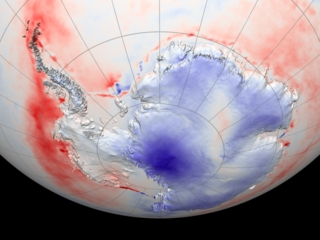
This peculiar figure is still up at a NASA site. The cooling rates are monstrously high (per annum!) and the boundary between land and sea is too sharp and there is altogether a misleading amount of detail. I seem to recall William Connolley warning me that this map was broken. But there it sits.

Meanwhile Robert Rohde's wonderful GlobalWarmingArt site finds the evidence equivocal:


Here the rates are per decade, and while still large, are not stunningly large. The time series are longer and hence perhaps less noisy, and the trends are far less uniform. (And as usual, Robert has made a visually beautiful image. Quite a few of those many hits to this site have been people coming by to admire my closeup of one of his sea level rise maps.)

Anyway, the NASA site with the peculiarly shaded map has a link to:
Comiso, J. C., Variability and trends in the Antarctic surface temperatures from in situ and satellite infrared measurements, J. Climate, 13(10), 1674-1696, 2000; Kwok, R, and J.C. Comiso, Spatial patterns of variability in Antarctic surface temperature: Connections to the Southern Hemisphere Annular Mode and the Southern Oscillation, Geophys. Res. Lett., 29(14), 10.1029/2002GL015415, 2002;
And therein we find this:


Although the NASA web page references the article, and while it has some obvious features in common, this figure doesn't perfectly match their fancy shaded map (check the area by the Ross Sea). That said it does show relatively steep gradients at the shore, and very high rates of change. Notice that the warming signal in the surrounding seas is far more pronounced than the cooling in the interior. Notice especially the intense warming near the Amundsen embayment, (a bit west of South America) which is spectacularly not where you want it.

So what's going on?

Wikipedia (and thereby, William, no doubt) refers us to
Thompson and Solomon 2002, Interpretation of Recent Southern Hemisphere Climate Change, Science, v 296 pp 895 ff.
They in turn make a strong case for a correlation of cold Antarctic interiors and a tightening of the "SAM", which is the anomalously strong phase of the Antarctic polar vortex, a mode which appears to be increasing, and which can be dynamically attributed to a sharp decline in ozone over the period record. Ozone, of course, heats the stratosphere, so its decline will lead to anomalously cold temperatures. Then you need to invoke the thermal wind law and (hmm skipping a few steps) voila! a tightened Antarctic vortex, and tightened temperature gradients around the Antarctic rim.

Of course for every person worried about the retreat of Arctic sea ice there is somebody willing to celebrate the advance of Antarctic ice. The map shows that ice is advancing through the relatively limited areas of cooler water, but that doesn't do much to separate cause and effect. Any ideas out there?

Anyway the short version of the story is at least plausibly argued to be like this. Antarctica seems to be special because of ANOTHER human impact on the global environment. As the ozone depletion subsides, this will be tested, as the anticipated forcings will both be towards warming in the Antarctic interior.

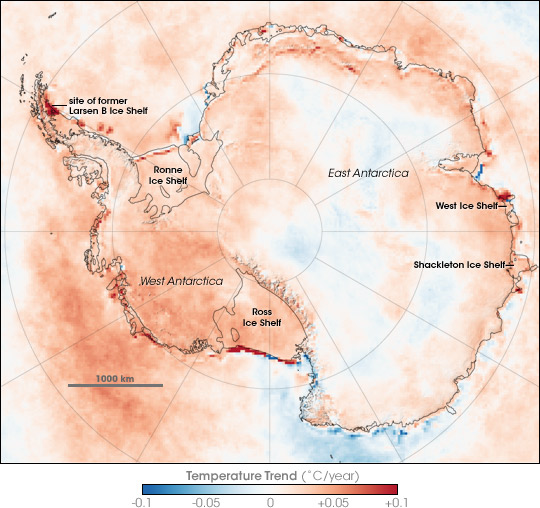
Update: I see Atmoz has taken this on in plenty of detail. The info I wanted from William is there too, along with many comments. And he says the shiny map is "probably the work of a PR droid" and points to this, via NASA, from Wikipedia:


Go figure.

I think there is actually something to complain about here in a McIntyrean way: how are these drastically different results from a single agency supposed to be reconciled? I note that the web publication of the later image refers to the earlier one without explaining the dramatic differences.

And while I haven;t heard a cogent explanation for the advancing Antarctic sea ice, I have heard a cogent explanation for interior cooling, along with, now, data that shows it isn't happening...

None of which changes the fact that so far all evidence seems to agree that warm water is being delivered to the structural weak point of the West Antarctic Ice Sheet.


Monday, May 5, 2008

High but Surmountable Cost, Except for Pride

Very interesting rebuttal to the "high cost" arguments I endorsed recently in an article by Adam Stein on Grist.

I don't buy the argument that responding to climate change is "an opportunity" for society at large. An atmosphere sensitive to CO2 is worse than an atmosphere not sensitive to CO2. The "cost" may be exaggerated, but that doesn't make it cost-free or a small matter.

There are also reasons that it is very over-optimistic to set the rate of progress in information technology as achievable in energy technology. Joe Romm explains this repeatedly, e.g., here.

At least one huge cost at this point is pride though. The market libertarians will have a very hard time admitting that climate forcing is at the least an important exception to their principles. They have painted themselves into a corner, and the rest of us are sort of stuck there along with them.

They have recently been doing a really impressive job fooling themselves that the evidence is piling up on their side. They will, eventually, be genuinely surprised when the problem fails to go away. I wonder when the realization will set in. Alas, I am not holding my breath.

Tuesday, April 29, 2008

Skepticism regarding "thermodynamics"

It's time the conspiracy of engineers promoting their "thermodynamics" stopped getting a free ride.

It happens I believe in Phlogiston Theory. But so did all the Nobel winners, not just in physics and chemistry but also economics and peace. Without exception. Also Winston Churchill and Mahatma Gandhi not to mention Babe Ruth and Bobby Orr and Joe Namath...

I understand that the contrary "thermodynamic" theory is motivated by economic self-interest on the part of engineers who want to keep getting money for designing their so-called combustion chambers and engines and such, but their pretense that the science is settled is very far from true. Look. Nobel winners. And hockey players.

They agree with me because I say so. Who are they to argue?


Friday, September 28, 2007

Help from the Tundra

From Bob Park's newsletter:
BALANCE: CLIMATE FEEDBACK MAY NOT BE AS BAD AS THOUGHT.
One of the global warming nightmares is that thawing permafrost might release methane, a potent greenhouse gas. This positive feedback would accelerate warming. A group led by M. Turetsky of Michigan State found that new plant growth in thawing Canadian peat bogs more than offset the release of methane.
I looked for Turetsky's study and found this press release linking to this abstract

Friday, August 17, 2007

Cure Worse Than Disease?

Trenberth and Dai in GRL argue that injection of aerosol into the upper atmosphere reduces the vigor of the hydrological cycle, and thus is not a good compensation for greenhouse gas forcing. Even the abstract is behind the firewall! (That seems a bit counterproductive on any model of scientific publishing.) Here is the abstract:
Effects of Mount Pinatubo volcanic eruption on the hydrological cycle as an analog of geoengineering

Kevin E. Trenberth and Aiguo Dai
National Center for Atmospheric Research, Boulder, Colorado, USA

[1] The problem of global warming arises from the buildup of greenhouse gases such as carbon dioxide from burning of fossil fuels and other human activities that change the composition of the atmosphere and alter outgoing longwave radiation (OLR). One geoengineering solution being proposed is to reduce the incoming sunshine by emulating a volcanic eruption. In between the incoming solar radiation and the OLR is the entire weather and climate system and the hydrological cycle. The precipitation and streamflow records from 1950 to 2004 are examined for the effects of volcanic eruptions from El Chichón in March 1982 and Pinatubo in June 1991, taking into account changes from El Niño-Southern Oscillation. Following the eruption of Mount Pinatubo in June 1991 there was a substantial decrease in precipitation over land and a record decrease in runoff and river discharge into the ocean from October 1991–September 1992. The results suggest that major adverse effects, including drought, could arise from geoengineering solutions.

Received 27 April 2007; revised 4 June 2007; accepted 26 June 2007; published 1 August 2007.

Keywords: Pinatubo, hydrological cycle, geoengineering.
Greenhouse forcing enhances the hydrological cycle, but in general not enough to compensate for evaporation, leading to much headscratching among the general public about how increased flooding and increased drought could both be valid predictions.

I think their overall conclusion, that we should not rely on geoengineering to extract us from our predicament, is true enough for another reason I have rarely seen cited; if we don't have the political structures to limit climate disruptions it is hard to see how the decisions to control any geoengineering effort can be put in place.

This isn't to say that T & D are wrong, of course.

If they are right it raises some interesting questions, in the context of this summer of astonishing flooding here in Texas and neighboring states, in the UK, in China, in Korea. To what extent do existing anthropogenic aerosol emissions already suppress the otherwise anthropogenically enhanced hydrological cycle?

Friday, August 10, 2007

Sea Ice Retreat Called 'Incredible'

Most regular readers will have already noted RealClimate's coverage of this year's record Arctic sea ice retreat. Let me also point out that it has made the New York Times, with the headline "Analysts See ‘Simply Incredible’ Shrinking of Floating Ice in the Arctic".

Also, Fergus has some interesting discussion and fascinating links.

Thursday, August 9, 2007

5 Meter Sea Level Rise Precedent

The latest IPCC report notoriously appears to reduce the predicted sea level rise. The caveats to this reduction do not appear in the summary for policymakers. The middle of the road climatologists' position is expressed in some detail by Stefan Rahmstorf on what I take to be one of the most important postings to appear on Realclimate. Here's the upshot:

The main conclusion of this analysis is that sea level uncertainty is not smaller now than it was at the time of the TAR, and that quoting the 18-59 cm range of sea level rise, as many media articles have done, is not telling the full story. 59 cm is unfortunately not the “worst case”. It does not include the full ice sheet uncertainty, which could add 20 cm or even more. It does not cover the full “likely” temperature range given in the AR4 (up to 6.4 ºC) – correcting for that could again roughly add 20 15 cm. It does not account for the fact that past sea level rise is underestimated by the models for reasons that are unclear. Considering these issues, a sea level rise exceeding one metre can in my view by no means ruled out. In a completely different analysis, based only on a simple correlation of observed sea level rise and temperature, I came to a similar conclusion. As stated in that paper, my point here is not that I predict that sea level rise will be higher than IPCC suggests, or that the IPCC estimates for sea level are wrong in any way. My point is that in terms of a risk assessment, the uncertainty range that one needs to consider is in my view substantially larger than 18-59 cm.


This is because of new results in ice sheet dynamics, which considerably increases the risk of rapid ice sheet contribution to sea level. A recent symposium here in Austin officially came to a similar conclusion. Unofficially, some of the participants have expressed the opinion that a there is a significant chance that the meeting's consensus report underephasized the risks. Here, the money quote is:

Our understanding of ice-sheet flow suggests the possibility that too much melting beneath ice shelves will lead to “runaway” thinning of the grounded ice sheet. Current understanding is too limited to know whether, when, or how rapidly this might happen, but discussions at the meeting included the possibility of several feet of sea-level rise over a few centuries from changes in this region.


(This report is Antacrtic-centered and does not address potential rapid sea level rise contributions from Greenland, which would have other mechanisms.)

On the other hand, we have a recent quote from no less than James Hansen, stating that he finds the concept of sea level rise this century not "measured in meters" "almost inconceivable". Hansen also claims that climate scientists systematically understate risks, for pretty much the same reason that the denialists claim that we systematically overstate risks, i.e., social, political and financial pressures.

So, practically, say if we are a petrochemical concern with billions of dollars invested near sea level, how should we consider these risks?

First of all, there is a precedent for sea level rise much faster than a meter per century in periods of global warming. In fact there are two of them clearly represented in coral records. These can only be associated with rapid decay of either the northern or the southern ice sheets; too much water is involved to attribute the rise to any other source.

Here is some evidence regarding the earlier pulse. It may help you to understand the graph to know that geologists tend to run the time axis backwards. Time is thousands of years ago on the horizontal axis, the vertical axis shows depth below contemporary sea level in meters. Each data point is obtained from some mud with evidence of when it supported mangroves; i.e.; was near sea level. Note that the fastest sea level rise is not resolved.


Rapid Flooding of the Sunda Shelf: A Late-Glacial Sea-Level Record

Till Hanebuth, Karl Stattegger, Pieter M. Grootes; Science V 288 pp 1033 ff (May 2000)

The increase in sea level from the last glacial maximum has been derived from a siliciclastic system on the tectonically stable Sunda Shelf in Southeast Asia. The time from 21 to 14 thousand calendar years before the present has been poorly covered in other records. The record generally confirms sea-level reconstructions from coral reefs. The rise of sea level during meltwater pulse 1A was as much as 16 meters within 300 years (14.6 to 14.3 thousand years ago).


A clever technique has identified the source of the pulse as Antarctic, which causes some headscratching because the forcing of the major glacial retreats is usually described as being in the northern hemisphere. (Sea-Level Fingerprinting as a Direct Test for the Source of Global Meltwater Pulse IA; P. U. Clark,1 J. X. Mitrovica,2* G. A. Milne,3 M. E. Tamisiea, Science V 295 pp 2438 ff, March 2002) Nevertheless, a big chunk of the Antarctic failed first; if I understand correctly its remnant now forms the Ross Ice Shelf.

Meltwater pulse 1a increased sea levels by about 16 meters over 300 years or less; the record is not fine enough to tell. So we have a precedent of at least 5 meters of sea level rise per century; for practical purposes it must have been faster than that at some point.

Let me emphasize the take home point. We do not have any strong limit on how fast significant chunks of Antarctica can fail, neither theoretically nor observationally, but we know it can be at least as fast as 5 meters per century.

There is little doubt that contemporary human behavior is destabilizing both Greenland and the West Antarctic, implying an eventual sea level rise of an additional 15 meters (dominating thermal expansion and minor ice caps). What we don't know is how fast this will happen.

There is a moral question as to whether we should care how fast. Perhaps we have a moral obligation to future generations not to burden them with the consequences of our own profligacy.

I am sure this affects the stockholders of Dow very little in their financial calculations, though. So let's consider how likely it is that Hansen is right. (He does after all have a very good track record, despite what is alleged about him by the lawyers' science camp.)

We are pretty sure that under sustained double-CO2 equivalent conditions both the West Antarctic and Greenland would collapse eventually. The question is only "how soon"?

We simply don't know in detail how or when the ice caps will fail. Ice dynamics turns out to be an amazingly complex process and observations are expensive and relatively few.

Hansen is not a glaciologist, so his intuitions probably should carry less weight than the core professionals. However, I know some of them, and they just aren't taking strong positions at this point.

The physics of the question is a race between the structural integrity and thermodynamic inertia of the ice on the one hand and the warming on the other. I personally find it entirely conceivable that one or the other will win out in the short run (i.e. on policy time scales); from what I can tell this is in line with much expert opinion. Some people are still resisting the idea, while others, or at least Hansen, go out on a limb in the other direction.

In the long run, presuming no dramatic change in human culture, the warming will win. The structural integrity of some major ice sheet component will fail, and sea level will go up by tens of centimeters per decade for a while.

There is good reason to expect two (one per hemisphere) or more very rapid increases. Not tsunami-like, but over a few decades. Recent results have come closer to understanding the physics of ice sheet retreats. They are reasonably expected to be episodic.

There will almost surely be meters of sea level rise in a century if we don't change our ways very soon. What isn't clear is which century. Place your bets, ladies and gentlemen; which cylinder has the bullet?

Note: This article is a follow-up to another recent posting of mine about low-lying Gulf Coast infrastructure which has generated a lot of interest.

Updated: Newly included sea level graphic; some changes to the text moving the substance closer to the included graphic.

Wednesday, August 8, 2007

Global Wierdness Index

The South Asian Monsoon is turning out to be quite exceptional.

I think there should be a global index of how anomalous the global weather is at any given moment. It's not obvious what the right metric would be. Because everything is more or less coupled to everything else, anomalous weather in one place should be accompanied by anomalous weather elsewhere.

It certainly is hard to avoid an intuitive sense that flooding is rampant this (northern hemisphere) summer.

update: An F2 tornado hit Brooklyn NY on the day I wrote the article. Urban tornados are rare and this one caused quite a lot of disruption.

update: A blogger at Wired chimes in.


Texas, however, has at last settled down into the wretchedly and uneventfully hot, humid and sunny pattern I had been warned about...

Thursday, July 26, 2007

Texas Flood

First of all, it's still raining and it looks to be getting worse soon.

The New York Times had an article recently about Ron Paul remarked on the strange confluence of far left and far right opinion. This has coastal folks baffled. It makes perfect sense in the south, though. People who dismiss "flyover country" and come up with stupid theories about what makes rural people tick drive me mad. They should drop their theories and try to get acquainted with the average Kinky Freidman or Ron Paul voter.

I'm on an interesting Texas-based mailing list. I won't identify the list; I'm not sure whether that would be a violation of trust, but I will say that it's interesting how kind and decent their hearts are and how confused their information is. There's some interesting dancing around religion on the list; people are going out of their way not to offend each other and I will stand by that. (While I won't point you to them I have pointed them to here.) This mutual respect is wonderful and remarkable.

The list pretty much begins with a substantive agreement that Something Is Wrong and We Must Do Something About It. While there are substantial and impressive competencies represented I have to say that broad education and scientific insight is distressingly weak. It's hard to imagine how this genuinely decent and courageous demographic can actually work together without making big mistakes.

There is blame aplenty on both sides for the nearly complete failure of the reds and the blues to communicate. I wish the courage and decency of this group could be combined with coastal sophistication. (Instead we have a government that combines coastal cynicism with heartland confusion. Great. Democracy at work.) Anyway I'll try to bring a little blue perspective to the list without being overbearing. It's hard to bite my tongue as much as I ought to.

So back to the point. Those on the list who are willing to treat climate science as authoritative seemed basically relieved when I told them that nothing uphill from San Antonio would be below the sea, ever. This strikes me as very strange; all the coastal counties, along with the enormous petrochemical infrastructure perched upon them, are at risk. The Katrina migration has affected everyone; refugees are scatterred hither and yon through Texas, and yet there is little concern what effect hundreds of times that amount of migration and homelessness might have on our beautiful hill country.

Meanwhile, August approaches. The high pressure cell that is supposed to be established over Texas by mid-June is nowhere to be seen. Rather, there's a persistent low. Rain occurs daily, downpours most days, and huge localized flood events pop up here and there in the hills. The normal high for the time of year is 97 F (36 C). Yesterday we barely hit 80 (27 C). An actual tropical depression approaches and we (and especially neighbors to our south around San Antonio and points south and east of there) may be in for some real trouble.

Statistically, one weird summer can't be called climate change, but the headscratching seen around here is very similar to what you saw in the shirtsleeve-weather Christmases in Chicago that have been popping up lately (including last year's one). Some people are sticking to their "climate change is natural" guns, but nobody except the statisticians suspects for a minute that what we are seeing is a part of normalcy.

I see the statisticians' point but there's a point they are missing. I don't think you can treat the various northern hemisphere anomalies happening this summer as independent events. I go along with the folk wisdom on this one. I don't suspect for a minute that nothing unusual is happening.

Update: The tropical depression fizzled. We are still fine.

Update: Hank Roberts points to a site with an alarming estimate of global flooding trends.

Thursday, July 12, 2007

Reading List about Climate Change (not "global warming")

Another reason to use the expression "climate change" rather than "global warming" is it's a far more fruitful search term. Amazon's hits on "climate change" are dramatically more useful, though Singer and Michaels do turn up. I discovered this in responding to a query this morning from a nonspecialist about what to read after "Inconvenient Truth" to learn more.

Here's my first pass at a response. Suggestions anyone?
If you have the patience, there is no better source than the IPCC itself, especially working group 1. Start with the summary for policymakers.

Somewhat easier reading is Elizabeth Kolbert's book "Field Notes from a Catastrophe".

There are a couple of other excellent pop science books I know of that give a lot of context:

Snowball Earth by Gabrielle Walker

Update: Some good suggestions in the comments. Also here's a nice Amazon list.

Plows, Plagues and Petroleum by Warren Ruddiman

All of the blogs on my blogroll are well-informed, and they span a spectrum of opinion, so that's another place to start.

Wednesday, June 27, 2007

How Do We Know We're Not Wrong?

All sincere doubters ought to consider Naomi Oreskes' excellent overview of the state of knowledge about anthropogenic climate change in specific, and about how we collectively come to know anything about anything in general.

Thanks to Andrew Dessler and Grist for the link.

Friday, June 22, 2007

Rolling Stone Magazine on Climate Change

Rolling Stone is running some climate change stories.

Global Warming: A Real Solution by Robert F Kennedy Jr

Al Gore's Fight Against The Climate Crisis by Eric Bates and Jeff Goodell

Al Gore Speaks: selected audio clips

The Secret Campaign of President Bush's Administration To Deny Global Warming
by Tim Dickinson

Slide Show: Inside the Bush Administration’s Denial Campaign Against Climate Change

I'm not expressing unbounded enthusiasm for all of this but it's all interesting.

Wednesday, June 20, 2007

National Review Gets Real

Can the Wall Street Journal be far behind?

Quark Soup
points out that the libertarian-conservative-republican (US) magazine National Review has a cover article conceding the reality of anthropogenic warming. You have to subscribe to read the article (I intend to read it over coffee at Borders, frankly) but here's the (current as of this posting) link for confirmation.

Update: The web is pretty cool sometimes. Apparently the author has written in with a link to a PDF of the article.

All they tell the nonsubscriber is this:
It is no longer possible, scientifically or politically, to deny that human activities have very likely increased global temperatures; what remains in dispute is the precise magnitude of the human impact. Conservatives should accept this reality — and move on to the question of what we should do about it. This would put us in a much better position to prevent a massive, counterproductive intervention in the U.S. economy.

By Jim Manzi

Tuesday, June 19, 2007

The Worth of an Ice Sheet - Paul Baer

Let me call your attention to an elegant article by Paul Baer which does a better job than I have of calling the Stern Report methodologies into question and arguing for something other than economics to be steering our decisions. I have not heard of Mr Baer before but I look forward to hearing from him again.

Wednesday, June 6, 2007

tropical storms and extreme climate change

Matt Huber and his student Ryan Sriver are onto some interesting ideas about tropical storms to say the least. Following on some ideas of Kerry Emanuel's they are arguing that there are no ifs or buts about it. If their argument, which looks pretty solid to me, is correct, increased tropical cyclone activity is inevitable in a warming scenario. If you have access to the May 31 issue of Nature you can look up the original article.

Matt also points me to this nice summary of the PETM climate crisis of 55 million years ago, including some of the implications of his work, so I thought I'd share.

Schrag doesn't think it's all that complicated

and neither do I, honestly. He is quoted in a news article in Science.
Geochemist Daniel Schrag of Harvard University argues that mandatory carbon caps should have been applied years ago to force energy technology innovations. He doesn't think that it's necessary to have, as Bush proposed, a year and a half of discussion to define emissions goals. "We know what we need to do now," he says.
PS - Like anyone in or around the paleoclimate science community, I have the utmost respect for Dan Schrag.