Tuesday, July 1, 2008
The Lions' Den
I have for some foolish reason been participating in a thread on Climate Audit. OK, I've basically hijacked the thread altogether. Starting with #28. Have a look, and if I post again there this month please shoot me.
Monday, June 30, 2008
Sleight-of-Mind
Andy Revkin has an article up on a public radio site that gives us some insight into what he thinks the problems of his work are and ends up, to me, emphasizing the related but not identical problems that I think are the core issue. This is striking:
You might argue that the endless saber-rattling in the middle east is a direct consequence of this sleight-of-mind.
Revkin offers us a case in point, remarkably mentioning "page 14":
It's time the Times realized that there is no requirement that it have the same number of "pages" every "day", nor that stories length should be related to their importance. The "paper" is no longer made of paper!
Which is why stuff like this:
Finally there's his anecdote about the reporter who got everything wrong. He tries to pass some blame onto the scientist.
Andrew seems to understand the quandary we are in, though he doesn't seem able to convey his understanding to the front page where it belongs, and is tied to an old model of what a newspaper is. Other than that, on the whole he does a good job. If he misquoted me I would call him on it and would expect a first rate clarification.
With the other reporter on the story, I wouldn't call to clarify at all. That reporter would get the clarification wrong too! That such a reporter is assigned to science stories is yet another sign that the editors, like reporters, lawyers, politicians, tink thanks, etc., the whole east coast power enterprise, don't have a clear idea of what planet we live on.
Settling for 300 words on page 14 is not going to help.
Now, however, the nature of environmental news is often profoundly different, making what was always a challenging subject far harder to convey appropriately to readers. By appropriately, I do not just mean accurately. Any stack of carefully checked facts can be accurate but still convey a warped sense of how important or scary or urgent a situation may be. Therein lies an added layer of responsibility—and difficulty—for the reporter.That goes directly to what I think the most cogent criticism of even the most responsible media on global change issues (as often voiced by Jeff Huggins in Dot Earth comments). These stories persistently appear on page 14, behind Pres. Sarkozy's love life or Michigan's manufacturing or California real estate and so on. On thing we are missing in the media is a serious concentration on the serious issues.
You might argue that the endless saber-rattling in the middle east is a direct consequence of this sleight-of-mind.
Revkin offers us a case in point, remarkably mentioning "page 14":
News is almost always something that happened today. A war starts. An earthquake strikes. In contrast, most of the big environmental themes of this century concern phenomena that are complicated, diffuse, and poorly understood. The runoff from parking lots, gas stations, and driveways puts the equivalent of 1.5 Exxon Valdez loads' worth of petroleum products into coastal ecosystems each year, the National Research Council recently found. But try getting a photo of that, or finding a way to make a page-one editor understand its implications.Emphasis added. And then there is this:
Here's how I handled that story, which the science editor pitched for page one, but was trimmed back and ran on A 14 on May 24, 2002 :
“Most oil pollution in North American coastal waters comes not from leaking tankers or oil rigs, but rather from countless oil-streaked streets, sputtering lawn mowers and other dispersed sources on land, and so will be hard to prevent, a panel convened by the National Academy of Sciences says in a new report.
“ The thousands of tiny releases, carried by streams and storm drains to the sea, are estimated to equal an Exxon Valdez spill -- 10.9 million gallons of petroleum -- every eight months, the report says.”
The hardest thing sometimes, is to turn off one's news instinct and insist that a story is not “frontable,” or that it deserves 300 words and not 800. Try it some time. It violates every reportorial instinct, but it's do-able—kind of like training yourself to reach for an apple when you crave a cookie.Indeed.
It's time the Times realized that there is no requirement that it have the same number of "pages" every "day", nor that stories length should be related to their importance. The "paper" is no longer made of paper!
Which is why stuff like this:
Somehow, through the ensuing years I adapted to the rhythm, but also to the reality of its limitations. Particularly on an issue like the environment, I understood why that crutch of “on the one hand” was so popular. There's just no time to do better.doesn't fly. Andrew simply is not acknowledging that the nature of his job has changed. News lasts forever, and should be written as such. I make little distinction between yesterday's story and last month's. If it comes to my attention and I find it interesting, I read it in exactly the same way with the same attention. If it's more than two years old I may be making some mental adjustments.
And there's no space. Science is one of the few realms where reporters essentially have to presume no familiarity at all in the reader's mind with the basics. Just about anyone in America knows the rules of politics, business, or baseball. But a spate of studies of scientific literacy shows just how little most people know about atoms or viruses or the atmosphere.
All that extra explication has to somehow fit into the same amount of space devoted to a story on a primary vote, a stock split, or a shutout. And it doesn't. The shrinking of an environment or other science story competing on a page with national or foreign developments is as predictable as the melting of mountain glaciers in this century.
Finally there's his anecdote about the reporter who got everything wrong. He tries to pass some blame onto the scientist.
I was at a meeting in Irvine, California, on building better bridges between science and the public, and one researcher stood up to recount her personal “horror story” about how a reporter totally misrepresented her statements and got everything wrong. I asked her if she had called the reporter or newspaper to begin a dialogue not only on fixing those errors, but preventing future ones.Despite all the grief I give him, I'd love to meet Andrew some day. But I hope never to meet the reporter in question here. I would never consider getting in touch with someone to whom I had given hours of my time who showed no sign of understanding a word I said. I might contemplate, in a charitable frame of mind, whether I should refrain from trying to get such a reporter fired, or at least assigned to another beat.
She had not. She had never even considered it.
Until the atmosphere has changed to the point where that scientist can make that call, and the reporter respond to it, everyone has a lot of work to do.
Andrew seems to understand the quandary we are in, though he doesn't seem able to convey his understanding to the front page where it belongs, and is tied to an old model of what a newspaper is. Other than that, on the whole he does a good job. If he misquoted me I would call him on it and would expect a first rate clarification.
With the other reporter on the story, I wouldn't call to clarify at all. That reporter would get the clarification wrong too! That such a reporter is assigned to science stories is yet another sign that the editors, like reporters, lawyers, politicians, tink thanks, etc., the whole east coast power enterprise, don't have a clear idea of what planet we live on.
Settling for 300 words on page 14 is not going to help.
Saturday, June 28, 2008
National Academies Get Iota of Press Coverage
The various national science academies of the G8 nations were joined by five others (China, India, Brazil, Mexico, South Africa) in issuing a joint statement calling for urgent action on climate change.
Unlike previous similar statements this did get a smattering of not especially deep press coverage, but it has to be counted as progress.
Here, for instance, is Andy Revkin's article from June 11. Nice work, Andy. Not to be an ingrate or anything, but how about a link to the actual report next time?
Unlike previous similar statements this did get a smattering of not especially deep press coverage, but it has to be counted as progress.
Here, for instance, is Andy Revkin's article from June 11. Nice work, Andy. Not to be an ingrate or anything, but how about a link to the actual report next time?
Friday, June 27, 2008
Hansen's Inflammatory Language
While you are trying to decide what to think or do about James Hansen's recent provocations, especially about fossil energy executives who ought to know better, you should take some time to understand who he is and why he might be quite so pissed off.
Hansen is not by origin the sort of person to become a flaming radical. Hansen is a physics Ph.D. from Iowa of high repute nearing comfortable retirement. I don't know if you know any midwestern PhDs or even any midwesterners nearing retirement, dear reader, never mind both at the same time, but I have had the privilege of meeting a few. (Updated his discipline. Thanks, Andrew.)
While there may always be exceptions, I hope you will concede that these are not the sorts of people who are normally given to such strong language.
It might be worthwhile thinking about what, exactly, the man is quite so peeved about.
Okay? Thanks in advance.
Hansen is not by origin the sort of person to become a flaming radical. Hansen is a physics Ph.D. from Iowa of high repute nearing comfortable retirement. I don't know if you know any midwestern PhDs or even any midwesterners nearing retirement, dear reader, never mind both at the same time, but I have had the privilege of meeting a few. (Updated his discipline. Thanks, Andrew.)
While there may always be exceptions, I hope you will concede that these are not the sorts of people who are normally given to such strong language.
It might be worthwhile thinking about what, exactly, the man is quite so peeved about.
Okay? Thanks in advance.
Thursday, June 26, 2008
What Science Blogs Can Do
Excellent find by Atmoz of an interesting article by Blake Stacey entitled What Science Blogs Can't Do.
Stacey begins as follows;
To inform means telling people:
Stacey begins as follows;
My thesis is that it’s not yet possible to get a science education from reading science blogs, and a major reason for this is because bloggers don’t have the incentive to write the kinds of posts which are necessary. Furthermore, when we think in terms of incentive and motivation, the limitations upon the effects of online science writing become disquietingly clear. The problem, phrased without too much exaggeration, is that science blogs cannot teach science, nor can they change the world.While I found it an engaging read I disagree with the thesis on no less than three major points:
- I do think science blogs are important
- I do think the web will change the nature of scientific education eventually and
- While I agree that we can't educate the public in the scientist's sense of "educate", it's the intended readers' motivations, not the writers' motivations, that present the main issue.
To inform means telling people:
- These are the facts as we understand them
- These are the options as best we can tell.
Tuesday, June 24, 2008
Hansen's 20th Anniversary Speech
 Opening salvo:
My presentation today is exactly 20 years after my 23 June 1988 testimony to Congress, which alerted the public that global warming was underway. There are striking similarities between then and now, but one big difference.
Again a wide gap has developed between what is understood about global warming by the relevant scientific community and what is known by policymakers and the public.
Now, as then, frank assessment of scientific data yields conclusions that are shocking to the body politic. Now, as then, I can assert that these conclusions have a certainty exceeding 99 percent.
The difference is that now we have used up all slack in the schedule for actions needed to defuse the global warming time bomb. The next President and Congress must define a course next year in which the United States exerts leadership commensurate with our responsibility for the present dangerous situation.
Update: The usual noise (sort of like sci.environment about ten years ago) appears on today's discussion of this presentation on Dot Earth. I'm particularly taken by this comment #129:
Guido,
My understanding of economics is quite complete, thank you, as is my understanding of the power of freedom, and the proven consequences of totalitarianism.
What is most disturbing is that AGW’s supporters understanding of economics is so weak, that they don’t recognize government force and intervention when it’s staring them in the face.
The whole underpinning of a carbon-tax, ignoring the whatever scientific basis it may or may not have, is government force. ...
I really appreciate the claim of "complete understanding". It is nice to know that economics is so trivial that a claim of "complete understanding" can be made without supporting evidence.
Unfortunately, all the usual patterns are reinforced in the Dot Earth discussion, and the stalemate continues.
Hansen's point, though, is that we can't afford a stalemate anymore.
Sunday, June 22, 2008
My Little World Revisited
Sometimes I think that I do some good that never gets formally associated with me.
Anyway, I have to wonder whether my essay "My Little World" had some effect on this graphic from a BBC report on the state of the planet that came out a few months later.

Mind you I didn't come up with the facts of the matter, just the way of presenting them. The shrinking planet graphic seems to draw upon that. I'd have liked it better if they explained the analogy a bit and emphasized how very small your planetoid really is getting to be. Still I am glad the Beeb ran this image and I urge you to think about it.
Though I'll confess that the vertical axis on the third graph is perhaps overprecise, the rest of the article should be part of any thinking person's world view too.
Anyway, I have to wonder whether my essay "My Little World" had some effect on this graphic from a BBC report on the state of the planet that came out a few months later.

Mind you I didn't come up with the facts of the matter, just the way of presenting them. The shrinking planet graphic seems to draw upon that. I'd have liked it better if they explained the analogy a bit and emphasized how very small your planetoid really is getting to be. Still I am glad the Beeb ran this image and I urge you to think about it.
Though I'll confess that the vertical axis on the third graph is perhaps overprecise, the rest of the article should be part of any thinking person's world view too.
Saturday, June 21, 2008
Surprised to Agree
Surprisingly, I have found nothing to disagree with in R. Pielke Jr.'s op-ed piece in the Financial Post. Have you?
As you might expect, he doesn't manage to quite come around to the point that the worst-case outcomes deserve more weight, in a cost-benefit risk analysis, than the best-case outcomes.
So while he agrees that uncertainty does not call for inaction, he doesn't go so far as I do, to claim that the less we believe the models, the more vigorously we should act.
That said, he didn't say anything I disagree with, and it appears he has, without crediting James especially, absorbed the impact of the discussion about "consistency with models" correctly. I think that his point about that is sound.
The appropriate moral behavior in this context is only obvious, though, if you think democracy is sound and functional and capable of rationally weighing ideas. In the best of worlds this process is necessarily imperfect. At present, we are faced with organized and funded people who cherry-pick any possible indication that concerns about AGW are overblown.
We can't win. If we react in a balanced way, the public splits the difference and moves to a muddled and inadequate response. If we cherry pick in the other direction, we become "the extremists on the other side".
It is very difficult for a balanced view based on reason to fight an unbalanced view based on polemics, the more so the more nature indicates consequences that don't seem intuitive.
While I may have some objections to what RP Jr doesn't say, surely expecting those blanks filled in, in the FP these days, is wishful thinking. But what he says in the op-ed seems correct.
Friday, June 20, 2008
Sea Ice Update

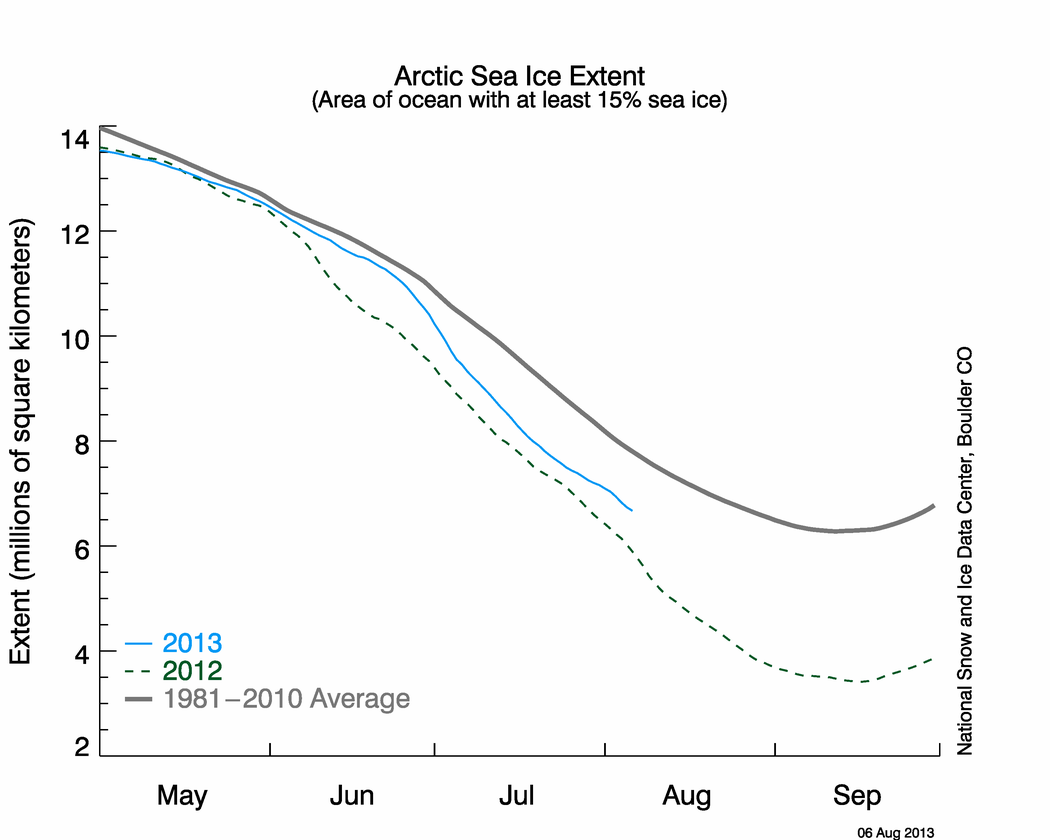
Well, as the sun reaches its azimuth in the north, we find ourselves neck and neck with last year in Arctic ice area and thus ahead of last year in seasonal ice area loss.
The first image is from the graphics guys at UNEP, and shows some of their usual sloppiness. The "79-00 average" must be for the seasonal minima, though this is not made clear. However, the data look right and are obviously spectacular. This should be no surprise to those of you who have been following climate news for over a year.
Now much was made of the fact that the area anomaly bounced right back to the trend line in late fall. The pollyanna camp suggested that it was just a glitch. The cassandra camp contested this, pointing out that young ice and old ice aren't exactly the same substance (yes, they're both water, but the older ice is harder and has fewer structural weaknesses) and that young ice is relatively thin. This camp appeared to me on the whole to be the one with more expertise, though we found William in the more pollyannish camp.
Perhaps my opinion of who had the real chops was deflected a bit by the inevitable crowing of the cherry-pickers' union. The further you are from a topic the harder it is to filter out uninformed opinion, and to be honest I have always avoided sea ice: the math is actually very messy. (It's three kinds of continuum blended together: elastic, viscous and plastic depending on where and when!)
So the time to prove the pudding is approaching.
From the NSIDC along with the graph of current data:
June 3, 2008 - Arctic sea ice still on track for extreme melt
Arctic sea ice extent has declined through the month of May as summer approaches. Daily ice extents in May continued to be below the long-term average and approached the low levels seen at this time last year. As discussed in our last posting, the spring ice cover is thin. One sign of thin and fairly weak ice is the formation of several polynyas in the ice pack.I understand there's some bets outstanding as to whether last year's record minimum will be overturned. This will give us some strong indication of whether the final meltdown of perennial sea ice is imminent or is still decades away as was thought prior to last season.
Showtime.
Thursday, June 19, 2008
Move Left!
 We will all find ourselves moving leftward under the pressure of events.
By "left" I don't mean become more socialist. I mean become more energy efficient. The industries on the right (except for refining) in this graphic are disadvantaged compared to those on the left. The 2002 data means that the bottom scale is off by a factor of what, three?
I am especially struck by the cost of paper production. I suppose we will be moving more toward digital displays. How's that digital ink idea coming along, I wonder?
Larger image, via World Resources Institute, here; a tiny bit of context is found here.
Update: Much more context in the associated report, which is about the potential effect of carbon taxes on the US manufacturing sector, which apparently still accounts for a hair over 10% of all employment.
Subscribe to:
Posts (Atom)

