"Our greatest responsibility is to be good ancestors."

-Jonas Salk

Tuesday, April 7, 2009

Journalism of Climate Change per Yulsman

Apparently, Tom Yulsman has been on the "climate beat" for quite some time.

Anyway, he has a collection of interesting observations about communicating climate science from various participants. Unfortunately, no compelling position emerges from it. Sometimes I suspect that it is exactly the purpose of conventional journalism, to avoid influencing the reader's position at all.

In this (for all I know unintentional) goal, Yulsman succeeds.

The necessary bow in the direction of RPJr contributes to the obfuscation:
As the politics heat up, he urges journalists not to take sides in what is certain to be a vigorous debate with all kinds of information vying for people’s attention and belief. “Climate policy needs more options, not less,” he argues. “Like it or not, people wanting to go slow or not go at all are part of the political scene.”
Whatever the hell that means.

Yulsman quotes Revkin saying something more or less sensible at first blush:
In his opinion, that clear view of the science is getting “terribly lost in the distillation that comes with saying that there is no more denying it.” His warning: “There is complexity out there, folks, and the things that are clear are only the basics: more CO2 means a warmer world.”
which hardly accounts for his craven habit of giving far too much attention to the people not clear on the basics. As I'm always pointing out, Revkin seems incapable of taking note of the extent to which he perpetuates exactly the problem he is complaining about here.

Schneider, of course, talks sense, though one wonders if there weren't juicier quotes that got left on the cutting room floor:
“Given the risks we’ve identified, how many chances do you want to take with planetary life-support systems, versus how many chances do you want to take with the economy?” Schneider asks. “That’s a value judgment, and that’s the government’s job, the corporation’s job, an individual’s job.”
Out of this muddle, Yulsman only manages to make one cogent summary point, a plaintive plea for more journalism:
Demanding that the case for climate change be proved “beyond a reasonable doubt” is unreasonable and has contributed to the false balance problem. “‘Preponderance of evidence’ is the order of the day in a civil court.… [And] this may be the fairest analogy to apply to policy and science issues such as climate change,” Dykstra recommends.

This is great advice. It’s just too bad that his bosses at CNN are no longer receiving it. They dropped Dykstra and his entire unit at the end of 2008. He believes their ouster leaves broadcast and cable news with no reporters or producers working full time on environmental issues, not to mention science and technology.

This gaping chasm in environmental expertise in television news, along with downsizing at nearly every newspaper and the slackening of online ad revenues that might pay for serious-minded digital journalism, does not bode well for the future of news reporting about climate change.
Dykstra's advice about the burden of proof, though nothing new, is solid. The question here is whether the reporting about climate change will be missed, whether the plea for more of what passes for science journalism should be heeded. As far as I am concerned, not this sort, thanks.

It's certainly true that blogspace as currently configured does not create readily credible sources for the average person investigating a complex topic. Perhaps this can be repaired somehow. Credentials are crucial to preserving the function of reporting on the net. But that doesn't mean that the sort of lukewarm indecision propagated in this article or elsewhere among trained journalists is helping the situation.

There are two questions that come to mind about science journalists:
  • 1) Do journalists know who is lying? If so, why do they give the liars so much prominence? If not, what service do they provide as filters?
  • 2) How do journalists decide correctly which stories are important enough to follow? Climate is not the only sustainability story out there. Where is the press on the rest of them?
It definitely feels, on our end, like earth scientists and biologists against a wall of ignorance, with the press as the guys on top of the wall dropping the burning oil.

It doesn't feel at all like the press is an ally of science conveying legitimate balance on matters that are open and backing up the experts on matters that are settled. And without huge improvements along that front, we are so very hosed. The question of how the public learns about science is a primary survival concern for civilization going forward. More "not taking sides" like this might just kill us all, good and dead.

Update 4/12: Jay Rosen just blogged a very insightful article on the false balance problem. From that article:
he said, she said is not so much a truth-telling strategy as as refuge-seeking behavior that also fits well into production demands. “Taking a pass” on the tougher calls (like who’s blowing more smoke) is economical. It’s seen as risk-reduction, too, because the account declines to explicitly endorse or actively mistrust any claim that is made in the account. Isn’t it safer to report, “Rumsfeld said…,” letting Democrats in Congress howl at him (and report that) than it would be to report, “Rumsfeld said, erroneously…” and try to debunk the claim yourself? The first strategy doesn’t put your own authority at risk, the second does, but for a reason.

We need journalists who understand that reason. And I think many do. But a lot don’t.

Also, and this is crucial:
The newswriting formula that produced it dates from before the Web made all news and reference pages equidistant from the user. He said, she said might have been seen as good enough when it was difficult for others to check what had previously been reported ... but that is simply not the case ... in April, 2009.
Where's Marshall McLuhan when you really need him?
Roman coin showing the two-faced God Janus from livius.org is in the collection of the Kunsthistorisches Museum, Wien.

I thought about including a picture of the old Batman nemesis "Two-Face", but, well, ewww.


Monday, April 6, 2009

The Red Herring of Green Jobs


Among economists who sort of seem to me to make sense, Jeffrey Sachs seems to me to hold as prominent a place as Krugman and DeLong. Sachs has an interesting and straightforward article about American macroeconomics and tax avoidance in the Scientific American. (hat tip to Dennis at Samadhisoft who, like Sachs, should be held blameless for the following.) 

Sachs says things like:
The stimulus debate has centered heavily around the question of “bang for the buck,” that is, whether tax cuts or spending increases would produce more jobs. This perspective is very limited and misleading, however: the implications of tax cuts, for example, depend importantly on whether they are perceived to be temporary or permanent. A temporary tax cut is more likely to be saved, or used to pay down credit-card debt, than consumed, a lesson demonstrated by the failed $100 billion tax-rebate stimulus last spring.

There is a far more important point, however. The choice of spending versus taxes should turn first and foremost on the purposes of government, or on what economists quaintly call “the allocation of resources.”
It’s silly to debate whether investing in a $100 million bridge creates more jobs than a $100 million tax cut if we really need the bridge! The American Society of Civil Engineers has credibly documented for years the crumbling state of U.S. infrastructure—roads, bridges, water supply, waste treatment, mass transit, toxic waste cleanup, dams and levees—and the urgent need for more than $2.2 trillion of investments for our wellbeing and competitiveness.
Whoa! Making sense! How strange!

The argument over whether "green jobs" will do the "economy" more good than loss of non-green, especially coal sector jobs will cost it, strikes me as ill-advised for a number of reasons. First of all, note that the the guy with a coal sector job is a real guy with an actual income stream to protect; politically his interests count for more than all the folks with hypothetical jobs making windmills, or whatever other thing is considered green right now.

(Note that green really is the new black: to some extent it is a fashion industry. What is or isn't sustainable is a real question, but what is or isn't green is a matter of perception as much as of fact.)

Note that the amount of employment and amount of resulting personal income is in no way guaranteed to be directly in excess of the income generated by the coal sector. Note especially, though, that the whole idea of promoting jobs is and has always been to celebrate inefficiency on one hand as much as the idea of stimulating the already sufficient economy has been about excess on the other. If it takes more people to produce the same amount of energy, the total wealth goes down, and something somewhere else has to get less "prosperous" at least in the way we have been defining prosperity.

Yes, of course I know about externalities. I am all about externalities. That is not a counterargument to what I am saying. That is my point! 

The economic argument for green energy doesn't work without the externalities. It would be amazing and bizarre if it did. Even if it just barely does, what wouldn't justify the associated risk and disruption. 

This brings us directly to Sachs' point. "It’s silly to debate whether investing in a $100 million bridge creates more jobs than a $100 million tax cut if we really need the bridge!" Yes, and it's profoundly silly to debate whether the shift to green is going to "save the economy". It is not the economy that needs saving. We have to do it whatever it costs. That's the argument.

We should minimize costs and maximize benefits (duh) but first we have to decide to do it. 

I don't really know whether the advocates for sustainability are marching into a trap. I think so.

What would have to be happening for it not to be a trap? How could this "green jobs" spin really be a good idea the way it is coming out?

The argument that this approach is sophisticated rather than unsophisticated is that the forces of decency, honor and respect for future generations understand these issues but feel incapable of selling them to the public. Americans will never willingly vote for a new tax. Maybe so; this recent "tea party" nonsense shows that many Americans have a desperately confused idea of the relationship between patriotism and taxation.

In other words, those arguing for replacing coal feel ethically compelled to misrepresent a tax as a benefit.

I suppose there may be rare cases when such a thing is advisable, but they must be very extraordinary. It's true, that our circumstances are indeed extraordinary, but nobody has made a case that I have seen that they are extraordinary in a way that calls for twisting the truth so far out of line.

The problem is that the resulting twisted discourse  feeds the cynicism and distrust that is at the root of the problem in the first place. People may not know exactly why their BS detectors are going off, but they are firing left and right. 

The great thing about Obama, the thing that enrages and confuses the right, is that he actually tells the truth. Maybe not the whole truth, but enough of it that his behavior starts to look sensible. He is working, little by little, to restore trust. It's absolutely crucial that the rest of us take his lesson.

Winning one legislative vote is worthless. These things can be overturned with the next shift of the tides. What we have to do is prevent the tides from ever shifting back. It is a very tall order, but it's the mission we are faced with. Without honesty, and truth, and respect for the public, there may be battles won but the campaign will never reach its objectives. 

The playing field is stacked against the forces of sustainability: we have to win consistently, not just sporadically. We have to be compelling, while our opponents merely need to be seen as credible. The only advantage we have is truth, a weapon which is sometimes frustratingly slow to take effect.

But we have to use it; otherwise the odds against us are overwhelming. Fighting fire with fire is actually possible in some situations, but if you follow your local fire truck around you won't see it stocked with blow torches. 

A win here and there on points won't do. The whole society has to get behind the shift. That means everybody has to line up behind what is true. Packaging the truth in what at best are palatable half-truths is not the path to winning this thing. 

Don't get me wrong. The economy needs stimulating, in the short run at least, and the green jobs need doing. It actually is an opportunity to kill two birds with one stone. But we are not doing this as an employment program. In the end, presumably, public efforts on such a scale do have net costs. We should do this carbon replacement because we have to do it, and not for any other reason. 

There will be large costs and large ancillary benefits but none of these are the point. Arguing as if they were the point will backfire.


Emphasis in the Sachs quote added.

The red herring plus pink slip image, which I take to be composed clip art, is from
a comparable argument at Higher Ed Watch, a site of the centrist New America Foundation.

Green Steve shows up on Google Image search for "green jobs" but doesn't appear on the linked Digg page or its Dugg page.

Sunday, April 5, 2009

Bruce Sterling's Problem

People who have no property don't seem to register as extant.
The "Exotic Enemies Do Get Married" Campaign
by Bruce Sterling and Jasmina Tesanovic
Surprising news has just arrived for us at our American home address. Although we have been married for four years now, the American Immigration services can't find any paper trail for the two of us.
We have no joint bank account, no insurance accounts and no joint children. The authorities therefore suspect that our marriage is a phony "Green Card marriage," and they would like to have Jasmina deported from the USA.
This is not too entirely surprising a mistake, since we're an Internet couple. By our nature, we just don't generate much paper.
We use electronic banking. Bruce uses American banks, while Jasmina uses Serbian banks. Why would anyone want to make his or her alien spouse use an American or Serbian bank?
There's no reason for us to jointly speculate in American real-estate, since we each already own places to live. No sane European would ever want American health insurance. And so forth.
Like a lot of geek couples, we live out of our cellphones and laptops. Furniture, wedding china, massive home improvement loans: we don't even go there. We have a light material footprint that'll generally fit onto a couple of rollaboards.
We're nevertheless a genuine married couple. Any reasonable Internet person would recognize this fact in two minutes.
It's one thing to have to establish a credit rating to buy a house; it's another to have to do so to establish existence under the law. Presumably, because Bruce is well-known and will find lots of people to attest to his marriage, he and Jasmina will prevail.

Now you can't accuse Bruce of really living lightly on the earth; he spends a lot of time on long distance airlines and his carbon footprint is not the daintiest. But the implications for less well-connected and greener folk are a matter of concern. Participate in the consumer economy. Or don't travel, lest you fall in love. Otherwise the law will separate you from your family. Charming.

Legal rights should not be tied to commercial activity. Doesn't a free market include the freedom not to participate?

Saturday, April 4, 2009

Hockey Stick


(The reference in the image is broken. I found the image here. There are lots of versions about.)

Hopefully you've seen this before, but it's worth contemplating now and again.

I also liked this version, though it's more schematic (I don't think it shows real data in detail, but it offers another aspect of the situation to contemplate).

I wonder that anybody is surprised that other hockey stick graphs show up on this time scale. I'm surprised when global trends aren't hockey sticks.

Raindrops on Roses, Whiskers on Kittens

A few of my favorite things, courtesy wordle.net :


That "Revkin" thing looms just a little too large, perhaps...

Friday, April 3, 2009

Wilkins Ice Shelf Disintegration proceeds


The narrow ice bridge that was all that was attaching the Wilkins Ice Shelf to Charcot Island has apparently cracked all the way through, though not in the intuitively obvious place, and large areas of the ice sheet are breaking off and forming icebergs. This is the second such event that has been observed, the precedent being further equatorward at the Larsen B site. While thus far the present event has been somewhat less abrupt than its predecessor, it is now comparable in scale and may continue deeper into the embayment now that the neighboring island no longer acts as a buttress.

(Most readers who follow the climate system will recognize that this does not contribute to sea level directly but will reduce the flow resistance of neighboring glaciers and thus will contribute to sea level rise in the future.) (Update: it actually does contribute a little bit.)

There are spectacular satellite photos of the event at the European Space Agency site.

Hat tip to Huntsville, Alabama's WHNT TV meteorologist Dan Satterfield.

Zeitgeist

Looking back, I see I was a Jay Rosen replacenik before I had any idea of the extent of the angst in the newspaper business. What's really astonishing is to recall Andy Revkin saying some of the same things I have been saying, but missing the extent to which the media shift changes the rules.

Economics survey

I'm looking over the blog from last year to see if I have anything worth nominating as a "best science blog" entry of the year. So far, well, no.

But I find this comment submission from Tidal which I probably didn't give its due at the time well worth highlighting:
This will be a bit of core dump, but I wanted to engage this discussion.

Even "mainstream" economics is struggling with it's evident shortcomings:
Robert Solow: Economic History and Economics
"modern economics has an ambition and style rather different from those I have been advocating. My impression is that the best and brightest in the profession proceed as if economics is the physics of society. There is a single universally valid model of the world. It only needs to be applied. You could drop a modern economist from a time machine-a helicopter, maybe, like the one that drops the money-at any time, in any place, along with his or her personal computer; he or she could set up in business without even bothering to ask what time and which place... We are socialized to the belief that there is one true model and that it can be discovered or imposed if only you will make the proper assumptions and impute validity to econometric results that are transparently lacking in power.... Of course there are holdouts against this routine, bless their hearts... Let me recapitulate. If the project of turning economics into a hard science could succeed, it would surely be worth doing. No doubt some of us should keep trying... There are, however, some reasons for pessimism about the project. Hard sciences dealing with complex systems-but possibly less complex than the U.S. economy-like the hydrogen atom or the optic nerve seem to succeed because they can isolate, they can experiment, and they can make repeated observations under controlled conditions. Other sciences, like astronomy, succeed because they can make long series of observations under natural but essentially stationary conditions, and because the forces being studied are not swamped by noise. Neither of these roads to success is open to economists. In that case, we need a different approach."

Or Joseph Stiglitz: There is no invisible hand "Adam Smith's invisible hand - the idea that free markets lead to efficiency as if guided by unseen forces - is invisible, at least in part, because it is not there.... That such models prevailed, especially in America's graduate schools, despite evidence to the contrary, bears testimony to a triumph of ideology over science. Unfortunately, students of these graduate programmes now act as policymakers in many countries, and are trying to implement programmes based on the ideas that have come to be called market fundamentalism... Good science recognises its limitations, but the prophets of rational expectations have usually shown no such modesty."

Two branches of the "holdouts", as Solow refers to them, would include "ecological economists" (Daly, Costanza, Ayres, Farley... I recommend Michael Common's text

More radically, you have the Post-Autistic Economics folks.

Nevertheless, this stuff is so radical compared to today's social memes, etc., it's hard to imagine their broad adoption on the timescales required... Part three of Climate Code Red posits that until we start acknowledging the "problem" as an emergencychallenge we are not likely to get much traction in changing our institutions/policies... Some of Ian Dunlop's quotes are particularly good: "we have created a political and capitalist system which has proved incapable of recognising that the most important factor for its own survival is the preservation of a global biosphere fit for human habitation. Our institutions are totally short-term focused; politically due to the electoral cycle and corporately due to perverse incentives. Thus we are uniquely ill-equipped to handle these major problems, which are all long-term.
Our ideological preoccupation with a market economy based on short-run profit maximisation is rapidly leading towards an uninhabitable planet. As inconvenient as it may be politically and corporately, conventional economic growth and rampant consumerism cannot continue. Markets are important, but they operate within rules. Henceforth, the rules must change to ensure long-run sustainability.
Nationalism and short-term vested interests have so far prevented the development of a global governance framework capable of handling this “Tragedy of the Commons”. However, the issue of global sustainability is now much bigger than any nation state. Global warming, in particular, is moving far faster than the scientists had predicted, to the point where we are already in the danger zone.
The stark fact is that we face a global sustainability emergency. But it is impossible to design realistic solutions unless we first understand and accept the size of the problem. We know those solutions; what is lacking is the political will, firstly to honestly articulate the problem and secondly to implement those solutions."


The first two sections of that report (which were previously published separately last year as "The Big Melt" and "Target Practice") make the case that we are already in emergency mode. And it discusses how reticent most of us are to adopt this position for fear of being seen as "alarmist" or "crazy" or "not practical"... I can certainly relate to those feelings... But the case they make for the status quo continuing unless we collectively frame this as an "emergency" is persuasive... Unfortunately, I have trouble imagining the "Pearl Harbour" that will trigger that mindset shift "in time"... if the Arctic melt in '07, or Katrina '05 aren't enough, what will be?

But on that point, much of the third part of "Code Red" uses military metaphors... one quote is from Admiral Stockdale, a "Hanoi Hilton" POW: "you must never confuse faith that you will prevail in the end - which you can never afford to lose - with the discipline to confront the most brutal facts of your current reality, whatever they might be"

Well, like I said, a core dump... But I really think that this is the next big issue... The "science" has done its part... Now it is up to society to implement policies to deal with the crisis... The question is whether we can do so within the current economic and institutional paradigms, or do we have to fix both issues at the same time? I certainly hope the existing paradigms are up to the challenge, because that would reduce the overall challenge... but I fear that they are not...

Low Hanging Fruit - Black Carbon in Arctic


Another useful INECE/IGSD press release via Alexandra Viets, verbatim:
New Study: Black Carbon Responsible for Half of Arctic Warming

Washington, D.C., April 2, 2009 – An article published this week in Nature Geoscience shows that black carbon is responsible for 50 percent, or almost 1˚C of the total 1.9˚C increased Arctic warming from 1890 to 2007. The paper by Drew Shindell of the NASA Goddard Institute for Space (GISS) and Greg Faluvegi of Columbia University also notes that most of the Arctic warming – 1.48˚C of the 1.9˚C – occurred from 1976 to 2007. The study is the first to quantify the Arctic’s sensitivity to black carbon emissions from various latitudes, and concludes that the Arctic responds strongly to black carbon emissions from the Northern Hemisphere mid-latitudes, where the emissions and the forcing are greatest.

Black carbon is an aerosol produced from the incomplete combustion of fossil fuels and biomass and is estimated to be the second or third largest contributor to climate change. Its emissions cause damage in two ways: while in the atmosphere, the dark particulates absorb sunlight and emit it as heat; when it falls back to earth it can darken snow and ice, reducing their reflectivity and accelerating melting.

Arctic warming is more than twice the observed global average surface warming of 0.78˚C above pre-industrial levels. According to another study published by Lenton, et al. in the Proceedings of the National Academy of Sciences last year, this increased warming may soon lead to the disappearance of the Arctic summer ice, which would in turn accelerate Arctic warming by exposing darker heat-absorbing water now covered by heat reflecting ice. This would also increase the risk of releasing methane and other greenhouse gases from permafrost and from methane hydrates in the ocean, which could lead to a runaway feedback process.

“Climate conditions in the Arctic are rapidly deteriorating,” said Rafe Pomerance, president of Clean Air - Cool Planet. “This study reinforces the opportunity to control short-lived forcers of global warming including black carbon, methane and tropospheric ozone in order to slow the rate of warming in the Arctic. We cannot afford to allow the shrinkage of the Greenland ice sheet to accelerate.”

Because black carbon only remains in the atmosphere for several days to weeks, reducing it can bring about almost immediate mitigation of warming, whereas decreases in temperature lag reductions in CO2 by 1,000 years or more.

“We need to broaden climate policy to include reductions in black carbon, given its critical role in Arctic warming and overall global warming,” said Durwood Zaelke, president of the Institute for Governance & Sustainable Development. “Black carbon is part of a package of fast-action strategies that can achieve mitigation in the near term and slow Arctic warming, including targeting short-lived, non-CO2 climate forcers such as HFCs, methane, and tropospheric ozone, as well as increasing carbon sequestration through forest protection and production of biochar.”

###
The image is from a student science journalism site. The map makes clear something that the text does not: most of this source of global warming is sourced in the rapidly developing economies of south and east Asia. I'm not sure why people feel a need to dance around this fact. Anyway, the good news is that this problem goes away with further development and conventional pollution controls, and that the residence time for the particulate carbon is short. Arctic warming is sensitive to this input and responsive to it on a short time scale. On a global view it would be sensible to address it urgently.

Recall Chip Levy's presentation from a year ago: according to GCM studies the most robust climate impact of east Asian particulate emission is increased temperature and decreased precipitation in the central United States.

Thursday, April 2, 2009

Sustainable Science Journalism Toward a Sustainable World

This is something of a rant about science journalism and my place in it. 

The core of the matter is this.

In our peculiar circumstances, science writing has an ethical component.

Although speech is free in a free country, individuals or corporations aren't free of ethical responsibility for what they write. The problems we face these days are so vast, the decisions we collectively make so consequential, that the ethical responsibility is greatly magnified. 

That said, here is the problem.  I heard Clay Shirky say this at the ill-fated #sxswbp: filtering (editing) is everything.
"The filter is the single most important function on the internet today."

Before the internet, anybody could say anything, but nobody could get anybody to listen. The Brits maintained their soapbox tradition in Hyde Park, I imagine, but I doubt anybody gathers much of an audience that way anymore. The action, for almost a century now, has been in the mass media. Consequently,
for the lifetime of everybody living and until just a few months ago, it was the moneyed interests who decided who would speak and who would be silent.

This broke down a bit in the period of 1966-1974, often called "the sixties", a brief period when radicals understood media better than the people who owned them. Soon enough everything interesting about that period was sanitized, obfuscated and duly forgotten by everybody who wasn't privileged to come of age exactly at that moment.

Control of intellectual input by the corporate sector is totally shattered now.
There is no governance on the internet. It's totally mob rule, as a Google search on "global warming consensus" will instantly reveal. The corporations run a bigger chunk of the economy than ever; even our barristas are publicly traded. But they have lost control of the media in a way that makes the revolution of the sixties look like a fraternity prank. (Which, in a way, it was, come to think of it.)

The corporate control of the Overton window (thanks to Eli for teaching me the concept) was already weakening before the great AIG screwup proved what many of us had always suspected about the Phil Gramms of the world. Now it's hopeless.
Speech is uncontrolled but it doesn't matter very much, because nobody trusts anybody anymore.

This is both very good news and very bad news. Freedom is the good news. If you have something interesting to say, you can find the audience to whom it is interesting. There is much more interesting stuff to read nowadays. 

Unfortunately, we also have the bad news. Lies are cheaper than truth, vague misgivings cheaper than balanced analyses, and wild-ass guesses cheaper than interview and investigation. In short, noise dominates signal. As things stand, most people lack effective filters. 

An important function that the corporations used to provide for us, and before that the culture and the churches, was to provide a sense of what was reasonable and what was outlandish, what was worthy of polite conversation and what was certifiable. As we lose this imposed sense of propriety, we are in desperate need of filters, of reliable mechanisms to connect the people who have lost faith in every institution to the people who really do mean well and really do know what the f*** they are talking about.

Now, one could argue (I used to argue this more vehemently) that science at least provides a model for how this could be done. It turns out that for a vast range of reasons, that science is struggling to scale up to its modern circumstances as well.

Instead, it surprisingly appears that the most functional corner of civilization nowadays is the software design community. (The reasons for that could fill books, and better books need to be written on the subject.) Many people are already  looking to the software community, particularly the open source community. for models of how to better organize ourselves at scale. This is promising, one of the few trends that is promising. And indeed, that model may solve science's internal communication and validation problems as it tries to scale to unprecedented complexity. That isn't the problem that has been occupying me, though.

The problem that suddenly fell into my lap was not that of George Will, nor of Roger Pielke Jr., nor of Mark Morano, nor Glenn Beck (nor Laurie David or James Kunstler either). These people's successes and failures all shine some light on our collective dysfunction in one way or another, but
the moment I slapped my forehead and said, that's it, I'm in the wrong game, something has to be done, was specifically in reference to Andy Revkin.

Three things, to me, are fairly obvious about Andy Revkin:
  • 1) he has a wonderful job and enjoys it and does it competently and successfully
  • 2) he thinks he is helping
  • 3) he isn't.
And it's point three that specifically galvanized me into rethinking whether this blog is really a hobby.

 It started with removing Revkin from my blogroll, but of course I don't think he cares. At worst it will cost him a handful of hits a month, and honestly, I am not going to stop reading it. To his credit, despite the extent to which I am on his case, Revkin still takes my comments, too. Delisting him on my humble little blog seems a pathetic and futile gesture, and maybe it will turn out to be. It's meant as a gesture. What matters in substance is replacing the Times as an authoritative source for scientific reporting. If Revkin thinks his family's comfort is more important than the survival of the planet, if he doesn't have the cojones to stand up to the publisher and say "kill the Dyson crap or I am out of here" or something like that, he is not doing us much good. As my good friend John M says, "you can't achieve anything if you're not willing to quit your job over principle".

Revkin might say that somebody else will be glad to do his job at the Times. A problematic excuse, of course. One thing you can easily say is just, yes, Andy, but not as well. We need you telling the truth full time, not 50.00% of the time.

The problem, of course, is that the Times is a pre-internet institution, and is incapable of blunt honesty that might be inconvenient for its owners or its advertisers. This is just a human foible under ordinary circumstances, but the time for hemming and hawing is over. The world is changing in ways that are casually obvious and are likely to become overwhelming if not grappled with soon. If these ways are embarrassing to the corporations that own newspapers, they simply must be replaced. I know that sounds grandiose, but I am not just windmill-tilting here. The Times is not serving effectively in science journalism of policy consequence. (The same phenomenon likely applies to the rest of their reporting, but that's not my topic here.)

In the huge tangled quandary that the world faces today
truth is the commodity in most desperate shortage, and its lack is traced to the lack of its raw material, trust.

So
what will replace the Times given that the Times has gone out of its way to prove that we cannot actually trust the Times?

A good place to start is from analyses of the future of the press in general, and Steven B. Johnson has that one right. And here is his figure, which I am lifting from his sxsw talk.


It seems that there must be a role for me in developing some corner of Johnson's model for scientific communication to the general public. But what? What's the business model? It's obvious to me that filtering is crucial.

The issue in scientific reporting is about trust.
One has to create mechanisms for individual science writers to establish trust with their audience. This isn't without precedent. I trusted Asimov, I trusted Sagan, I trusted Gould. Didn't you? The writer is the brand. It is only with the individual human voice that trust develops. I read those guys because I trusted them. I trusted them for at least three reasons:
  • they wrote things I could understand,
  • they were close enough to science to know how it works,
  • they spoke with their own voices in ways that average everyday people around me never seemed to manage.
The great pop science writers of my youth were lucky to be on relatively uncontroversial turf (less so Gould, I guess, but I always found doubts about evolution to be laughable.) Nowadays though, I just discover someone like the unspellable Hrynyshyn and find myself trusting him, whether he is being controversial or not, whether I agree with him or not. When I take the time to read Hrynyshyn I get something out of it; it alters my point of view. When I read Revkin, I expect him not to get the facts wrong, but now that I understand what he does better, I am very surprised if the experience affects my behavior or beliefs in any way. Revkin is not wrong, usually, but a scientist is usually right, and usually in a non-obvious way. There is a difference. And in the quandary we are all facing, that is the difference we desperately need.

In the course of becoming a not entirely anonymous blogger I've met a couple of science journalists in person, some of whom I admire more than others, some of whom are quite commendable. I hope I'm not out of line in singling out John Fleck as a standout. But unfortunately he also seems to me still something of an exception. For the most part,
I get a lot more out of reading scientists, or journalists who were trained as scientists, on science than I do from reading trained journalists on science, even if that's their beat. Don't you?

(Less profoundly and with more exceptions, but still strikingly, I get more out of reading scientists on politics and economics than I do journalists, politicians and economists. For instance, Steinn Sigurdsson has been "indispensible" on the Iceland story, but has opened my eyes to many other aspects of the economic crisis as well. Steinn is an astronomer.)

It doesn't matter what level of sophistication the article is pitched at. Scientists writing at the 11th grade level are usually much more interesting to me than journalists writing at that level. See Grumbine, for instance, or my scientific colleagues on the imperfect but lamented Correlations blog.


So, let's pretend a business model has emerged in my fevered brain out of all these constraints. What would it be like?

What I'm willing to say about it:
  • reporters must own their content and be their own brand
  • filtering is crucial and must be achieved by a collaborative infrastructure
  • new software is involved
  • I think I see how the people who work hard enough and produce a good enough product can get paid even though the content will be free. Anyway after pondering it intensively for six weeks, I have an idea worth considering.
  • Science journalism is my target, but the core idea will probably work for some other branches of reporting.
I'd like to talk this through with someone willing to confer in confidence. I need allies to make this work (even as a nonprofit, which is definitely a consideration). Which is really the point of this great long rant. I am looking for somebody to talk business who understands the nature of the problem, something about how the web works, and a little bit about making a business concern go. 


The business model chart, as I said, is lifted from the linked Steven B Johnson article

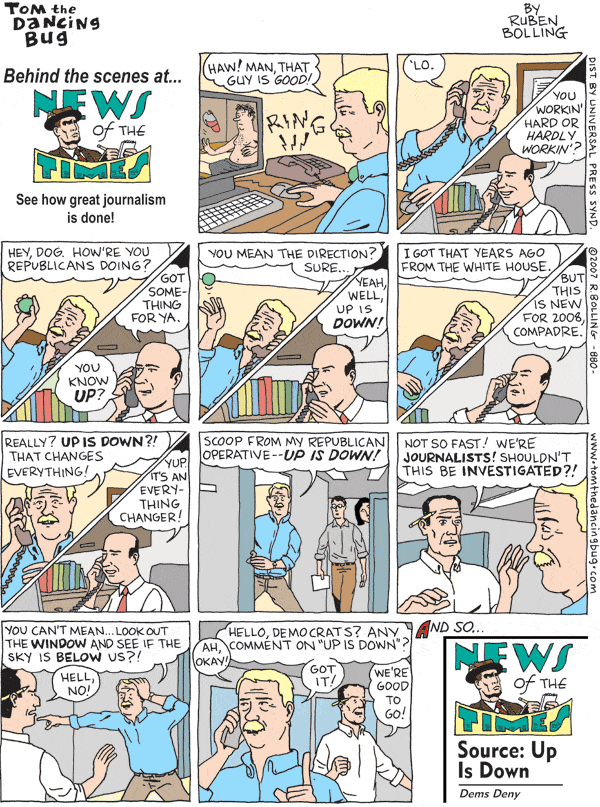
The comic clippings are from an episode of Tom the Dancing Bug

I thought Bora Z might be having some similar thoughts so I deliberately avoided reading his recent article on science journalism until I got this out to avoid undue influence. So finally I looked at it. He did indeed say some similar things among many ideas. His recent article on blogging, journalism and science is excellent indeed and very highly recommended for those who care about communicating science.