 As scientists, we believe that certain propositions are demonstrably and objectively true, and that our objective is to determine which ones they are. Given that we are in the public employ, the public has some say about which matters we are paid to investigate, and we try to align our own interests with those of the public.
Before people were going around wishing climate scientists dead, we had rather interesting lives, as there was a social motivation to pursue an incredibly interesting set of questions about how the world is put together. Not every intellectual style is happy with our pursuits; evidence tends to be messy, experiments equivocal, models approximate. On the other hand, the contacts with other fields are varied, and contacts with other countries inevitable. Unfortunately, we started to come across some rather bad news.
The beliefs of the best-informed people held together. Evidence that didn't align was almost invariably found faulty, as the picture was refined. By 1979, the outlines of the present consensus had emerged among the most accomplished physical scientists, and rather quickly became the basis for further research.
As time progressed, the news became bad enough that we had to start drawing the public's attention to it. Accordingly, an international body, the IPCC, was formed to collate and represent that news to decision makers and the public. There is evidence that IPCC was deliberately constituted so as to understate risks, largely under the influence fo the Reagan administration.
The Reagan administration wanted to forestall pronouncements by self-appointed committees of scientists, fearing they would be 'alarmist.' Conservatives promoted the IPCC's clumsy structure, which consisted of representatives appointed by every government in the world and required to consult all the thousands of experts in repeated rounds of report-drafting in order to reach a consensus. Despite these impediments the IPCC has issued unequivocal statements on the urgent need to act.The IPCC summaries of the "consensus" were intended to report the state of science, not to define it. The "consensus" was and is just the spectrum of opinion held by working scientists. Some questions often raised by the public are considered "settled" in the community, while others are not. (Nobody claims "the science is settled" as a whole. This is a straw man.) The purpose of IPCC is not to do research but to review it and report upon it.
Nobody "worked for" the IPCC. (A few WMO employees spend most time on IPCC business. Pachauri himself draws no salary from IPCC.)
The climate science was reported by the first working group, and other issues (respectively impacts, and strategies) by the second and third working groups. Was this a good idea? I was not alone in being unimpressed by the last WG 2 imapcts assessment. Two far more accomplished and prominent U of Texas scientists than myself from opposite ends of the "main hump" (one an ecologist specializing in climate impacts and one a climatologist who is also a member of the American Association of Petroleum Geologists) have expressed disdain for the last WG 2 assessment to my own knowledge. A recent article in the Boulder Daily Camera takes a similar position (emphasis added):
No errors have surfaced in the first and most well-known of the reports, which said the physics of a warming atmosphere and rising seas is man-made and incontrovertible. So far, four mistakes have been discovered in the second report, which attempts to translate what global warming might mean to daily lives around the world. "A lot of stuff in there was just not very good," said Kevin Trenberth, head of climate analysis at the National Center for Atmospheric Research in Boulder and a lead author of the first report. "A chronic problem is that on the whole area of impacts, getting into the realm of social science, it is a softer science. The facts are not as good." ... No errors have surfaced in the first and most well-known of the reports, which said the physics of a warming atmosphere and rising seas is man-made and incontrovertible. So far, four mistakes have been discovered in the second report, which attempts to translate what global warming might mean to daily lives around the world. "A lot of stuff in there was just not very good," said Kevin Trenberth, head of climate analysis at the National Center for Atmospheric Research in Boulder and a lead author of the first report. "A chronic problem is that on the whole area of impacts, getting into the realm of social science, it is a softer science. The facts are not as good."Stoat piles on, and is quoted in the Guardian as saying
"While some of the WG2 is fine, it is clear that some sections have been edited by people who should not have been trusted with the job.It should be done more on merit. At the very least, get someone competent to review the edit comments for their sections."In short, there really is an objective system that physical science can be done on, and there is enough geophysics for a coherent set of positions to emerge on it. We can call this the consensus. The IPCC WG1 report attempts to report this consensus. It does not define the consensus. Conceivably IPCC WG 1 could misrepresent the consensus. Science attempts to find truth, and IPCC attempts to match science.
What of groups 2 and 3? Here one could argue that there is no consensus. There are too many aspects of the impacts question, and too many approaches to the mitigation/adaptation question. It is important for policy makers to understand the spread of professional opinion on these matters. Many people believe that the most recent working group 2 report failed to do so.
I strongly hope that the absurd hooting over the Himalaya glaciers error is not enough to hound Pachauri out of IPCC leadership. Whether he has done a good job or not, we need to defend people against the strategy of taking minor errors and missteps, and using them to destroy the careers and reputations of good, smart and decent people.
We cannot function with only politicians in charge. Somebody has to represent science, and scientists often have strong personalities of the sort politicians learn early to suppress, and while generally ethical, perhaps more of a detailed sense of the laws of nature than those of humans.
That doesn't mean we shouldn't revisit the role of IPCC and its achievements and failures. WG 2 seems to have been overrun by people with political agendas. The bad sort of committee thinking is painfully obvious to anyone who reads it. The WG 1 report in AR 4 continues to uphold the fine standards of the previous cycles. On the whole, the geosciences community deserves congratulations and respect for its efforts.
Anyway, ironically behind the paywall, Nature has some interesting ideas on the future of IPCC. I'm sympathetic to (of all people) John Christy, at least on process:
voluminous printed reports, issued every six years by government-nominated authors, cannot accommodate the rapid and chaotic development of scientific information today. An idea we pitched a few years ago that is now worth reviving was to establish a living, 'Wikipedia-IPCC'. Groups of four to eight lead authors, chosen by learned societies, would serve in rotating, overlapping three-year terms to manage sections organized by science and policy questions (similar to the Fourth Assessment Report). The authors would strike a balance between the free-for-all of true science and the need for summary statements.Controversies would be refereed by the lead authors, but with input from all sides in the text, with links to original documents and data. The result would be more useful than occasional big books and would be a more honest representation of what our fledgling science can offer. Defining and following rules for this idea would be agonizing, but would provide greater openness.
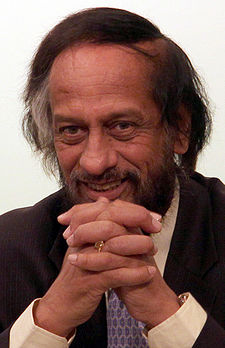
Image of Ragendra Pachauri by evstafiev via Wikipedia




Realclimate.org, you mean the website run by Al Gore's press secretary, whose moderators are some of the very people implicated in the hadley CRU scandal?
Talk about drinking the fucking Kool Aid.