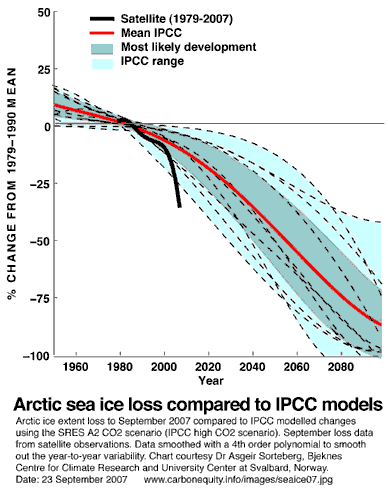
From an alarming article from a group called Carbon Equity with a hat tip to Eric Swanson.
"Our greatest responsibility is to be good ancestors."
-Jonas Salk
Thursday, October 11, 2007
Barton vs Gore: Discuss
Apparently, there has been a judgement rendered in the UK regarding the showing of An Inconvenient Truth in UK public schools, and it's a mixed blessing. A Judge Burton has listed nine points of "guidance" that British teachers must bring to the classroom in order to show the film.
Thanks to James for the tipoff.
Are the nine points fair? That's a bit much for discussion in a blog format, so I set up a quick wiki for the purposes of conversation. We'll see if this works out or fizzles, or worse, if it takes off too far and I get swamped by administrivia. Consider it an experiment. Anyway, rather than trying to get to the bottom of all nine points, why not try to see how far you can get with one of them?
It seems likely that if we do a good job of this, the final result could be contributed as a collaborative RealClimate article.
(And remember, as we say in Austin, Barton Springs Eternal.)
Update: The majority appears to believe the judge is called Burton, not Barton, though the latter appears in many places. As far as I know, Burton does not spring eternal.
More Important Update: Excellent discussions at Stoat, Deltoid (thanks, john), and New Scientist
DailyKos pitches in with the progressive Democrat p.o.v.
Thanks to James for the tipoff.
Are the nine points fair? That's a bit much for discussion in a blog format, so I set up a quick wiki for the purposes of conversation. We'll see if this works out or fizzles, or worse, if it takes off too far and I get swamped by administrivia. Consider it an experiment. Anyway, rather than trying to get to the bottom of all nine points, why not try to see how far you can get with one of them?
It seems likely that if we do a good job of this, the final result could be contributed as a collaborative RealClimate article.
(And remember, as we say in Austin, Barton Springs Eternal.)
Update: The majority appears to believe the judge is called Burton, not Barton, though the latter appears in many places. As far as I know, Burton does not spring eternal.
More Important Update: Excellent discussions at Stoat, Deltoid (thanks, john), and New Scientist
DailyKos pitches in with the progressive Democrat p.o.v.
Wednesday, October 10, 2007
Fallibility of Consensus
I think it's ludicrous to claim that scientific consensus constitutes scientific fraud, as Crichton alleges and as many people have echoed. In fact, I believe that consensus is how science operates; ultimately it is a flawed social process that tends to reveal truth.
The circumstances under which the consensus process succeeds or fails are very important, and are not at all easy to investigate.
The social momentum of a given academic community can deflect progress. I had hoped this would be increasingly rare, but perhaps it isn't. It may depend to a large extent on the health of the scientific culture.
I had a brush with a minor example of this myself. It happens that my thesis advisor, John R. Anderson (tellingly, now at Pixar) recommended a topic for me where I would disprove the common wisdom about a relatively obscure atmospheric phenomenon, called the Madden-Julian oscillation. I never quite understood what John was going on about, to be honest, so it was problematic right there, though he convinced me that the prevailing wisdom had to be wrong. However, nobody except those who have already published cares enough about the MJO to care very much about an alternative hypothesis. So this would be a bad career move, even if John is right (as he tends to be about such matters). It would make a few enemies and no friends. I moved on. John's hypothesis remains published only as grey literature from Colorado State. Does it matter? Mostly as an instance; the consensus is sticky on matters of limited importance.
The New York Times has an interesting article by John Tierney, subtitled "A Severe Case of Mistaken Consensus" on this matter, claiming that the relevance of a high-fat diet to heart disease, long held as a consensus in the US, is uncertain. I am having some difficulty judging the quality of the article or of the truth of the matter at hand.
In the discussion area, Tierney's readers are, unsurprisingly, quick to bring up "Al Gore" (the new word for "Global Warming" apparently). Unsurprisingly, given the vagueness of Teirney's reporting, some or unconvinced of the point being made.
To be fair to Tierney, the point is Gary Taubes' (no relation) point, which he is making in the book Good Calories, Bad Calories, which Tierney is reviewing.
On the other hand, one commenter mentions Tierney in the same breath as Easterbrook, which is perhaps unfair guilt by association, but worth considering:
Please don't misunderstand. Consensus itself is not a sign of science misfiring. I am acknowledging that consensus is not a sign of science working correctly either. It's more subtle than that, unfortunately.
And regarding Taubes' point, it's certainly argued that he suffers from the same selectivity of evidence that other consensus-busters are prone to.
As for myself, I was influenced by Taubes' article in the Times a few years ago to take up very low carbohydrate dieting. I lost some weight episodically but in the end it was just an oscillation. And a few weeks ago I had a kidney stone episode. The doctors were puzzled because they claimed I was rather older than a typical first onset of this problem. It's associated with excessive animal protein. So I am regrouping. Count me as one anecdotal argument against Atkins, though.
All the same, the arguments against consensus have some cogency.
Economists have a number of consensus opinions, including that theirs is the only science that is qualified to synthesize all other sciences for the policy sector. The fact that some belief is a consensus in some academic community doesn't make it true.
Let me make sure this is clear.
The circumstances under which the consensus process succeeds or fails are very important, and are not at all easy to investigate.
The social momentum of a given academic community can deflect progress. I had hoped this would be increasingly rare, but perhaps it isn't. It may depend to a large extent on the health of the scientific culture.
I had a brush with a minor example of this myself. It happens that my thesis advisor, John R. Anderson (tellingly, now at Pixar) recommended a topic for me where I would disprove the common wisdom about a relatively obscure atmospheric phenomenon, called the Madden-Julian oscillation. I never quite understood what John was going on about, to be honest, so it was problematic right there, though he convinced me that the prevailing wisdom had to be wrong. However, nobody except those who have already published cares enough about the MJO to care very much about an alternative hypothesis. So this would be a bad career move, even if John is right (as he tends to be about such matters). It would make a few enemies and no friends. I moved on. John's hypothesis remains published only as grey literature from Colorado State. Does it matter? Mostly as an instance; the consensus is sticky on matters of limited importance.
The New York Times has an interesting article by John Tierney, subtitled "A Severe Case of Mistaken Consensus" on this matter, claiming that the relevance of a high-fat diet to heart disease, long held as a consensus in the US, is uncertain. I am having some difficulty judging the quality of the article or of the truth of the matter at hand.
In the discussion area, Tierney's readers are, unsurprisingly, quick to bring up "Al Gore" (the new word for "Global Warming" apparently). Unsurprisingly, given the vagueness of Teirney's reporting, some or unconvinced of the point being made.
To be fair to Tierney, the point is Gary Taubes' (no relation) point, which he is making in the book Good Calories, Bad Calories, which Tierney is reviewing.
On the other hand, one commenter mentions Tierney in the same breath as Easterbrook, which is perhaps unfair guilt by association, but worth considering:
Have Tierney, Gregg Easterbrook, and John Stossel ever been seen in the same place as the same time?Regardless, the article does discuss the dynamics of incorrect consensus very effectively and is worth a read on that account.
They all seem to pay their bills by claiming that they know more about science than the overwhelming majority of scientists. They are journalists, and not very good journalists, at that.
Outrageous, undefendable strawmen and the appeal to an oddjob, outspoken authority are their stock in trade.
Please don't misunderstand. Consensus itself is not a sign of science misfiring. I am acknowledging that consensus is not a sign of science working correctly either. It's more subtle than that, unfortunately.
And regarding Taubes' point, it's certainly argued that he suffers from the same selectivity of evidence that other consensus-busters are prone to.
As for myself, I was influenced by Taubes' article in the Times a few years ago to take up very low carbohydrate dieting. I lost some weight episodically but in the end it was just an oscillation. And a few weeks ago I had a kidney stone episode. The doctors were puzzled because they claimed I was rather older than a typical first onset of this problem. It's associated with excessive animal protein. So I am regrouping. Count me as one anecdotal argument against Atkins, though.
All the same, the arguments against consensus have some cogency.
Economists have a number of consensus opinions, including that theirs is the only science that is qualified to synthesize all other sciences for the policy sector. The fact that some belief is a consensus in some academic community doesn't make it true.
Let me make sure this is clear.
- I think the IPCC WG1 report does represent a consensus position among the relevant sciences.
- I think the IPCC WG1 report is a good representation of truth.
- IPCC report represents truth not because there is consensus. Consensus exists because of the same intellectual and social robustness of the relevant disciplines that allows them to approach truth.
- The extent of the robustness of a scientific community is difficult for outsiders to determine.
- Yet that determination is crucial to successful governance.
Monday, October 8, 2007
Montreal public bicycles
Montreal, despite its steepness and iciness, is following in the footsteps of various European cities and setting up public one-way bicycle rental facilities.
Can Austin Texas be far behind? Alas, yes.
Quark Soup
Quark Soup is back, yet again. I hope, like Garrison Keillor, David Appel can now live with the obligations of his peculiar genius and will stick to it.
Friday, October 5, 2007
Airline Mag: Green Edition
Hi, y'all, from beautiful Montreal (that's in Southern Canada, you understand), where it is unseasonably warm and sunny today. The trees seem a bit paler and less spectacular than usual this autumn, too... hmm....
I'm a bit out of the loop this week, what with the excitement of launching Correlations (come on over and give me some grief...) and visiting with family. So my main report for this week is that there's so much global warming in the press right now (I don't usually look at newsstands except when I'm stuck in an airport) that my head spins. I may have more to say soon, but for now I'll report that even the American Airlines in-flight magazine is featuring a green issue and an article about green guilt.
It was interesting how the author (Mark Henricks, a fellow Austinite feller) went on about light bulbs and such (not to mention bamboo flooring and recycled plastic bathmats) and nevertheless managed to shrug off the environmental impact of aviation with an unchallenged quote.
In fact, George Monbiot has pointed out that aviation is the only part of modern life where no non-GHG intensive substitute was foreseeable. I can't find that right now but a typical anti-aviation rant of his is here. It's not easy to shoot this down, unfortunately. I much prefer to drive or Amtrak even as far as Chicago, but Montreal-Austin is quite a shlep and I see no escape from making this particular type of journey twice a year anytime soon.
So it was weird reading an article actually entitled "green guilt" on an in flight magazine on an airplane, which pretty much told me to feel guilty about bathmats and not about flying.
I'm a bit out of the loop this week, what with the excitement of launching Correlations (come on over and give me some grief...) and visiting with family. So my main report for this week is that there's so much global warming in the press right now (I don't usually look at newsstands except when I'm stuck in an airport) that my head spins. I may have more to say soon, but for now I'll report that even the American Airlines in-flight magazine is featuring a green issue and an article about green guilt.
It was interesting how the author (Mark Henricks, a fellow Austinite feller) went on about light bulbs and such (not to mention bamboo flooring and recycled plastic bathmats) and nevertheless managed to shrug off the environmental impact of aviation with an unchallenged quote.
But air travel probably gets more attention than it deserves, says Arnold. While flying does have an impact, especially with regard to carbon emissions, it does not have nearly the negative effect that other carbon contributors do. For instance, he considers coal-fi red electricity-generating plants a much more serious problem. “Aviation is a minor part,” Arnold says. “For certain travelers, it’s an issue, but globally, it’s only about 2 percent of the problem.”Right, but, um, aren't those 'certain travelers' the ones who use airplanes?
In fact, George Monbiot has pointed out that aviation is the only part of modern life where no non-GHG intensive substitute was foreseeable. I can't find that right now but a typical anti-aviation rant of his is here. It's not easy to shoot this down, unfortunately. I much prefer to drive or Amtrak even as far as Chicago, but Montreal-Austin is quite a shlep and I see no escape from making this particular type of journey twice a year anytime soon.
So it was weird reading an article actually entitled "green guilt" on an in flight magazine on an airplane, which pretty much told me to feel guilty about bathmats and not about flying.
Wednesday, October 3, 2007
Trust and Expertise
In a post to the Globalchange list, Fergus points to a remarkable discussion on a British weather geek list regarding the trustworthiness of climate science.
I think valid public perceptions of trustworthiness are absolutely crucial to a functioning democracy. I think that we climatologists get rather less than our due, but, more problematically, that economists get vastly more than theirs.
I don't think credentials or tradition suffice. If they did, the Wall Street Journal editorial page (among others) would be genuinely conservative, rather than recklessly mad.
So while I have no objection to the topic, I am a little dubious about whether the prominent naysayer with the cute avatar is really motivated selflessly.
More to the point though, I'd like to see comparable attention paid to the validity and utility of advice from economists.
I think valid public perceptions of trustworthiness are absolutely crucial to a functioning democracy. I think that we climatologists get rather less than our due, but, more problematically, that economists get vastly more than theirs.
I don't think credentials or tradition suffice. If they did, the Wall Street Journal editorial page (among others) would be genuinely conservative, rather than recklessly mad.
So while I have no objection to the topic, I am a little dubious about whether the prominent naysayer with the cute avatar is really motivated selflessly.
More to the point though, I'd like to see comparable attention paid to the validity and utility of advice from economists.
Tuesday, October 2, 2007
Don't Major in Sea Ice
The New York Times has a story about the astonishing decline in sea ice this summer.
An interesting twist appears. If sea ice continues to vanish, it's a fertile research topic, likely to be funded, likely to be published. Unless, that is, it goes away altogether. When the ice cover becomes purely seasonal, it becomes a less interesting phenomenon for field study or modeling. The problem is that this may happen sooner than expected.
A sardonic quote from an Alaskan geophysicist about this is nevertheless not entirely a matter of grim humor:
How much risk should scientists be taking in the event that their field goes out of fashion (or, in this case, out of existence)? There are a lot of intrinsic reasons to do science, but there are some extrinsic reasons not to bother. What should be the fate of the person who bets on the wrong scientific horse?
Scientists historically traded off the possibility of wealth for a life of calm contemplation, not one of personal financial risk. If the deal gets worse, fewer people will become scientists. This matters.
An interesting twist appears. If sea ice continues to vanish, it's a fertile research topic, likely to be funded, likely to be published. Unless, that is, it goes away altogether. When the ice cover becomes purely seasonal, it becomes a less interesting phenomenon for field study or modeling. The problem is that this may happen sooner than expected.
A sardonic quote from an Alaskan geophysicist about this is nevertheless not entirely a matter of grim humor:
At a recent gathering of sea-ice experts at the University of Alaska in Fairbanks, Hajo Eicken, a geophysicist, summarized it this way: “Our stock in trade seems to be going away.”Anyway, even if Eicken isn't serious, I am. Should we be as concerned about the glaciologists as about the polar bears who are under the same threat? More so? Less so?
How much risk should scientists be taking in the event that their field goes out of fashion (or, in this case, out of existence)? There are a lot of intrinsic reasons to do science, but there are some extrinsic reasons not to bother. What should be the fate of the person who bets on the wrong scientific horse?
Scientists historically traded off the possibility of wealth for a life of calm contemplation, not one of personal financial risk. If the deal gets worse, fewer people will become scientists. This matters.
Monday, October 1, 2007
Three Scary Postings
Well, I managed to find some good news a few days ago, but it's getting swamped.
Will the long-term sensitivity of the system be twice what we expect? Joe Romm reports that Hansen thinks so.
Eli has some disturbing feedback from overseas.
And Tamino paints a picture of what just happened that might please Dr Tufte, but is more than a little bit sobering.
PS - Not actually stolen from Atmoz's "what I'm reading" list, but might as well have been.
Will the long-term sensitivity of the system be twice what we expect? Joe Romm reports that Hansen thinks so.
Eli has some disturbing feedback from overseas.
And Tamino paints a picture of what just happened that might please Dr Tufte, but is more than a little bit sobering.
PS - Not actually stolen from Atmoz's "what I'm reading" list, but might as well have been.
Nordhaus Seeks Magic Bullet, Will Pay
Nordhaus and Shellenberger have made a splash with their A Manifesto for a New Environmentalist, and there's been much reaction hither and yon, of which what I have seen has missed the mark.
As usual with economists, I was planing to wheel out my "wrong question, therefore answer irrelevant" spiel, but somehow it didn't quite fit. They aren't growth-obsessed, at least not in the arguments they present.
As I read it, their problem is here, in their core paragraph:
This is new-age magical thinking, which is to say, not actual thinking. There is no "clean-energy revolution". No amount of expenditure on homeopathy or cold fusion will pan out.
Clean energy is, presently, expensive and limited. People are motivated to change this, but have so far not succeeded. Accordingly, the prognosis isn't very good. You can no more wish this inconvenient truth away than any other. It is conceivable that there is a fix, but there's no reason to expect that throwing money at the problem will pay off.
I will be cheering as loudly as anyone if something pans out, and I am certainly in favor of as much research in this direction as makes sense scientifically or technically. But there is a limit to what experts can achieve, no matter how much funding they get. Insufficeint funding slows things down, but excessive funding certainly does not speed things up. Ten scientists cannot get a decade's worth of one scientist's work done in a year any more than nine women can make a baby in a month.
If there's anything to this stuff they ought to offer some arguments of substance. "Some energy experts have calculated that an investment of roughly $200 billion would bring the price of solar energy down to that of coal." Names, details please? Solar advocates have long compared apples and oranges. Oh, and until storage problems are solved, coal will continue to be much cheaper at night.
No, the reason we are in trouble is not because we are too mopey. Yes, bad news is always a hard sell, but that's no reason to deliver imaginary good news instead.
Exactly which research programs are underfunded, and by how much? I am sure there are some. That's something we can talk about, and we can also talk about which programs haven't panned out and should be cut.
Throwing too much money in the general direction of a problem never solved anything.
Update: To clarify, I have no objection to further R&D on renewables. In fact, I encourage it. I object to the idea that we can, without diminishing returns, avoiding subsidies or taxes, count on decreasing the unit cost of renewable energy to the point where it is cheaper than digging up some foul gunk and torching it. That's wishful thinking taken to the point of insanity.
The collapse in prices per unit of information technology are a bizarre and possibly unique event in history. Relying on something similar happening in energy technology is where Nordhaus & Shellenberger lose touch with reality. And everything else they say is completely conventional.
In the end, we will be devoting a larger share of GDP to energy, and if we manage to prosper through our coming troubles, we will have plenty of it. This means the energy will be "more expensive". So?
I say let's get it over with. The disruption is tiny compared to the alternative, and investing huge efforts into magic pixie dust is probably not going to help. A gradually increasing tax on carbon emissions to the point where sustainable sources are competitive will do the trick. The magic pixie dust, maybe not.
As usual with economists, I was planing to wheel out my "wrong question, therefore answer irrelevant" spiel, but somehow it didn't quite fit. They aren't growth-obsessed, at least not in the arguments they present.
As I read it, their problem is here, in their core paragraph:
...this money ought to be used to create a new military-industrial-academic complex around clean-energy sciences, similar to the one we created around computer science in the 1950s and '60s. The transformation of Silicon Valley from a sleepy collection of apple orchards and small towns to the information technology powerhouse that it is today was the result of massive investments by the federal government into a set of interlinked military, industrial, and academic institutions in the region--a fact that is largely ignored by many high-tech executives, who prefer to imagine that it all started in Bill Hewlett's garage. Concretely, this means creating undergraduate and graduate programs in new energy sciences; post-graduate fellowships for scientists, engineers, and technicians; and training for the electricians, construction workers, efficiency experts, and installers needed to make the clean-energy revolution real.
This is new-age magical thinking, which is to say, not actual thinking. There is no "clean-energy revolution". No amount of expenditure on homeopathy or cold fusion will pan out.
Clean energy is, presently, expensive and limited. People are motivated to change this, but have so far not succeeded. Accordingly, the prognosis isn't very good. You can no more wish this inconvenient truth away than any other. It is conceivable that there is a fix, but there's no reason to expect that throwing money at the problem will pay off.
I will be cheering as loudly as anyone if something pans out, and I am certainly in favor of as much research in this direction as makes sense scientifically or technically. But there is a limit to what experts can achieve, no matter how much funding they get. Insufficeint funding slows things down, but excessive funding certainly does not speed things up. Ten scientists cannot get a decade's worth of one scientist's work done in a year any more than nine women can make a baby in a month.
If there's anything to this stuff they ought to offer some arguments of substance. "Some energy experts have calculated that an investment of roughly $200 billion would bring the price of solar energy down to that of coal." Names, details please? Solar advocates have long compared apples and oranges. Oh, and until storage problems are solved, coal will continue to be much cheaper at night.
No, the reason we are in trouble is not because we are too mopey. Yes, bad news is always a hard sell, but that's no reason to deliver imaginary good news instead.
Exactly which research programs are underfunded, and by how much? I am sure there are some. That's something we can talk about, and we can also talk about which programs haven't panned out and should be cut.
Throwing too much money in the general direction of a problem never solved anything.
Update: To clarify, I have no objection to further R&D on renewables. In fact, I encourage it. I object to the idea that we can, without diminishing returns, avoiding subsidies or taxes, count on decreasing the unit cost of renewable energy to the point where it is cheaper than digging up some foul gunk and torching it. That's wishful thinking taken to the point of insanity.
The collapse in prices per unit of information technology are a bizarre and possibly unique event in history. Relying on something similar happening in energy technology is where Nordhaus & Shellenberger lose touch with reality. And everything else they say is completely conventional.
In the end, we will be devoting a larger share of GDP to energy, and if we manage to prosper through our coming troubles, we will have plenty of it. This means the energy will be "more expensive". So?
I say let's get it over with. The disruption is tiny compared to the alternative, and investing huge efforts into magic pixie dust is probably not going to help. A gradually increasing tax on carbon emissions to the point where sustainable sources are competitive will do the trick. The magic pixie dust, maybe not.
Subscribe to:
Posts (Atom)