Last week, a third independent investigation exonerated the climate scientists whose emails were hacked last fall -- finding the attacks lacked foundation. That's right: Three full, independent reviews have found no wrongdoing on the part of the scientists -- and most importantly, affirmed the scientific evidence of climate change.
So you might think that any reputable media outlet would feel compelled to set the record straight. But you'd be wrong.
In particular, the Wall Street Journal has published more than 30 editorials and op-eds on climate change since November of 2009. All took the stance that climate science was unreliable, dishonest or questionable -- or minimally unimportant. And unbelievably, just today, the Journal published another op-ed about the reviews, calling them a "whitewash" by "global warming alarmists."Send a letter to the editor of the Wall Street Journal editorial page demanding that they set the record straight on climate change science.
It's vital that we receive balanced coverage from all of the media, and the Journal's actions matter. As Congress works to craft comprehensive policies to address our energy and climate crises, public understanding of this issue is more important than ever before.
A news outlet like the Wall Street Journal relies on its reputation as a balanced, unbiased news source. With your help, we can convince the Journal editorial page to give equal space to the fact that climate scientists have been exonerated and their findings remain affirmed.
Demand that the Wall Street Journal cover the facts about climate science.
Few news outlets in the U.S. are as well regarded and widely read among opinion makers and politicians as the Wall Street Journal. It has a responsibility to its readers and the American public to be fair and accurate on one of the most important issues of our time.
Balanced media coverage today won't give back the precious time we've lost defending scientific facts that should not have been in question. But perhaps it will remind our media outlets, including the Wall Street Journal, of their responsibility to the American people.
Thank you,
Maggie L. Fox
President and CEO
Alliance for Climate Protection
Monday, July 12, 2010
WSJ Letter-Writing Campaign
Via email:
Sunday, July 11, 2010
The Three Real Scandals about the Fake One
“What everyone has lost sight of is the spectacular failure of mainstream journalism
to keep the whole affair in perspective.”
to keep the whole affair in perspective.”
Forgive me for adding my retrospective on the "climategate" noise. I wonder if there's much I can add to the brilliant summaries by Gareth Renowden: Part 1 Part 2 and especially Part 3. Stoat is also shaking his head sadly but not uninterestingly. And Steve has an interesting critique about the investigations themselves compellingly entitled "another tiresome exoneration".- Myles Allen
Still, it's really time to press the point: the press is the point.
So here's my two cents:
Of course, "climategate" should have been a small story in the UEA campus press about some idiot breaking into an academic server. The end.
The First Scandal
A couple of weeks into it, it became clear that there was a much bigger scandal; the fact that a group of people was planning to make political hay out of the stolen emails to embarass the scientific community and set back public will to address the problem. The fact that the hacking itself almost certainly had political motivations. You would think that the immune systems of the civilized world would kick in. If we allow ordinary controversy to be successfully influenced by felonious activity, we will blur the line between politics and felony. Past history shows this to be a less than brilliant idea.
I thought it scandalous that they should try such a thing, and ludicrous that they thought they could get away with it. My dissatisfactions with the press were already severe, but I didn't imagine them to be that stupid, lazy, or irresponsible, or whatever combination, that would allow the illicitly obtained contents of ordinary, ambiguous emails among ordinary scientists to be inflated into a fake scandal. I expected the matter would either vanish entirely, or backfire.
Woe unto the one who expects a spine from modern journalism or modern politics.
The Second Scandal
The plan was a wild success. How many imitators lurk in the wings remains to be seen, but the precedent is about as ugly a one as can be imagined.
The roots of the fake scandal boiled down to the fact that the observational and millenial reconstruction guys loathe McIntyre and vice versa. The community is also perfectly aware that naysayer science is of marginal quantity and would like to keep material that is obviously at odds with existing science (lacking the extraordinary evidence that they lack) out of the journals.
(After all, how could these papers not be junk? There really is no longer any serious way to argue against the proposition that the radiative balance of the earth is shifting enough to disrupt climate. Might as well argue against, hmm, evolution for instance.)
The reader will recall that the naysayer squad decided that this was a good occasion for a huge push against IPCC as well as the climate reconstruction "team". This culminated in an actual real witch hunt (not the innocuous kind).
A bunch of nits were picked and embellished into decoration for the empty scandal. Every single one of them amounted to either a minor but much embellished embarassment, (the most celebrated of them originating in a typographical error!) or a complete and total fabrication. And in any case, almost all of them revolved around the working group II report, which is not produced by climate scientists.
Yet, to read the press coverage, you'd think some massive horrors about climate science lurk in the eccentric corners of Phil Jones' lair in East Anglia. The reader so inclined is offered plenty of room to imagine a hotbed of the evil global Stalinist windmill conspiracy in Norwich.
The press credulously reported the malicious and distorted explanations of who the CRU people and their associates are and what they do; they inflated a couple of small errors in IPCC WG II, a volume written by a totally different community, into corroborating evidence, and they tried to use this evidence to declare the "global warming" "scare" "dead". The second scandal is that this interpretation was taken seriously by the press.
The Vindication
Well, we've now had, what, five distinguished panels all saying roughly the same thing "Well, openness is a principle of science of course, blah, blah, but actually these chaps were basically doing their job which we all pay them to do about as well as it can be done." There's generally a bone thrown to the opposition to the effect that" they could have been a little more politic (in their private conversations!) and may have made an error of emphasis in one marginal case, so do carry on insulting and maligning them if you are so inclined". I'm not sure why any of this should rise to the level of general interest, but maybe the commissions are seeking some credibility among the people who loathe the climate reconstruction scientists.
(There's another bone they throw, "talk to statisticians more", but that presumes that statisticians will pick up the phone. I'll have more to say about that one later.)
Something like that is the result of every investigation into widespread and outraged accusations of hiding data, misrepresenting data, forging data, and outright fraud. In the end this amounted to precisely and exactly one bad cover art graphic to a report that likely was the work of a junior staffer at WMO.
Other than that, complete and total vindication on ethical grounds. The publications of the group may be right and they may be wrong, but they were produced in good faith according to standard practice in the field. Some expressions of stress under undue harassment were revealed. Nobody did anything seriously wrong. Nothing, nothing, nothing. Is the press's face red?
The Third Scandal
If nothing changes, the world's response to the relevant policy crisis looks to have been set back by years. So you'd think it would be time for the press to undergo some self-examination. Otherwise, when history looks back at this, it may be recorded as the most damaging failure of journalism in history. So far there is little sign of anything besides defensiveness from the press.
Instead, we see responses like total silence on the vindications, a tepid walk-back, or business as usual.
The Australian, a Murdoch outlet I believe, is simply ignoring the whole embarassing business. Deltoid has the story.
A good example of the tepid walk-back is Monbiot's. James gives him his due.
Revkin offers an incredibly disappointing bit of whiplash, starting off in a promising direction and then swinging around so quickly to offer a nice comfy puff piece to the egregious Pat Michaels that you don't know what hit you. Despite presenting a huge target, I don't know of anyone who has given Revkin his due on this latest disaster area of his. There has been so much crap flinging about this week that one hardly knows where to begin. It appears we can't keep up even with the major league press's blunders, never mind the naysayer blogs.
To be fair, the typical response of the Broderite press is the Wall Street Journal's, the yeah-but:
Yes, all true, but basically spends the majority of the space on minor improprieties (a misleading chart) and stuff that sounds like an impropriety but is in fact perfectly proper (how to keep critics' papers out of prominent scientific journals when the fact is that the papers were lousy) and stuff that basically nobody has the least idea how to do (respond to "reasonable requests" ad infinitum). Absolutely nothing about how the whole matter was instigated by a crime, probably a felony; how it was blown up to represent a major scandal; how it has so far succeeded in contributing to derail the future of the earth.Report Backs Climate Data, Scolds Scientists
In some emails, the scientists discussed how to keep critics' papers out of prominent scientific journals. In one, the Climatic Research Unit's director, Phil Jones, talked of using a "trick" to hide a discrepancy in data that has been cited prominently as evidence of man-made climate change.
Wednesday's report, by a team of outside scientists appointed by the University of East Anglia, found that the East Anglia researchers' "rigor and honesty as scientists are not in doubt." It also found no "evidence of behavior that might undermine the conclusions of the IPCC assessments" that climate change is happening and is probably caused by humans.
But the report criticized the East Anglia climate scientists for "a consistent pattern of failing to display the proper degree of openness."
In particular, the report said, the researchers' responses to "reasonable requests for information" by outside scientists "were unhelpful and defensive."
It called an "iconic" chart the scientists constructed as evidence of man-made global warming "misleading," saying the chart didn't sufficiently explain the researchers' methods. And the report concluded that the East Anglia researchers may have deleted emails "in order to make them unavailable should a subsequent request be made for them."
The most egregious of all is Fred Pearce's at the Guardian, a piece apparently written before the latest exonerations hit, which is duly eviscerated by Things. Pearce's choice of representatives of the climate community is enough to drive a peaceful man to drink. I don't know what it drives a less peaceful man to, as I'm a peaceful man, but it can't be good.
Most of the press, though, is ignoring the role of the press in this fiasco. In fact, it seems they are desperately running away from considering it.
The closest thing to a remotely serious response in any general press outlet I have seen is an editorial call in the New York Times for self-examination, which apparently ran in the local edition.
Meanwhile the scientific community remains livid. Of the prominent mass press, not one outlet is allowing the scientific community to defend itself.
This is not a story about minor flaws in climate science.
This is a story about a spectacular failure of the press.
This is a story about a spectacular failure of the press.
The Tragedy of the Uncommons
(the tragedy of the privates?)
The most tragic aspect of all is how the grotesque cynicism of the press feeds into the general slip into hostility and suspicion, cynicism and despair that the world has sunk to. The Bush administration effectively set back the world's ability to extend trust to one another by decades. Obama has not managed the clout to reverse the trend.
And climate change has not helped.
The odd thing is that it should. While one side of the polarity argues for the trivial costs of action and the enormous risks of inaction, the other argues exactly the opposite. In such a topsy-turvy argument there is little room for a middle ground. In fact there are risks and costs everywhere: this is a big problem we never adequately bargained for. There is no way it is good news in any way. (Watch the video; it's worth it.)
Except for one thing. It should not be driving us apart. It should be pulling us together.
It's possible that a well-defined common problem is what we need. Some measurable, defeatable problem we must face. Pulling against each other is something we can no longer afford as individuals, tribes or nations in a suddenly finite world. There are no lifeboats. We must all right the ship.
Update: Inbound link here from this interesting discussion kicked off by the Dutch report.

Saturday, July 10, 2010
NYTimes Hopes for Better from NYTimes
There's an encouraging editorial in today's New York Times:
Perhaps now we can put the manufactured controversy known as Climategate behind us and turn to the task of actually doing something about global warming. On Wednesday, a panel in Britain concluded that scientists whose e-mail had been hacked late last year had not, as critics alleged, distorted scientific evidence to prove that global warming was occurring and that human beings were primarily responsible.
...
This is more like what we need, now. Encouraging.Climate skeptics pounced on [the stolen emails] as evidence of a conspiracy to manipulate research to support predetermined ideas about global warming.
The panel found no such conspiracy. It complained mildly about one poorly explained temperature chart discussed in the e-mail, but otherwise found no reason to dispute the scientists’ “rigor and honesty.” Two earlier panels convened by Britain’s Royal Society and the House of Commons reached essentially the same verdict. And this month, a second panel at Penn State University exonerated Michael Mann, a prominent climatologist and faculty member, of scientific wrongdoing.
But somewhat peculiar, too. Alas, the fine print (original font settings) says:
A version of this editorial appeared in print on July 11, 2010, on page WK7 of the New York edition.
Does this mean it was only in the local edition? I guess it hardly matters. Who looks at print anymore? But then there's the concluding sentence:
Given the trajectory the scientists say we are on, one must hope that the academy’s report, and Wednesday’s debunking of Climategate, will receive as much circulation as the original, diversionary controversies.The Times hopes, inter alia, that the Times does much better on this story. Well, I agree. Hopefully the Times is in a better position to do something about it than I am...
Jaworowski Refutation
Apparently, the Jaworowski thing is still bouncing around the denyosphere. For the record, from sci.environment ca. 2004:
I cannot easily obtain either referenced Jaworowski paper. The first
one ('92) is in the Citation Index (err, sorry 'Web of Science'.)The second one, from '94, appears not to be.
Not including a self-citation, Jaworowski '92 has been cited only 7
times in the literature according to the citation index, mostly in
opinion pieces.
However, there is a citation in Science 1993 in:
The Ice Record of Greenhouse Gases.
Raynaud, D.; Jouzel, J.; Barnola, J. M.; Chappellaz, J.; Delmas,
R. J.; Lorius, C.
Science Volume 259(5097) 12 February 1993 pp
926-934
"The uncertainties concerning the reliability of the record increase
with the age of the ice and the depth of recovery of the core, and it
has been suggested that the long-term CO2 record is an artifact caused
by the structural changes of the ice with depth and by post-coring
processes [8]. "
where reference 8 is Jaworowski '92.
Reynaud et al go on to refute this and related positions quite in the
next two paragraph.
===>
The record itself provides evidence that the changes observed are not
caused by the presence of air hydrates or fractures. For example,
increases in CO2 and CH4 concentrations in the Vostok core are similar
for the last two glacial-interglacial transitions, even though only
the most recent transition is located in the brittle zone. Such
evidence argues that the atmospheric trace-gas signal is not strongly
affected by the presence of the brittle zone (an increasing scatter of
the trace-gas concentrations can be observed in ice samples
contaminated by drilling fluid intrusions; such scattered data must be
interpreted with caution). Also, the last glacial-interglacial
transition has been investigated along the two Antarctic ice cores
from Byrd and Vostok stations. The transition is in the region of
air-hydrate formation at Byrd but not at Vostok, yet the CO2 and CH4
records from the two cores are similar. We are consequently confident
that the large CO2 and CH4 increases, recorded during the glacial to
interglacial transitions and showing similar amplitudes from one core
to another, are not an artifact linked with the air-hydrate occurence
in ice.
More generally, the good agreement obtained for the
glacial-interglacial changes of CO2 [11-14] and CH4 levels [15-17]
recorded in different types of ice (with and without air hydrates or
fractures or cracks, as well as different temperatures, snow
accumulation rates, ice structures, and so on) on the same core
(Vostok) or among different cores support the notion that, overall,
the long-term trace-gas record from ice cores accurately reflects
atmospheric changes. That the records can be reproduced with a new set
of measurements performed several years after the initial measurements
[see [13,18] for instance] is another reason for confidence in the
atmospheric signal of the ice record of trace gases.
<===
Further significant citation of Jaworowski '92 doesn't appear in the peer review literature. Jaworowski's review makes no bones about its position:
===>
Until 1985 most studies of CO2 in gas inclusions in pre-industrial ice
indicated that CO2 concentrations (up to 2450 ppm) were higher than
the current atmospheric level. After 1985, lower pre-industrial CO2
values were reported, and used as evidence for a recent man-made CO2
increase. The errors in these revised values, however, are of a
similar magnitude to the apparent increase in atmospheric CO2 level.
The assumptions used in estimating lower CO2 values in past
atmospheres have been: no liquid phase in polar ice; younger age of
air than of ice due to free gas exchange between deep firn and the
atmosphere; and no change in composition of air inclusions. These
assumptions are shown to be invalid. Liquid saline water exists in
ice at low temperatures, even below -70-degrees-C; airtight ice layers
are ubiquitous in Antarctic firn; and more than 20 physico-chemical
processes operating in situ and in ice cores contribute to the
alteration of the chemical composition of air inclusions. The
permeable ice sheet with its capillary liquid network acts as a sieve
which redistributes elements, isotopes, and micro-particles.
Thirty-six to 100% of air recovered from old ice is contaminated by
recent atmospheric air during field and laboratory operations. The
value of approximately 290 ppm, widely accepted from glacier studies
for the pre-industrial atmospheric CO2 level, apparently results from:
invalid assumptions; processes in ice sheets; artifacts in ice cores;
and arbitrary rejection of high readings. To date, glaciological
studies are not able to provide a reliable reconstruction of either
the CO2 level in pre-industrial and ancient atmospheres or
paleoclimates. Instead these studies have led to a widely accepted
false dogma of man-made climatic warming. This dogma may have
enormous negative impact on our common future.
<===
To me this reads as polemics and not as science, but I suppose one could argue that I am prejudiced. Still I note that this is Jaworowski's only paper on any closely related topic. Mostly he appears to be interested in anthropogenic radiation from nuclear power. The citation index does not list the '94 paper, so I can't even see an abstract. Both appear in rather obscure journals. As far as I can tell, there was no followup to Reynaud's refutation, and Jaworowski's paper has had little impact in the scientific discussion since.
mt
Friday, July 9, 2010
Arrogance
I call your attention to Jerry Steffens' comment at RC (#403 on the linked article):
“... comments are almost Kafkaesque; he appears to represent a group that believes that scientific matters can be decided in the same way that cases are settled in a courtroom, i.e., that the side that can argue most persuasively wins. What he doesn’t seem to fully grasp is that there is an underlying physical reality that is being discussed. Using his technique, a group of people in a speeding bus on a dark, rain-slick road might argue about whether or not the bridge up ahead has been washed out. Presumably, if those arguing against the “wash-out theory” win the debate by, say, undermining the credibility of those on the other side of the argument (perhaps two of them were seen to be improperly conferring in the restroom) then the passengers can rest easy.”
This is exactly the problem.
There is more than one lesson to be gleaned from this parable. I think the intended one is that arguing to win the argument is different from arguing to find the truest result and in fact is less adaptive.
Another lesson is this: It is not rude, stubborn, arrogant or unreasonable to refuse to compromise on a question of fact. “Maybe the bridge will be out next week, so we should come back some other way.” You compromise on strategies; sometimes you even compromise on principles; you cannot compromise on facts. Sometimes you know stuff the other folks don’t know, and when it's important, you have to say so, whatever they end up thinking of you. Which sometimes won't be very flattering. After all you seem so stubborn and uncompromising. But truth is the dominant ethic of the scientific world view. Without honest pursuit of truth you have nothing.
Formerly a comment at Kloor's.
More Journalism Like This, Please
Stuart Jordan in the Humanist:
OK, then, why don't scientists do the writing about science, then?
A more rational explanation for Climategate is that the climate contrarians had run out of alternative scientific hypotheses for global warming and were desperate to find another way to discredit the prevailing science. Several independent reviews of the controversy, completed in the UK this past spring, found no evidence of malpractice on the part of CRU, nor did they find anything to contradict the consensus that human-caused global warming is a threat. A Pennsylvania State University review of the work of faculty member Michael Mann (he of hockey stick and now Climategate fame) likewise found no evidence of wrongdoing. Yet Virginia Attorney General Ken Cuccinelli has revisited the case. In April Cuccinelli ordered the University of Virginia, where Mann was formerly employed, to turn over more than a decade’s worth of emails, documents, “things or data” related to Mann’s research (most federally, not state funded). This tactic has been used before to intimidate scientists, or at least to waste their time.Why can't more journalists write like that?A distinguished group of 255 members of the National Academy of Sciences published a letter in the journal Science on May 7, 2010, striking back hard against those who egregiously misrepresent science to a vulnerable and confused public in support of “special interests or dogma, not by an honest effort to provide an alternative theory that credibly satisfies the evidence.” They note that no serious study has found anything wrong with contemporary climate science, even though scientists have “quite expectedly and normally, made some mistakes.” They go even further in connecting their letter to Climategate in calling for “an end to McCarthy-like threats of criminal prosecution against our colleagues based on innuendo and guilt by association, the harassment of scientists by politicians seeking distractions to avoid taking action, and the outright lies being spread about them.”
Stuart Jordan is a senior staff scientist (retired emeritus) at the NASA Goddard Space Flight Center. He has a PhD in physics and astrophysics and is science advisor for the Center for Inquiry’s Office of Public Policy in Washington, DC.Oh. Not a journalist. I see.
OK, then, why don't scientists do the writing about science, then?
Thursday, July 8, 2010
Press Criticism Below the Fold
Below the fold (click on "read the whole post") at the Morning Energy column at Politico, a story that deserves more attention than that:
CLIMATEGATE CLEARING -More exoneration of the IPCC’s Climategate scientists – http://bit.ly/aPxVOs
AND EXCORIATION OF MEDIA COVERAGE – MediaMatters for America and 12 environmental organizations sent letters to editorial boards across the country asking them to update their coverage of the scandal. “Last winter, newsrooms across the world raced to add the newest layer to the then-controversy over stolen emails, the reliability of climate science, and the legitimacy of the findings of the United Nations' Intergovernmental Panel on Climate Change. The journalistic arms race on both sides of the Atlantic, enabled by the lax publishing standards of Europe and fueled by oil industry-funded climate deniers in the U.S., resulted in the mutual destruction of accurate reporting and an informed readership. These false reports had a measurable impact on public opinion. With the dust finally settling now six months later, it's painfully clear that news outlets across the globe hastily published hundreds of stories -- based on rumors, unsubstantiated claims, and the shoddy reporting of their competitors -- questioning the overwhelming scientific consensus that human activities are causing climate change. One by one, the pillars of evidence supporting the alleged "scandals" have shattered, causing the entire storyline to come crashing down.” http://bit.ly/ctuczh
Wednesday, July 7, 2010
The Krypton Cataclysm: Why So Few Survivors?

Most readers will know the story of Kal-El, the child of celebrated Kryptonian scientist Jor-El, who became a prominent citizen of Earth and the scourge of its criminal element. Many are aware of the few other survivors of the great planetaty explosion; the Phantom Zone prisoners, the Kandorians, and a few others, each under peculiar circumstances. Still, the most captivating of all the survival stories remains the escape of Kal-El in a tiny homebrew spacecraft built by Jor-El with his own hands. But why was Jor-El compelled to this bizarre course of action? A rocket-propelled spaceship capable of life support is obviously the undertaking of years of effort. Why, given his prominence in the community and his well-known brilliance, was Jor-El incapable of saving more of his fellow Kryptonians, including himself?
It turns out that it was not for want of trying. In the year 19989 KD, Jor-El testified before the Council of the Western Continent to the effect that the earlier theoretical concerns about Global Exploding were becoming imminent, and that the problem needed to begin to be treated as a realistic concern with policy implications. If the planetary use of Negative Zone energies were not replaced with more sustainable sources, the planetary core was likely to destabilize at some time in the 201st century. A "tipping point", after which restabilization would become impossible, might be reached in the near future.
It was based on work of the most eminent scientists. In 19979, the Cha-Ni commission (including the founder of mathematical negativology Cha-Ni, the space negativologist Su-Mi and the famed Eastern Continent liquidologist Wun-Tish) had already reported as much. Some of the most eminent Kryptonological scientists of the time signed off on that report.
Of course, industrial interests with investments in Negative Zone infrastructure were less than pleased with this information, and sought to discredit it. Commissions of scientists of somewhat lesser note but more philosophical pliability were assembled, and doubts were raised, most of them without substance. The congress, the news-plastics and the public were hard pressed to determine where the real scientific expertise lay.
However, as predicted, a period of increased seismic activity, particular in the equatorial zone, ensued. It was sufficiently prominent for the public to take notice of the predictions. The more eminent general journals published many peer reviewed plastics supporting the -Ni commission, -El's simulation group at the North-Continental Air and Space Administration, and brilliant theoretical work, notably at the Ha-Li Center on Sceptred Isle and the Ma-Sa Chu-Si Institute of Technology at Bottled City.
Nevertheless, Negative Zone industrial concerns were not inclined to take Dr. -El at his word. Doubts were cleverly raised in the public, and a constituency formed in most major Councils that supported the views of the Negative industry. Of course, care was taken to separate these views from the appearance of industry support, and to appear objective and scientific. Enough doubts were raised to force the creation of an international scientific review board, the Intercontinental Probe on Core Cataclysm Concerns, or IPCCC. Early IPCCC reports were tentative, but arriving on a five year cycle (eventually stretched to six and then seven years) they generally supported the Global Exploding position and did so with increasing confidence over the years. Eventually, evidence showed the Tipping Point was nigh.
Members of the public had difficulty believing that the Negative industry would put profits ahead of the survival of the planet. After all, what good is Krypto-currency among a vast swarm of airless asteroidal shards? So when committees of so-called Global Exploding Skeptics showed some vigor, some of the public was easy to convince that the question was not settled.
To further confuse the situation, a group calling itself "Shakists" appeared, which asserted that while the planet's core would, in fact, probably explode, the consequences at the surface weren't likely to be very severe.
Nevertheless, it began to appear that the political vigor of the various negativist groups was inadequate, and that an effort to constrain Negative Zone energy use might indeed be implemented on a Krypton-wide basis. However, there was much worry that any realistic effort might already be too little, too late.
Nevertheless, it began to appear that the political vigor of the various negativist groups was inadequate, and that an effort to constrain Negative Zone energy use might indeed be implemented on a Krypton-wide basis. However, there was much worry that any realistic effort might already be too little, too late.
As the Tipping Point approached, strains began to appear within the IPCCC. While many scientists insisted that the proper role of science was to report, not to advocate, others pointed out that it was increasingly looking like a matter of survival. Dry scientific texts, plastics in peer review journals, paste-ups in conference hallways, and traditional nars and semi-nars would not suffice. This group felt that the evidence was sufficiently compelling, and the popular plastics so poorly informed, that the scientific community had to move into a role of advocacy.
This resulted in a somewhat schizophrenic IPCCC fourth report, with some chapters in the usual dry voice, some even excessively cautious, and some leaning toward advocacy that was fairly strident by past IPCCC standards. The time to begin an evacuation plan, certain chapters strongly implied, had come.
It was at this point, around the year 20010, that a previously obscure effort of the Negative industry came to the fore. A diverse group of hobbyists with negativist inclinations had been discussing Global Exploding on the StegaNet. Leaders of this group, notably a retired negativist Ma-Kint and the mysterious statistician, Ms. L L, had been second-guessing a small group of scientists who had been scrounging up old seismograms to reconstruct the seismic history of the past. They questioned the statistical significance of the commonly accepted increase in equatorial seismicity. They demanded copies of all the old seismograms, which were in various formats stored in various places, scanned with various equipment, and had been painstakingly but informally collated over the years at the Kryptonography Reconstruction Unit (KRU) at a minor university on Sceptred Isle.
Ma-Kint and L L and their group managed to make life extremely difficult for these reconstruction groups, ultimately resorting to legal mechanisms to force release of mountains of obscure data of trivial importance. Then, a mysterious ally (never identified) brazenly stole a copy of all recent correspondence of the KRU, picked out a few somewhat embarrassing samples, and published them. The Negativists were peculiarly delighted by this crime. Removed from context, messages provided fodder for an array of suspicious and hostile interpretations at almost every turn. A plethora of implausible and mutually inconsistent scenarios implying various shady motivations and actions were worked out and promulgated through various channels. The press were delighted to echo the innuendo, as embarrassment to authority figures tended to sell plastics.
Jor-El, along with Han-Sin, Shnai-Da, Ar-Cha, Pyar-Mber, Shmee-Dat and other prominent scientists at first mostly ignored this fiasco. They insisted that the work of the KRU, while as far as they knew entirely commendable, was not of great importance, given that the planet was about to explode.
There was plenty of less equivocal evidence, they insisted, to that effect. This drove the Negativists into a frenzy. The equatorial seismic record was the key, they insisted, and clearly the KRU (whose members had indeed written a couple of IPCCC chapters) were the key to the key. Some even went so far as to portray the scientific community as a tool of the (in fact, essentially unfunded) IPCCC, and the IPCCC itself as a branch office of the (in fact, tiny and previously obscure) KRU. Thus they expanded their innuendo to the IPCCC itself, and the confusion was promulgated by a credulous press. Political support in various regions for de-negativization and ark-building declined.
Because a global effort was needed, and one or another prominent region could always be diverted by increasingly sophisticated negativist tactics, no ark was constructed, and any efforts toward denegativization, though paid much lip service, were sporadic, superficial and entirely symbolic. The destabilization of the core continued apace.
Committee after committee after committee found that no wrongdoing had taken place at KRU or its allied institutions in seismic reconstruction. While invariably met with relief by the small group of reconstruction scientists who were the target of the baseless allegations, this kept the rather unimportant issue of seismic reconstruction in the news, along with repeated suggestion of scandal and secrecy among the Kryptological sciences. Press reports consistently repeated the innuendo and vague implications of impropriety right along with the news of formal findings of innocence. Examination of the manipulation of the press's attentions, which would have been embarassing to the press, were never undertaken. Thus, despite the fact that the accusations proved entirely baseless, the inquiries themselves ended up by lending political support to the negativists.
The journalistic profession, finally under some scrutiny, defended itself by constructing a middle ground that while lacking scientific support had broad political appeal. With some pride the press offered itself as an intermediary, favoring partial denegativization, and postponement of ark-building until new, more cost effective space technologies could be developed. Scientists who pointed out that the universe is not always set up to reward half measures were dismissed as hot-headed and arrogant.
While the main scientific community insisted that Shakism was not a "coherent theory of the planetary core", the press eagerly recruited and promoted Shakist scientists, who developed considerable prominence and great respect among the governing classes, especially those nostalgic for a less contentious political environment. This good fortune persisted for the Shakists until the planet actually exploded.
While the main scientific community insisted that Shakism was not a "coherent theory of the planetary core", the press eagerly recruited and promoted Shakist scientists, who developed considerable prominence and great respect among the governing classes, especially those nostalgic for a less contentious political environment. This good fortune persisted for the Shakists until the planet actually exploded.
It was during this period that Jor-El withdrew, and dedicated his remaining time and fortune to building the small spaceship for the survival of his young child.
Dizzying Array of Climate News
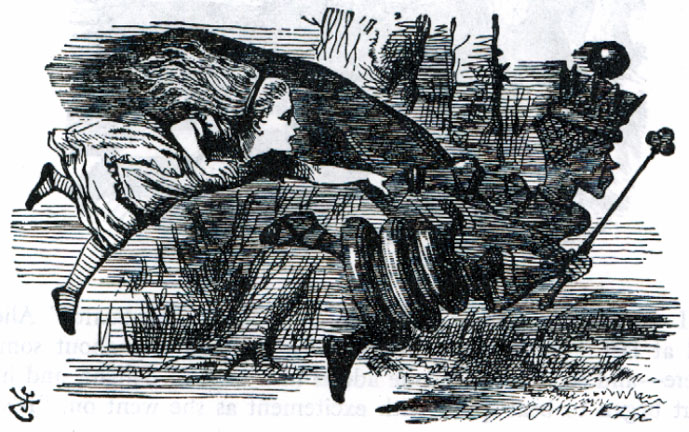
All the Running You Can Do To Stay in the Same Place
Of course, now that there's a heat wave in DC and NYC, global warming is back on.

Of course, now that there's a heat wave in DC and NYC, global warming is back on.
In other big climate news:
Mann re-re-re-re-re-re-vindicated.
Ho hum.
Big league pundits have been discussing AGW this week:
It all seems based on an absolutely ludicrous claim in WGIII (quoted at p 17 in AR4 WGII SPM) that by 2100 global warming will have a total cost of 3% of GDP (not compounded annually, total). This is, as far as I am concerned, indistinguishable from noise; this is an annual compounded hit of 0.03%. Based on a 40 hour week, we can all just work an extra 36 minutes a year, send the proceeds to places like Bangladesh, and call it a wash.
I really wish I believed this but I don't. So there is some SPM level stuff in AR4 that's totally complacency-provoking. If it's true, we really ought to find something better to worry about. Unfortunately it really doesn't look true. On the one hand, so much for the idea that IPCC is alarmist. On the other hand, so much for the idea that IPCC is uniformly good.
The answer from the punditry to Manzi is not to call the absurdly small cost into question, but to say that we should take drastic action anyway, even though the risk is trivial.
(Update: TB does a better job answering Manzi.)
(Update: TB does a better job answering Manzi.)
The Dutch have reconsidered IPCC.
Press reports are wildly, spectacularly inconsistent, as the press tries to spectacularize a sober, unspectacular, genuine critique into a crisis or a triumph.
Lou Grinzo, in email, shrugs:
Honestly, these days I'm happy if the mass media can spell "IPCC" correctly.
On the other hand
The Guardian has, with a flourish, issued a pile of fetid middle-of-the-road bilge as if it summarized anything. This is at least a wonderful who's who of them what say nothing and get quoted for it. Hulme, Curry, RP Jr., Ravetz. This Pearce de resistance (as in Fred Pearce) may make you lose your lunch. Don't read it within an hour of eating.
Anyway, "climategate" apparently has changed "everything". Stop the presses. Please.
The Friends of Science
are still hoping to get something immensely complicated and ineffective through the US congress, because shoveling huge amounts of money to some corporate interests at the expense of others and adding vast layers of bureaucracy would be better than nothing if it led to a tiny reduction in carbon emissions.
Or they could just try the Republican plan, which is to cripple the economy quickly in the interest of electoral gains by simple straightforward idiocy. That would probably be more effective in reducing emissions in the short run.
Moderation in All Things, Especially Human Decency

Keith Kloor's until-recently promising efforts to establish a middle ground for reasoned conversation, as well as recent efforts by David Brin, are quickly overrun by the familiar horde of flying monkeys. In related tragicomedy Keith has decided that I am an extremist, which is tedious in the extreme. On the other hand it seems to be increasing my notoriety, which will help once I have a book to flog, I suppose.
Unfortunately, as a diligently reasonable middle-of-the-roader, Keith is unable to accept the idea that the right target for carbon emissions is the same as the right target for mugging little old ladies. I am sure he is looking to split the difference.
If this journalistic moderating impulse were alive during the days of Lincoln, I figure we'd now have slavery Monday through Wednesday every week and on alternate Saturdays. (*)
Meanwhile
Meanwhile
Meanwhile, today, this very day, amid all this light comedy, an additional eighty million tons of fossil CO2 are being released into the biosphere. Tomorrow's emissions are predicted to be similar.
And to all of you in the eastern time zone
I hope your AC holds out. Welcome to Texas.
(*) In case you think I'm being overly facetious here, consider that they actually tried something like that.
Subscribe to:
Posts (Atom)

