"Our greatest responsibility is to be good ancestors."

-Jonas Salk

Sunday, July 12, 2009

Robert Reich Gets It

Now we are getting somewhere. 

I guess economists don't count Robert Reich as serious, but political scientists, I think, do. So maybe the light is starting to dawn in Punditia.

My prediction, then? Not a V, not a U. But an X. This economy can't get back on track because the track we were on for years -- featuring flat or declining median wages, mounting consumer debt, and widening insecurity, not to mention increasing carbon in the atmosphere -- simply cannot be sustained.

The X marks a brand new track -- a new economy. What will it look like? Nobody knows. All we know is the current economy can't "recover" because it can't go back to where it was before the crash. So instead of asking when the recovery will start, we should be asking when and how the new economy will begin. More on this to come.


Sunday, July 5, 2009

Would be a Nice Tool

The Nature Conservancy has some global change projections available at http://www.climatewizard.org/index.html

It's a nice looking page. Unfortunately, the attention to presentation exceeds the attention to detail. Several model views are available as well as an ensemble average, but the latter is identical to the HadCM output.

Hope this gets fixed soon so we can have a little more confidence in what we are looking at. I have contacted them with a bug report.


Friday, July 3, 2009

Change


Thursday, July 2, 2009

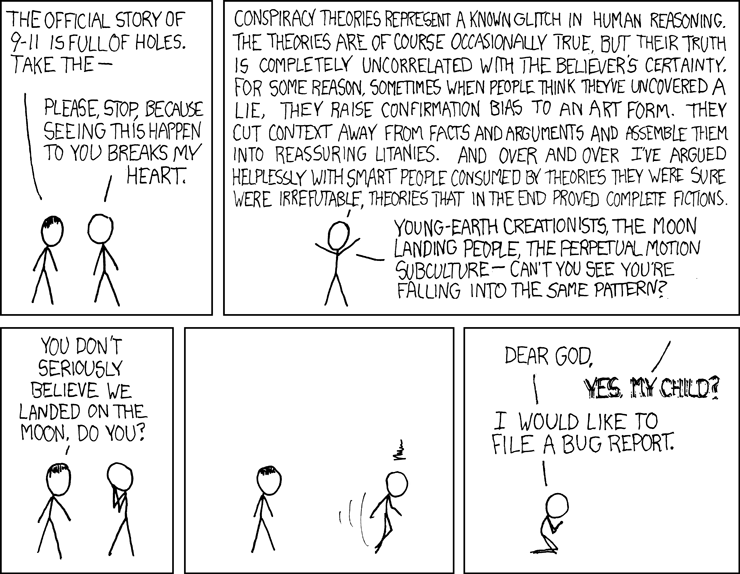
Bug Report

http://xkcd.com/258/

To clarify: I feel the same way xkcd (aka Randall Munroe) does about conspiracy theories in general.

I mention it here because I was specifically thinking about the idea that there is a vast conspiracy of scientists to convince people of the otherwise absurd idea that there might be some problem about releasing too much carbon dioxide into the atmosphere and to squelch any arguments to the contrary.

Instead of, you know, overwhelming evidence.

Inexcusable Austin/Singer/Lindzen Letter

The denialist sites are all over this  open letter signed by a bunch of physicists and emeriti including Singer and Lindzen. My comments are in green.
TO THE CONGRESS OF THE UNITED STATES: YOU ARE BEING DECEIVED ABOUT GLOBAL WARMING
Obviously. But by whom?
You have recently received an Open Letter from the Woods Hole Research Center, exhorting you to act quickly to avoid global disaster. The letter purports to be from independent scientists, but that Center is the former den of the President's science advisor, John Holdren, and is far from independent. This is the same science advisor who has given us predictions of “almost certain” thermonuclear war or eco-catastrophe by the year 2000, and many other forecasts of doom that somehow never seem to arrive on time.
Great! Let's keep up the good work of avoiding the various pitfalls, then, shall we?
The facts are:
The sky is not falling; the Earth has been cooling for ten years, without help. The present cooling was NOT predicted by the alarmists' computer models, and has come as an embarrassment to them.
Shameless bastards. These are Ph.D.s; they should understand the possibility of cherrypicking from a noisy record. The earth is not cooling in any way that isn't just an argumentative artifice.
The finest meteorologists in the world cannot predict the weather two weeks in advance, let alone the climate for the rest of the century. Can Al Gore? Can John Holdren? 
Weather is not climate. Can Lindzen really have sunk to the point that he is willing to sign this? 
We are flooded with claims that the evidence is clear, that the debate is closed, that we must act immediately, etc, but in fact
THERE IS NO SUCH EVIDENCE; IT DOESN'T EXIST.
That is news to most of us. What is all this evidence-shaped stuff in the journals, then, anyway?
The proposed legislation would cripple the US economy, 
How do you know? It's those infallible economic models isn't it?
putting us at a disadvantage compared to our competitors. 
Why? Is the US so decadent by now that we can't compete on energy technology? I think we should be future oriented, not become one of those declining societies holding on to a vanishing past.
For such drastic action, it is only prudent to demand genuine proof that it is needed, not just computer projections, and not false claims about the state of the science.
What do you mean by "genuine"? Would ANYTHING satisfy you?
SCIENCE IS GUIDED BY PROOF, NOT CONSENSUS
Consensus is a key mechanism for the advancement of science. That is how it works. 
And proof? Well, here's a funny thing. Science NEVER PROVES ANYTHING ABOUT NATURE! You can only prove things ABOUT MODELS OF NATURE. And models, well, either they are fit for purpose or they aren't. 
I am absolutely stunned that a bunch of Ph.D. scientists are promoting this essentially ignorant idea of what science is. Even if climatology really is bathwater...
This is nothing short of treachery toward science. Every one of these people must know that science is not about proof. This one has me absolutely slack-jawed. I understand polemicists undermining science in the name of their pet cause. For scientists to join them is very strange.  
Finally, climate alarmism pays well. Alarmists are rolling in wealth from the billions of dollars floating around for the taking, and being taken. 
Hey, George Soros, where's my check, dammit? 
It is always instructive to follow the money.
Something I can agree with at last. Follow the damned money.
Really, the opposition gets more shameless each year than you could even have imagined the year before.

Age discrimination

I find it interesting that age discrimination is frowned upon in most situations but celebrated in science. It's a bit demoralizing now that I am on the losing side of the proposition, but I can see both sides of the argument. 


Tuesday, June 30, 2009

Talk (by Me): Cybernetics of Climate July 1

I'm giving this talk July 1 at 6:30 PM as part of the Austin Forum at the Texas Advanced Computing Center in Austin.

Y'all come. Directions and details here.

If anyone is interested in seeing me present this talk in your town, please contact me.


Cybernetics of Climate

You're invited to a discussion session entitled "Cybernetics of Climate" presented by Dr. Michael Tobis, Research Scientist Associate at the University of Texas Institute for Geophysics. at The University of Texas at Austin.

Dr. Tobis's presentation will focus on climate change as an example of whether, when and how computing can influence policy.

As human activity changes the composition of the global atmosphere at an unprecedented pace, human society is faced with unprecedented challenges. We have to determine to what extent the changes matter, and by when. Some argue that the risks of excessive policy response are as large as or larger than the risks of inadequate policy response. One of the unique aspects of the problem is that the conditions being predicted have no historical or paleontological analogy. We are entering new territory, and are forced to make projections based only on scientific principles, without any direct observations.

Most progress in engineering relies to some extent on doing exactly this sort of extrapolation. The assistance of high performance computers is crucial in developing most new technologies these days, from spacecraft to medicines.

How well do these techniques apply to predicting the future of the earth as a physical system? Climate simulations often take center stage in public discussions about climate change, but how should these computations be understood? Is the climate system well enough characterized to rely on models? If not, how should that affect what we do about it?

Dr. Tobis will offer a tour of how computers and computations are used in addressing our planet's future and some ideas as to the strengths and limitations of these approaches.

Michael Tobis started his career as an electrical engineer with a focus in statistics. As a graduate student, he built one of the first multicore computers and used it to run ocean simulations using code he himself developed. Since his doctorate in climatology, he has been focusing on climate computation, at Argonne National Laboratory, at The University of Chicago, and now at The University of Texas at Austin.

Update: Changed the posting date to move this to the top, to remind people in commute distance of this.

Monday, June 29, 2009

Manzi's Folly and Economics in General

Remarkably, an IPCC WGII report (see p 17) shows the "cost" of a 4 degree C temperature increase to be on the order of 3% of net economic output.

Jim Manzi uses this assertion to conclude that Waxman-Markey is a bad idea. I would go further. If 3% were a measure of anything realistic it would be hard to argue for the sort of policy measure that we are all so urgently arguing for. So I can't provide a counterargument to Manzi. He even goes so far as to address the fat-tail argument (though of course he misattributes it to Weitzman... sigh...) but it's all calibrated against that 3% .

I think it becomes crucial to track down that 3% and address it. Which makes us all economists, whether we want to be or not. Boulding's observation seems germane; total capital is NOT actually the integral of net economic output. It's where our capital stocks are in 2100, not our GDP, that matters. If climate change is marginal, we should let the chips fall where they may, but the conclusion that only 3% of net economic output is at stake seems totally disproportionate to the risks. IPCC or no (and I've never been a big fan of WGII) I have a lot of trouble believing it.

Hope to pick this up again at some point.

Update: Nice followup here. UT doesn't have priv's to the referenced article, unfortunately. Is this any way to run an intelligentsia?

Sunday, June 28, 2009

For Those Who Underestimate Climatology


This is climate model output! See the movie here. Watch for the tropical storm in the Indian Ocean toward the end of the simulated month.

If anyone has any advice how I can include this Quicktime in a Keynote presentation I'd be very much obliged.

Update: It's a matter of paying $30 to Apple to ransom the ability to download a Quicktime.

Saturday, June 27, 2009

Long Time Coming

Via Erik Conway on Facebook, via Encyclopedia of Earth
Title: The Economics of the Coming Spaceship Earth
Author: Kenneth Ewart Boulding
Source: H. Jarrett (ed.), Environmental Quality in a Growing Economy, pp. 3-14. Baltimore, MD: Resources for the Future/Johns Hopkins University Press.
Year published: 1966
It's interesting though not flawless. "The question of whether there is anything corresponding to entropy in the information system is a puzzling one" is a bit of a clunker, wouldn't you say? And I'm still inclined to think of von Bertalanffy, whom he cites directly, as a hack pretending to be Norbert Wiener. But the interest is more than historical.
Economists in particular, for the most part, have failed to come to grips with the ultimate consequences of the transition from the open to the closed earth. One hesitates to use the terms "open" and "closed" in this connection, as they have been used with so many different shades of meaning. Nevertheless, it is hard to find equivalents. The open system, indeed, has some similarities to the open system of von Bertalanffy, in that it implies that some kind of a structure is maintained in the midst of a throughput from inputs to outputs. In a closed system, the outputs of all parts of the system are linked to the inputs of other parts. There are no inputs from outside and no outputs to the outside; indeed, there is no outside at all. Closed systems, in fact, are very rare in human experience, in fact almost by definition unknowable, for if there are genuinely closed systems around us, we have no way of getting information into them or out of them; and hence if they are really closed, we would be quite unaware of their existence. We can only find out about a closed system if we participate in it.

...

The closed earth of the future requires economic principles which are somewhat different from those of the open earth of the past. For the sake of picturesqueness, I am tempted to call the open economy the "cowboy economy," the cowboy being symbolic of the illimitable plains and also associated with reckless, exploitative, romantic, and violent behavior, which is characteristic of open societies. The closed economy of the future might similarly be called the "spaceman" economy, in which the earth has become a single spaceship, without unlimited reservoirs of anything, either for extraction or for pollution, and in which, therefore, man must find his place in a cyclical ecological system which is capable of continuous reproduction of material form even though it cannot escape having inputs of energy.

The difference between the two types of economy becomes most apparent in the attitude towards consumption. In the cowboy economy, consumption is regarded as a good thing and production likewise; and the success of the economy is measured by the amount of the throughput from the "factors of production," a part of which, at any rate, is extracted from the reservoirs of raw materials and noneconomic objects, and another part of which is output into the reservoirs of pollution. If there are infinite reservoirs from which material can be obtained and into which effluvia can be deposited, then the throughput is at least a plausible measure of the success of the economy. The gross national product is a rough measure of this total throughput. It should be possible, however, to distinguish that part of the GNP which is derived from exhaustible and that which is derived from reproducible resources, as well as that part of consumption which represents effluvia and that which represents input into the productive system again. Nobody, as far as I know, has ever attempted to break down the GNP in this way, although it would be an interesting and extremely important exercise, which is unfortunately beyond the scope of this paper.

By contrast, in the spaceman economy, throughput is by no means a desideratum, and is indeed to be regarded as something to be minimized rather than maximized. The essential measure of the success of the economy is not production and consumption at all, but the nature, extent, quality, and complexity of the total capital stock, including in this the state of the human bodies and minds included in the system.

In the spaceman economy, what we are primarily concerned with is stock maintenance, and any technological change which results in the maintenance of a given total stock with a lessened throughput (that is, less production and consumption) is clearly a gain. This idea that both production and consumption are bad things rather than good things is very strange to economists, who have been obsessed with the income-flow concepts to the exclusion, almost, of capital-stock concepts.

Emphasis added (along with a couple of paragraph breaks for easier reading).

The same site describes Boulding as follows:
Kenneth Ewart Boulding (1910-1993), an American economist famous for his emphasis on the social, moral, and ecological implications of economic growth. Boulding coined the term “spaceship earth” to emphasize the energy, material, and environmental limits to economic growth. He compared the economy to biological systems in terms of its need to use energy to transform materials, which in the process produces wastes. Boulding suggested that the current “cowboy” economy, defined by the wasteful use of nonrenewable resources, must ultimately be replaced by a “spaceship” economy, powered by renewable energy and characterized by efficient recycling of materials. Boulding was a founding intellectual in the field of ecological economics.
I had thought the Spaceship Earth idea was Bucky Fuller's. Clearly there was some mutual influence between Bucky and Boulding.